

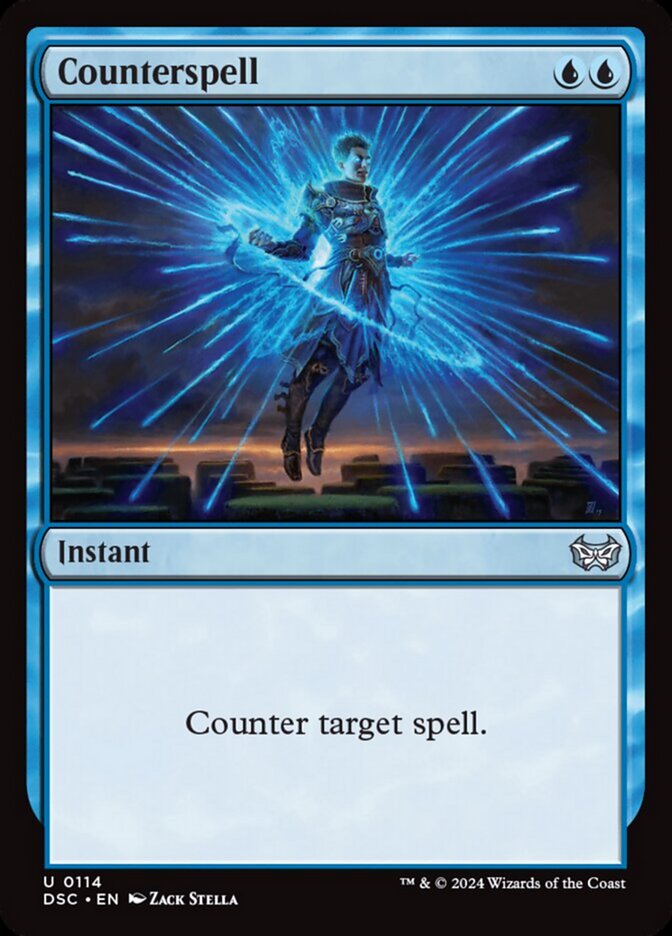
Counterspell is one of those cards players keep asking about. Here is, in plain words, what its official text says, the rulings published by Wizards of the Coast, and the combos players actually run.
Official card text
Counter target spell.
Complete guide
Counterspell is the quintessential blue magic card, serving as the gold standard for control players since the very beginning of the game. Its simple text allows a player to stop almost any threat before it even hits the battlefield for just two blue mana. Understanding the nuances of the stack is key to mastering this powerful tool.
What It Does
Counterspell targets a single spell currently on the stack and moves it directly to its owner's graveyard. Once a spell is countered, it does not resolve, and none of its effects happen. This applies to creatures, sorceries, instants, artifacts, enchantments, and planeswalkers, making it a universal answer to your opponent's plays.
How It Resolves Step by Step
First, an opponent casts a spell, which is placed on the stack. In response, you cast Counterspell, choosing that spell as the target. If no further actions are taken, Counterspell resolves first; it checks if the target is still valid, then moves the target spell from the stack to the graveyard. Finally, Counterspell itself is put into your graveyard.
Common Mistakes
A common error is trying to use Counterspell on a permanent that is already on the battlefield. Counterspell can only target 'spells'—which only exist on the stack. Once a creature has entered the battlefield, it is no longer a spell and cannot be countered. Additionally, some spells are 'uncounterable' due to specific card text; while you can target them with Counterspell, it will simply fail to do anything upon resolution.
When to Play It
Timing is everything. Because you only have two blue mana invested, you often want to save Counterspell for 'game-ending' threats rather than every minor utility spell. Since it is an instant, you should almost always wait until the last possible moment to cast it, keeping your mana open to represent a threat to your opponent's strategy.
Interaction examples
 An Offer You Can't Refuse
If you cast a spell and your opponent casts An Offer You Can't Refuse to stop it, you can respond by casting Counterspell targeting their An Offer You Can't Refuse. Your Counterspell resolves first, removing their counter from the stack. This allows your original spell to resolve successfully, and since An Offer You Can't Refuse was countered, you do not receive the Treasure tokens.
 Arcane Denial
Suppose your opponent casts a massive creature. You can cast Counterspell to stop it immediately with no downside for them. However, if you chose to use Arcane Denial instead, the creature is still countered, but the stack interaction ensures that at the beginning of the next upkeep, your opponent may draw two cards while you draw one. Using Counterspell in this scenario is often preferred to maintain card advantage.
Guide written with AI from the official text and rulings. Official English text prevails.
How it works : Counterspell
Original English text — Wizards of the Coast / Scryfall
No additional ruling has been published for this card.
Legal formats
Commentaires
- Sois le premier à commenter cette carte.
Read next
Meta decks with Counterspell
No archived Top 8 deck with this card yet.