

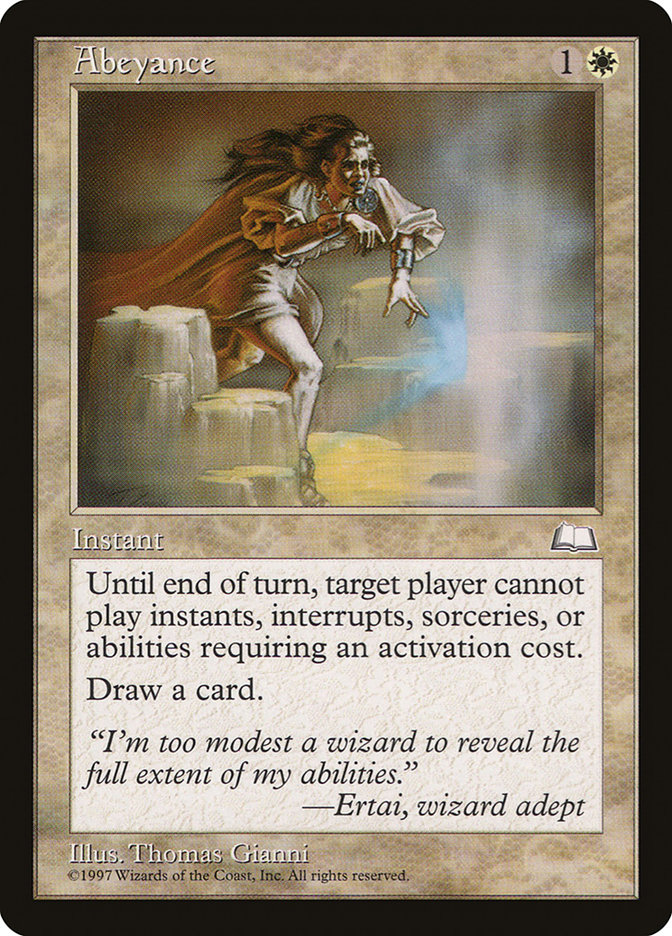
Abeyance is one of those cards players keep asking about. Here is, in plain words, what its official text says, the rulings published by Wizards of the Coast, and the combos players actually run.
Official card text
Until end of turn, target player can't cast instant or sorcery spells, and that player can't activate abilities that aren't mana abilities. Draw a card.
Complete guide
Abeyance is a classic white utility spell that can completely disrupt an opponent's plans for a turn. By restricting their ability to cast spells and use non-mana abilities, it provides you with a safe window to execute your strategy while replacing itself in your hand.
What It Does
Abeyance targets a single player and places two major restrictions on them until the end of the turn. First, they cannot cast any instant or sorcery spells. Second, they cannot activate any abilities that are not mana abilities. Because it includes a 'Draw a card' clause, it is a cantrip that keeps your hand full while slowing down the opposition.
How It Resolves Step by Step
When you cast Abeyance, you choose a target player. If the spell resolves, that player is immediately under the restriction. You then draw a card as the final part of the spell's resolution. Note that this spell does not 'counter' anything; if a player has already cast a spell, Abeyance will not stop it. It only prevents new actions from being taken after it has finished resolving.
Common Mistakes
A frequent error is trying to use Abeyance to stop an ability that has already been put on the stack; it will not remove abilities that are already there. Additionally, it does not stop triggered abilities (which start with 'When', 'Whenever', or 'At') or static abilities. It also does not prevent mana abilities, meaning players can still tap lands for mana or use creatures like Llanowar Elves. Finally, it does not stop a player from declaring attackers or blockers.
When to Play It
The best time to cast Abeyance is often during your opponent's upkeep. This prevents them from casting sorceries or activating non-mana abilities during their main phase. Alternatively, you can cast it during your own turn to ensure an opponent cannot interfere with your plays using removal or countermagic.
Interaction examples
 Swords to Plowshares
If you are worried that your opponent will use Swords to Plowshares on your creature during your turn, you can cast Abeyance first. Once Abeyance resolves, the opponent cannot cast Swords to Plowshares for the rest of the turn, allowing you to attack or use your creature safely.
 Path to Exile
If you cast Abeyance, your opponent can respond by casting Path to Exile before Abeyance resolves. In this scenario, Path to Exile will resolve first and exile your creature. However, once Abeyance finally resolves, that opponent will be unable to cast any further instant or sorcery spells for the remainder of that turn.
Guide written with AI from the official text and rulings. Official English text prevails.
How it works : Abeyance
Original English text — Wizards of the Coast / Scryfall
- #1· Wizards of the Coast
This can't be used as a counterspell. It will have no effect on spells which were on the stack when it was cast, nor on those cast in response to it.
No other card is named in this ruling.
- #2· Wizards of the Coast
Abeyance prohibits activated abilities of cards which are not on the battlefield.
No other card is named in this ruling.
- #3· Wizards of the Coast
Abeyance never prevents mana abilities from being activated.
No other card is named in this ruling.
- #4· Wizards of the Coast
Abeyance does not affect abilities which are not activated, such as static abilities and triggered abilities. It also doesn't stop the declaration of attackers or blockers.
No other card is named in this ruling.
Legal formats
Commentaires
- Sois le premier à commenter cette carte.
Read next
Meta decks with Abeyance
No archived Top 8 deck with this card yet.