

Aerith, Last Ancient is one of those cards players keep asking about. Here is, in plain words, what its official text says, the rulings published by Wizards of the Coast, and the combos players actually run.
Official card text
Lifelink Raise — At the beginning of your end step, if you gained life this turn, return target creature card from your graveyard to your hand. If you gained 7 or more life this turn, return that card to the battlefield instead.
Complete guide
Aerith, Last Ancient is a powerful Legendary Creature that rewards players for their lifegain strategies with recurring value from the graveyard. By bridging the gap between healing and reanimation, she ensures your most important creatures are never gone for long. This Human Cleric Druid turns every point of life gained into a potential tactical advantage.
The Mechanics of Raise
Aerith features a unique ability called Raise that triggers at the beginning of your end step. To even put this ability on the stack, the game checks if you have gained any amount of life during the current turn. If your life total has not increased, the ability simply does not trigger. Once active, the ability targets a creature card in your graveyard; if you have gained 7 or more life by the time the ability resolves, that creature returns directly to play.
Resolution and Timings
The most important aspect of Aerith is the 'intervening if' clause. The first check happens exactly when the end step begins. If you haven't gained life yet, you cannot gain it 'in response' to start the trigger. However, the check for the 7-life threshold happens during resolution. If you have only gained 3 life when the trigger goes on the stack, you can cast a spell to gain 4 more life while the ability is waiting to resolve to ensure the creature hits the battlefield instead of your hand.
When to Cast Aerith
Aerith is best utilized in decks that can consistently trigger lifegain before the end step. Since she has Lifelink, she can often enable her own trigger by attacking or blocking. Because her ability targets, you must have a valid creature card in your graveyard at the moment the end step begins to successfully put the trigger on the stack.
Interaction examples
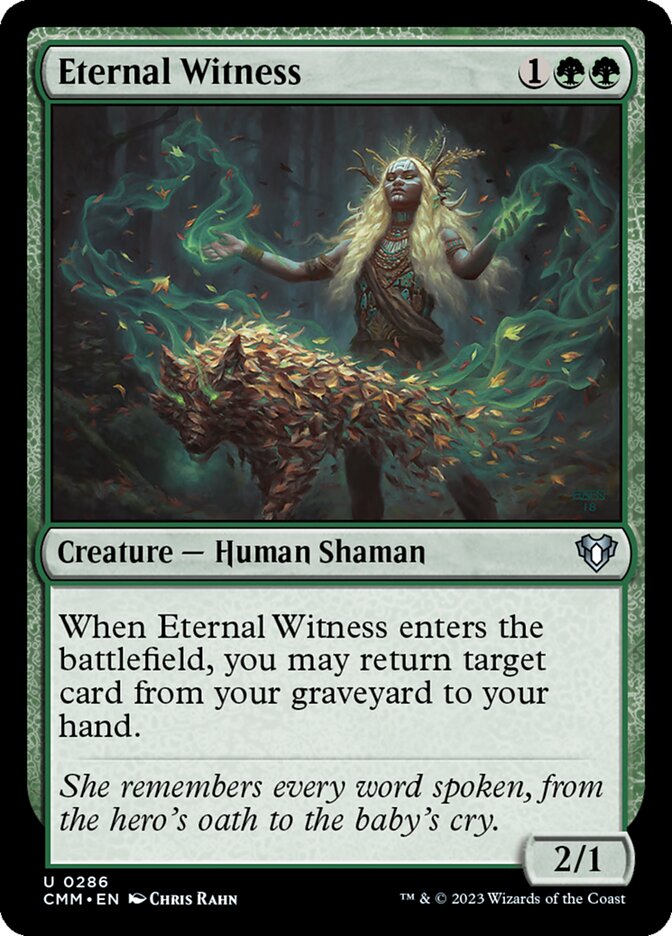 Eternal Witness
During your turn, you gain 2 life and have Eternal Witness in your graveyard. At the beginning of your end step, Aerith triggers. Since you gained less than 7 life, you return Eternal Witness to your hand. You can then cast it on your next turn to get another card back from your graveyard.
 Solemn Simulacrum
Suppose you gain 8 life during your combat phase. At the beginning of your end step, Aerith's ability triggers targeting Solemn Simulacrum in your graveyard. Because you met the 7-life threshold, the Golem enters the battlefield directly. This triggers its own ability, allowing you to search for a basic land card immediately.
If you gained 4 life during your main phase, Aerith triggers at the end step targeting Solemn Simulacrum. While the ability is on the stack, you cast a spell that gains you 3 more life. When Aerith's ability resolves, it sees a total of 7 life gained this turn and puts the Golem onto the battlefield instead of into your hand.
Guide written with AI from the official text and rulings. Official English text prevails.
How it works : Aerith, Last Ancient
Original English text — Wizards of the Coast / Scryfall
- #1· Wizards of the Coast
Aerith's last ability checks at the moment it would trigger to see if you gained life this turn. If you didn't, the ability won't trigger at all. Once your end step begins, it's too late to gain life in order to cause this ability to trigger. However, the last part of the ability will check how much life you've gained as the ability resolves, so if you've only gained 5 life this turn by the time the end step comes around, you could still gain 2 more life while this ability is on the stack in order to return the target creature card to the battlefield instead of your hand.
No other card is named in this ruling.
Legal formats
Commentaires
- Sois le premier à commenter cette carte.
Read next
Meta decks with Aerith, Last Ancient
