

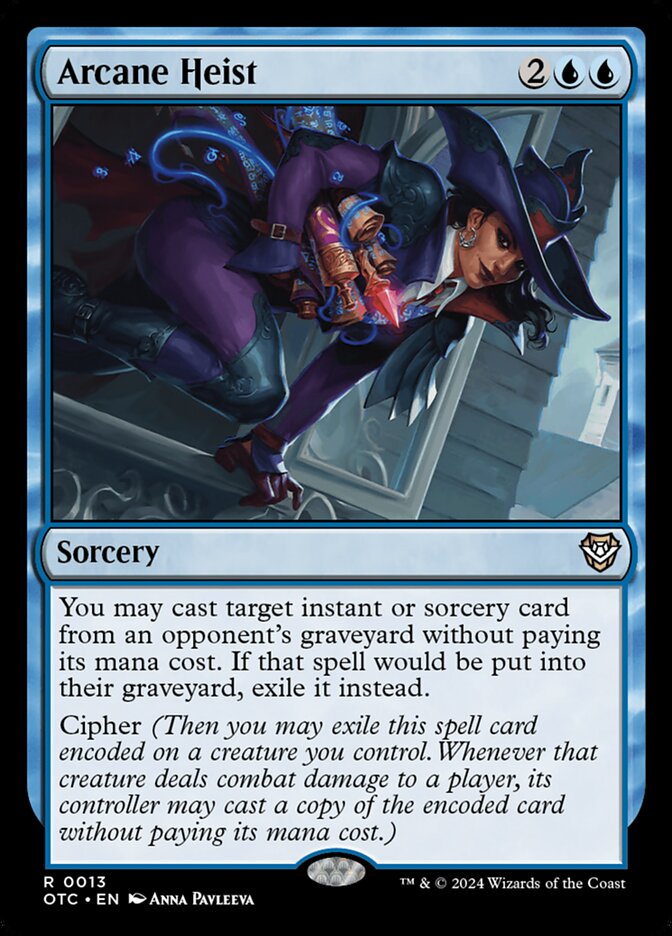
Arcane Heist is one of those cards players keep asking about. Here is, in plain words, what its official text says, the rulings published by Wizards of the Coast, and the combos players actually run.
Official card text
You may cast target instant or sorcery card from an opponent's graveyard without paying its mana cost. If that spell would be put into their graveyard, exile it instead. Cipher (Then you may exile this spell card encoded on a creature you control. Whenever that creature deals combat damage to a player, its controller may cast a copy of the encoded card without paying its mana cost.)
Complete guide
Arcane Heist is a versatile sorcery that lets you turn your opponent's best spells against them while providing long-term value through the Cipher mechanic. By stealing a spell and encoding the Heist onto a creature, you can create a repeating cycle of theft every time you connect for damage.
What It Does
Arcare Heist targets an instant or sorcery card in an opponent's graveyard and allows you to cast it immediately without paying its mana cost. Because of the Cipher keyword, after the spell resolves, you may exile Arcane Heist and 'encode' it onto a creature you control. This creature gains a triggered ability: whenever it deals combat damage to a player, you may cast a copy of Arcane Heist for free, allowing you to steal another spell from an opponent's graveyard.
How It Resolves Step by Step
First, you choose a legal target in an opponent's graveyard. Upon resolution, you decide whether to cast that card; if you do, you cast it as part of the resolution, ignoring normal timing restrictions. If the stolen spell would go to a graveyard, it is exiled instead. Finally, the Cipher effect happens: you choose a creature you control and exile Arcane Heist encoded on it. It is important to note that the Cipher choice does not target, so you choose the creature only as the spell finishes resolving.
Common Mistakes
A frequent error is trying to save the stolen spell for later in the turn; you must cast it during the resolution of Arcane Heist or not at all. Additionally, if the stolen spell has an {X} in its mana cost, you must choose 0 for the value of X. Finally, remember that if the creature leaves the battlefield, Arcane Heist remains in exile and is no longer encoded, meaning you lose the ability to trigger it again from that creature.
When to Play It
Arcane Heist is most effective when your opponents have high-impact utility spells in their graveyards. It is best played when you have an unblockable or evasive creature ready to attack, ensuring you can trigger the Cipher ability immediately on your next combat phase to maximize the card's value.
Interaction examples
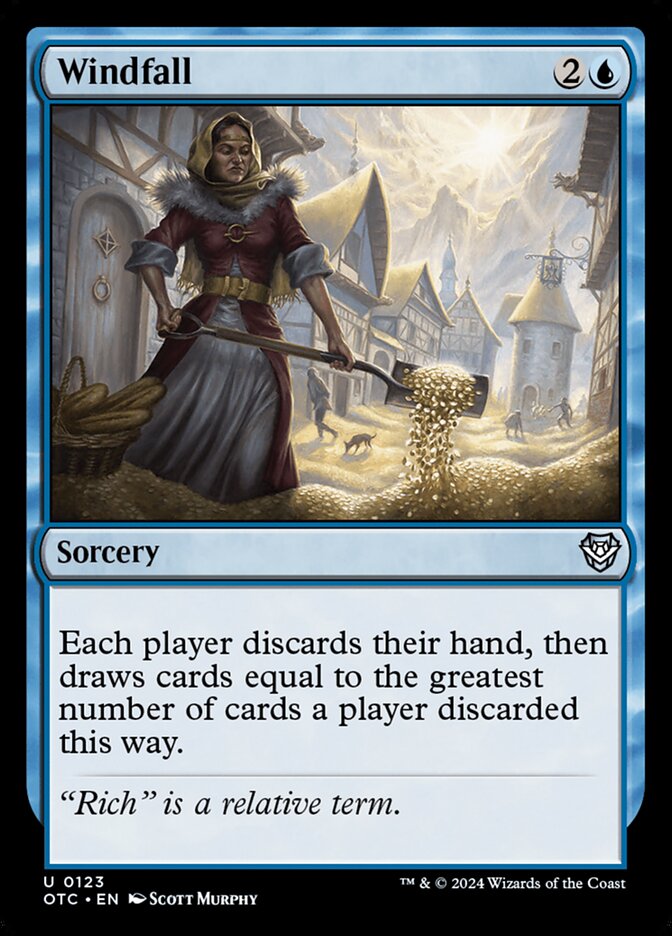 Windfall
If your opponent has Windfall in their graveyard, you can cast Arcane Heist to cast it. Everyone discards and draws cards, then Arcane Heist encodes onto your creature. If that creature deals combat damage later, you can cast a copy of Arcane Heist to target that same Windfall (now back in the graveyard if it wasn't the original target) or any new spells they discarded.
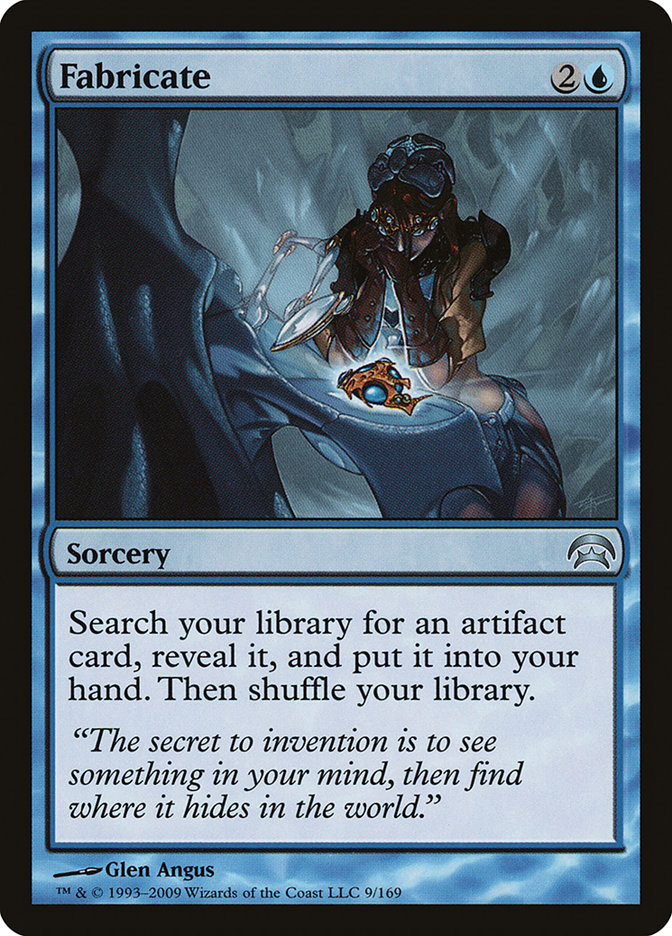 Fabricate
When you cast Arcane Heist targeting an opponent's Fabricate, you search your own library for an artifact. Even though it is your opponent's card, you are the one casting the spell, so you follow the instructions to reveal an artifact and put it into your hand. After searching, you encode Arcane Heist onto a creature to potentially search for more artifacts on future turns.
Guide written with AI from the official text and rulings. Official English text prevails.
How it works : Arcane Heist
Original English text — Wizards of the Coast / Scryfall
- #1· Wizards of the Coast
You choose whether to cast the target instant or sorcery card as Arcane Heist resolves. If you do, you do so as part of the resolution of Arcane Heist. You can’t wait to cast it later in the turn. Timing restrictions based on the card’s types are ignored.
No other card is named in this ruling.
- #2· Wizards of the Coast
If you cast a spell “without paying its mana cost,” you can’t choose to cast it for any alternative costs. You can, however, pay additional costs, such as kicker costs. If the spell has any mandatory additional costs, those must be paid to cast the spell.
No other card is named in this ruling.
- #3· Wizards of the Coast
If the spell you cast has
 in its mana cost, you must choose 0 as the value of X when casting it without paying its mana cost.
No other card is named in this ruling.
- #4· Wizards of the Coast
The spell with cipher is encoded on the creature as part of that spell’s resolution, just after the spell’s other effects. That card goes directly from the stack to exile. It never goes to the graveyard.
No other card is named in this ruling.
- #5· Wizards of the Coast
You choose the creature as the spell resolves. The cipher ability doesn’t target that creature.
No other card is named in this ruling.
- #6· Wizards of the Coast
If the spell with cipher doesn’t resolve, none of its effects will happen, including cipher. The card will go to its owner’s graveyard and won’t be encoded on a creature.
No other card is named in this ruling.
- #7· Wizards of the Coast
If the creature leaves the battlefield, the exiled card will no longer be encoded on any creature. It will stay exiled.
No other card is named in this ruling.
- #8· Wizards of the Coast
You can choose only a creature to encode the card onto.
No other card is named in this ruling.
- #9· Wizards of the Coast
The copy of the card with cipher is created in and cast from exile.
No other card is named in this ruling.
- #10· Wizards of the Coast
You cast the copy of the card with cipher during the resolution of the triggered ability. Ignore timing restrictions based on the card’s type.
No other card is named in this ruling.
- #11· Wizards of the Coast
If you choose not to cast the copy, or you can’t cast it (perhaps because there are no legal targets available), the copy will cease to exist the next time state-based actions are performed. You won’t get a chance to cast the copy at a later time.
No other card is named in this ruling.
- #12· Wizards of the Coast
The exiled card with cipher grants a triggered ability to the creature it’s encoded on. If that creature loses that ability and subsequently deals combat damage to a player, the triggered ability won’t trigger. However, the exiled card will continue to be encoded on that creature.
No other card is named in this ruling.
- #13· Wizards of the Coast
If another player gains control of the creature, that player will control the triggered ability. That player will create a copy of the encoded card and may cast it.
No other card is named in this ruling.
- #14· Wizards of the Coast
If a creature with an encoded card deals combat damage to more than one player simultaneously (perhaps because some of the combat damage was redirected), the triggered ability will trigger once for each player it deals combat damage to. Each ability will create a copy of the exiled card and allow you to cast it.
No other card is named in this ruling.
Legal formats
Commentaires
- Sois le premier à commenter cette carte.
Read next
Meta decks with Arcane Heist
No archived Top 8 deck with this card yet.