


Arcane Proxy is one of those cards players keep asking about. Here is, in plain words, what its official text says, the rulings published by Wizards of the Coast, and the combos players actually run.
Official card text
Prototype— 2/1 (You may cast this spell with different mana cost, color, and size. It keeps its abilities and types.) When this creature enters, if you cast it, exile target instant or sorcery card with mana value less than or equal to this creature's power from your graveyard. Copy that card. You may cast the copy without paying its mana cost.

Complete guide
Arcane Proxy is a versatile Wizard that bends the rules of time and mana to reuse your best spells. By utilizing the prototype mechanic, it can enter the battlefield early as a smaller blue creature or late as a massive colorless threat to facilitate more powerful recursion. It provides incredible utility for decks that rely on instant and sorcery synergies.
Understanding Prototype
Arcane Proxy features the prototype ability, which allows you to cast it for two different costs. If you cast it for its normal cost of 7 mana, it is a colorless 4/3 artifact creature. If you cast it for its prototype cost of 1UU, it is a blue 2/1 creature. Crucially, the 'enters' ability checks the Proxy's current power on the battlefield. Therefore, the prototyped version can only target cards with mana value 2 or less, while the full-cost version can target cards with mana value 4 or less.
Resolving the Ability
When Arcane Proxy enters the battlefield, if you cast it, its ability triggers. You must choose a target instant or sorcery in your graveyard. When the ability resolves, you exile the target, copy it, and may cast that copy immediately without paying its mana cost. Note that you must cast the copy during the resolution of the ability; you cannot save it for later. If the Proxy's power is reduced below the target's mana value in response to the trigger, the ability will fizzle and you will not get a copy.
Common Pitfalls
A common mistake involves spells with X in their mana cost. If you cast an X-spell using Arcane Proxy, X must be 0. Additionally, since you are casting the copy 'without paying its mana cost,' you cannot pay alternative costs like Overload, though you can still pay additional costs like Kicker. Also, remember that the trigger only occurs if you actually cast the Proxy; flickering it or bringing it back with a reanimation spell will not trigger the ability.
When to Play It
Arcane Proxy is best used to double-dip on powerful low-cost cantrips or removal in the early game. In the late game, it acts as a finisher by recurring mid-range spells. It is also an excellent way to trigger 'cast' abilities on other permanents since you are technically casting two spells: the Proxy itself and the copy from the graveyard.
Interaction examples
 Hullbreaker Horror
With Hullbreaker Horror on the battlefield, you cast Arcane Proxy. This triggers the Horror, allowing you to bounce a nonland permanent. When Arcane Proxy enters and its ability resolves, you cast a copy of an instant from your graveyard. Because you are casting a spell, the Hullbreaker Horror triggers a second time, allowing you to bounce another permanent.
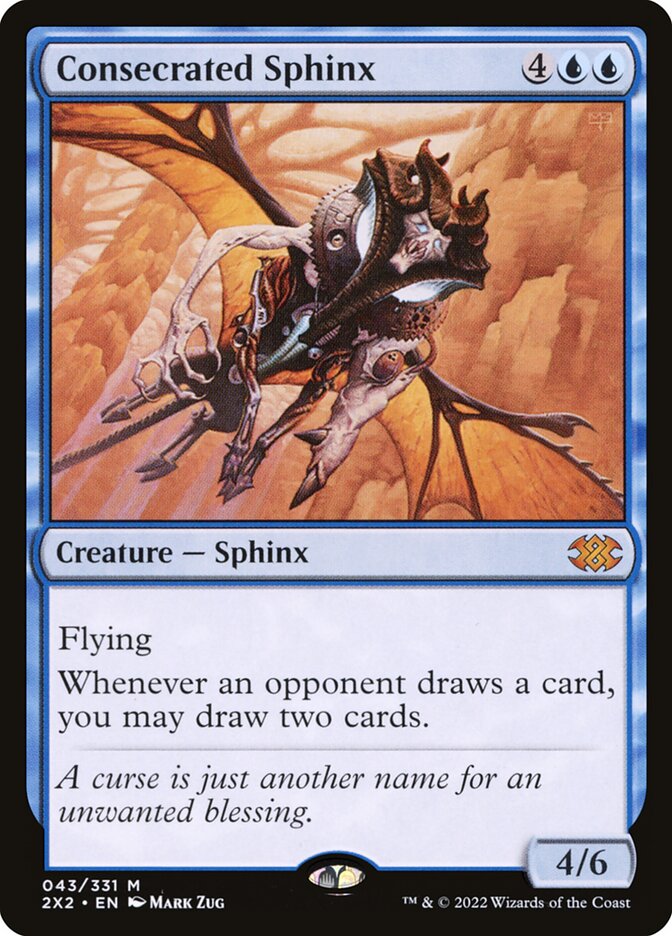 Consecrated Sphinx
If you have Consecrated Sphinx on the board and your opponent attempts to destroy it, you can cast Arcane Proxy. If you have a defensive spell like a mana-value 2 protection spell or a counterspell in your graveyard, the Proxy can exile it and cast a copy to safeguard your Sphinx while leaving a body on the board to block.
Guide written with AI from the official text and rulings. Official English text prevails.
How it works : Arcane Proxy
Original English text — Wizards of the Coast / Scryfall
- #1· Wizards of the Coast
You cast the copy while the ability is resolving and still on the stack. You can't wait to cast it later in the turn.
No other card is named in this ruling.
- #2· Wizards of the Coast
If you cast a spell "without paying its mana cost," you can't pay any alternative costs. You can, however, pay additional costs, such as kicker costs. If the card has any mandatory additional costs, you must pay those.
No other card is named in this ruling.
- #3· Wizards of the Coast
If the spell you cast has
 in its mana cost, you must choose 0 as the value of X.
No other card is named in this ruling.
- #4· Wizards of the Coast
If you don't want to cast the copy, you can choose not to; the copy ceases to exist the next time state-based actions are checked.
No other card is named in this ruling.
- #5· Wizards of the Coast
If another effect causes Arcane Proxy's power to be less than the mana value of the target card as the ability tries to resolve, the target is illegal. The card won't be exiled, and you won't get to cast a copy.
No other card is named in this ruling.
- #6· Wizards of the Coast
A prototype card is a colorless card in every zone except the stack or the battlefield, as well as while on the stack or the battlefield if not cast as a prototyped spell. Ignore its alternative characteristics in those cases. For example, while it's in your graveyard, Blitz Automaton is a colorless creature card with mana value 7. It can't be the target of Recommission, a spell that targets an artifact or creature card with mana value 3 or less in your graveyard.
No other card is named in this ruling.
- #7· Wizards of the Coast
When cast as a prototyped spell, that spell has the mana cost, power, and toughness characteristics shown in its colored, secondary text box rather than the normal values of those characteristics. Its color and mana value are determined by that mana cost. The permanent that spell becomes as it resolves has the same characteristics. If the spell leaves the stack in any other way, or the permanent it becomes leaves the battlefield, it immediately resumes using its normal characteristics.
No other card is named in this ruling.
- #8· Wizards of the Coast
Regardless of how it was cast, a prototype card always has the same name, abilities, types, and so on. Only the mana cost, mana value, color, power, and toughness change depending on whether the card was cast as a prototyped spell.
No other card is named in this ruling.
- #9· Wizards of the Coast
The prototype ability functions in any zone that the spell could be cast from. For example, if an effect allows you to cast artifact spells from your graveyard, you could cast a prototyped Blitz Automaton from your graveyard.
No other card is named in this ruling.
- #10· Wizards of the Coast
Casting a prototyped spell isn't the same as casting it for an alternative cost, and an alternative cost may be applied to a spell cast this way. For example, if an effect allows you to cast an artifact card without paying its mana cost, you could either cast Blitz Automaton normally, or as a prototyped spell.
No other card is named in this ruling.
- #11· Wizards of the Coast
When casting a prototyped spell, use only its prototype characteristics to determine whether it's legal to cast it. For example, if Blitz Automaton is exiled with the last ability of Chandra, Dressed to Kill, you would be able to cast it for

 (because it's a red spell), even though you wouldn't be able to cast it as a colorless spell for its normal cost.
No other card is named in this ruling.
- #12· Wizards of the Coast
If an effect copies a prototyped spell, that copy (as well as the token it becomes on the battlefield) will have the same characteristics as the prototyped spell. Similarly, if an effect creates a token that's a copy of a prototyped permanent or causes another permanent to become a copy of it, the copy would have the same characteristics as the prototyped permanent.
No other card is named in this ruling.
Legal formats
Commentaires
- Sois le premier à commenter cette carte.
Read next
Meta decks with Arcane Proxy
No archived Top 8 deck with this card yet.