

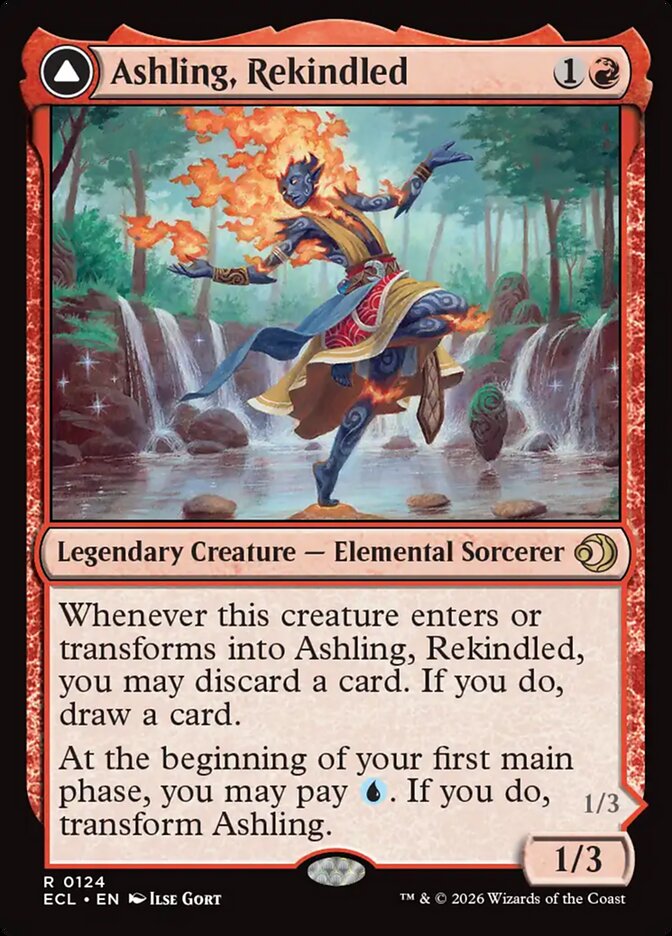
Ashling, Rekindled // Ashling, Rimebound is one of those cards players keep asking about. Here is, in plain words, what its official text says, the rulings published by Wizards of the Coast, and the combos players actually run.
Official card text
Whenever this creature enters or transforms into Ashling, Rekindled, you may discard a card. If you do, draw a card. At the beginning of your first main phase, you may pay. If you do, transform Ashling. Whenever this creature transforms into Ashling, Rimebound and at the beginning of your first main phase, add two mana of any one color. Spend this mana only to cast spells with mana value 4 or greater. At the beginning of your first main phase, you may pay
. If you do, transform Ashling.
Complete guide
Ashling, Rekindled is a versatile double-faced legendary creature that rewards players for tactical transformation. Whether you need to filter your hand or generate explosive mana for high-cost spells, Ashling offers a rhythmic cycle of power across both faces.
Dual Faces and Transformation
Ashling begins on the battlefield as Ashling, Rekindled. In your first main phase, you have the option to pay {U} to transform her into Ashling, Rimebound. Once she is Rimebound, you have a similar option in your next first main phase to pay {R} and flip her back to her Rekindled form. Note that because she is a nonmodal double-faced card, her mana value is always 2 (based on the front face), regardless of which side is currently face up.
The Economy of Rimebound
When Ashling transforms into Ashling, Rimebound, or if she starts your first main phase in that form, she generates two mana of any one color. This mana comes with a specific restriction: it can only be spent to cast spells with a mana value of 4 or greater. This makes her an excellent engine for reaching your late-game threats earlier than expected.
Filtering and Triggers
Every time Ashling enters the battlefield or transforms back into Ashling, Rekindled, you get a 'looting' effect: you may discard a card to draw a card. This trigger is optional, allowing you to keep a perfect hand or pitch unnecessary cards to find answers. Remember that if an effect causes her to transform twice in response to a single trigger, the second transformation will fail because she has already changed state.
Strategic Timing
Since both transformation abilities trigger at the beginning of your first main phase, you must decide immediately if you want to pay the mana. If you choose to transform her into Ashling, Rimebound, you will immediately trigger her mana-production ability for that same phase, giving you the resources needed to cast a large spell right away.
Interaction examples
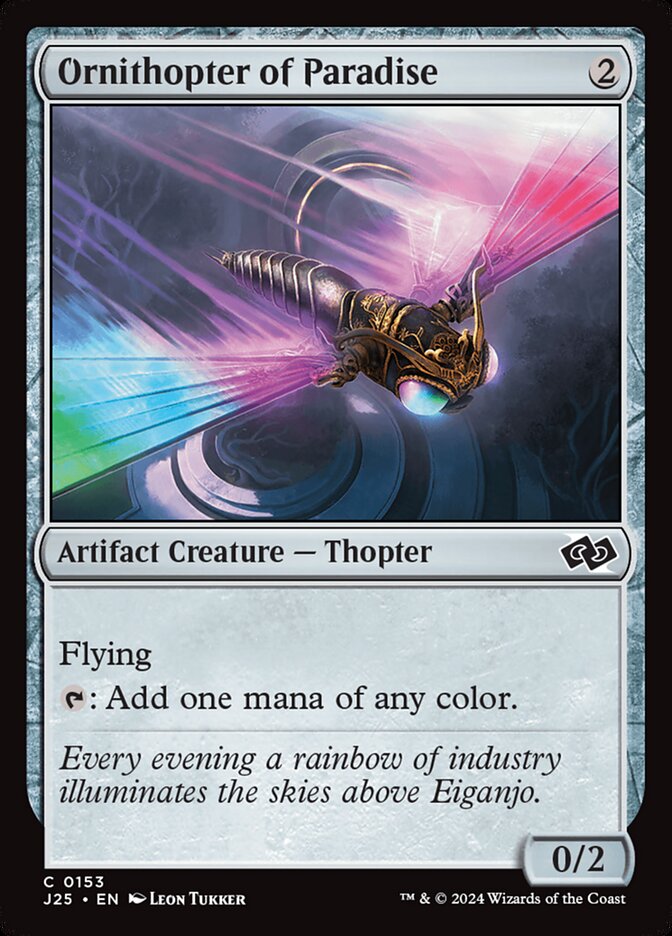 Ornithopter of Paradise
With Ashling, Rekindled on the battlefield, you start your first main phase. You tap Ornithopter of Paradise for {U} to pay for Ashling's transformation ability. Ashling transforms into Ashling, Rimebound. This triggers her second ability, adding two mana (for example, {R}{R}) to your pool. You now have the mana available to cast a spell with mana value 4 or greater during this main phase.
 Professional Face-Breaker
If you control Professional Face-Breaker and have used its ability to exile a card you cannot cast, you can use Ashling's Rekindled face to improve your hand. When Ashling transforms from Rimebound back into Rekindled, her 'enters or transforms' ability triggers. You discard a dead card from your hand to draw a new one, while your Professional Face-Breaker ensures you have the aggressive board presence to keep the pressure on while you dig for your high-mana payoffs.
Guide written with AI from the official text and rulings. Official English text prevails.
How it works : Ashling, Rekindled // Ashling, Rimebound
Original English text — Wizards of the Coast / Scryfall
- #1· Wizards of the Coast
Each nonmodal double-faced card in this release is cast face up. In every zone other than the battlefield, consider only the characteristics of its front face. If it is on the battlefield, consider only the characteristics of the face that's up; the other face's characteristics are ignored.
No other card is named in this ruling.
- #2· Wizards of the Coast
A nonmodal double-faced card enters with its front face up by default, unless a spell or ability instructs you to put it onto the battlefield transformed or allows you to cast it transformed, in which case it enters with its back face up.
No other card is named in this ruling.
- #3· Wizards of the Coast
If you are instructed to put a card that isn't a double-faced card onto the battlefield transformed, it will not enter at all.
No other card is named in this ruling.
- #4· Wizards of the Coast
If a spell has
 in its mana cost, use the value chosen for that X to determine the mana value of that spell.
No other card is named in this ruling.
- #5· Wizards of the Coast
In the Commander variant, a double-faced card's color identity is determined by the mana costs and mana symbols in the rules text of both faces combined. If either face has a color indicator or basic land type, those are also considered. For example, Oko, Lorwyn Liege's color identity is green and blue, since its front face is blue, its rules text contains a green mana symbol, and its back face has a green color indicator as well as a blue mana symbol in its rules text.
No other card is named in this ruling.
- #6· Wizards of the Coast
The back face of a nonmodal double-faced card usually has a color indicator that defines its color.
No other card is named in this ruling.
- #7· Wizards of the Coast
Each face of a nonmodal double-faced card has its own set of characteristics: name, types, subtypes, abilities, and so on. While a double-faced permanent is on the battlefield, consider only the characteristics of the face that's currently up. The other set of characteristics is ignored.
No other card is named in this ruling.
- #8· Wizards of the Coast
The mana value of a nonmodal double-faced card is the mana value of its front face, no matter which face is up.
No other card is named in this ruling.
- #9· Wizards of the Coast
A token that is created as a copy of a double-faced permanent or a double-faced card in another zone is a double-faced token. It will have both the front face and back face of whatever object it's copying. If it's copying a double-faced permanent whose back face is up, the token will enter with its back face up. It can transform if instructed to do so.
No other card is named in this ruling.
- #10· Wizards of the Coast
In some rare cases, this permanent might transform while its triggered ability that allows you to pay mana to transform it is still on the stack. (For example, another effect might cause that ability to trigger an additional time.) In such a case, even if you pay mana as the triggered ability resolves, this permanent won't transform because it already transformed while the triggered ability was on the stack.
No other card is named in this ruling.
Legal formats
Commentaires
- Sois le premier à commenter cette carte.