


At Knifepoint is one of those cards players keep asking about. Here is, in plain words, what its official text says, the rulings published by Wizards of the Coast, and the combos players actually run.
Official card text
During your turn, outlaws you control have first strike. (Assassins, Mercenaries, Pirates, Rogues, and Warlocks are outlaws.) Whenever you commit a crime, create a 1/1 red Mercenary creature token with ": Target creature you control gets +1/+0 until end of turn. Activate only as a sorcery." This ability triggers only once each turn.
Complete guide
Step into the lawless frontier where every dark deed earns you a loyal follower. At Knifepoint is a powerful enchantment that turns your devious plays into a growing board presence and ensures your band of outlaws strikes first in any duel. By rewarding you for committing crimes, this card turns every targeted removal or disruption spell into extra value.
Outlaws and Combat Dominance
At Knifepoint provides a significant tactical advantage during your turn by granting First Strike to all outlaws you control. Outlaws include any creature with the Assassin, Mercenary, Pirate, Rogue, or Warlock creature types. It is important to note that 'Outlaw' itself is not a creature type; you cannot choose it for effects that ask you to name a type. This combat bonus only applies during your own turn, meaning your outlaws will not have First Strike while you are defending during an opponent's turn.
Mastering the Art of Crime
The second ability triggers whenever you 'commit a crime.' You commit a crime when you cast a spell, activate an ability, or put a triggered ability on the stack that targets an opponent, an opponent's permanent, their spells, their abilities, or cards in their graveyard. The crime is considered committed as soon as the targets are chosen and the spell or ability is fully put onto the stack. Even if the spell is countered or the targets become illegal later, the crime has still been committed and the trigger will resolve to create a Mercenary token.
Timing and Restrictions
The crime-triggering ability is restricted to once each turn. This includes your opponents' turns, meaning you can potentially create a Mercenary on your turn and another on each opponent's turn if you have ways to target their permanents or graveyard. Additionally, the Mercenary tokens produced have a activated ability to buff your creatures' power, but remember this can only be activated as a sorcery, meaning you cannot use it during the combat phase to surprise an opponent after blockers are declared.
Interaction examples
 Black Market Connections
 Mercenary
If you control At Knifepoint and choose the 'Hire a Mercenary' mode on Black Market Connections, you create a 3/2 Shapeshifter with changeling. Because it has changeling, it is every creature type, including Mercenary, Rogue, and the others. This makes it an outlaw, granting it First Strike during your turn. However, because Black Market Connections does not target an opponent or their permanents, creating this token does not count as a crime.
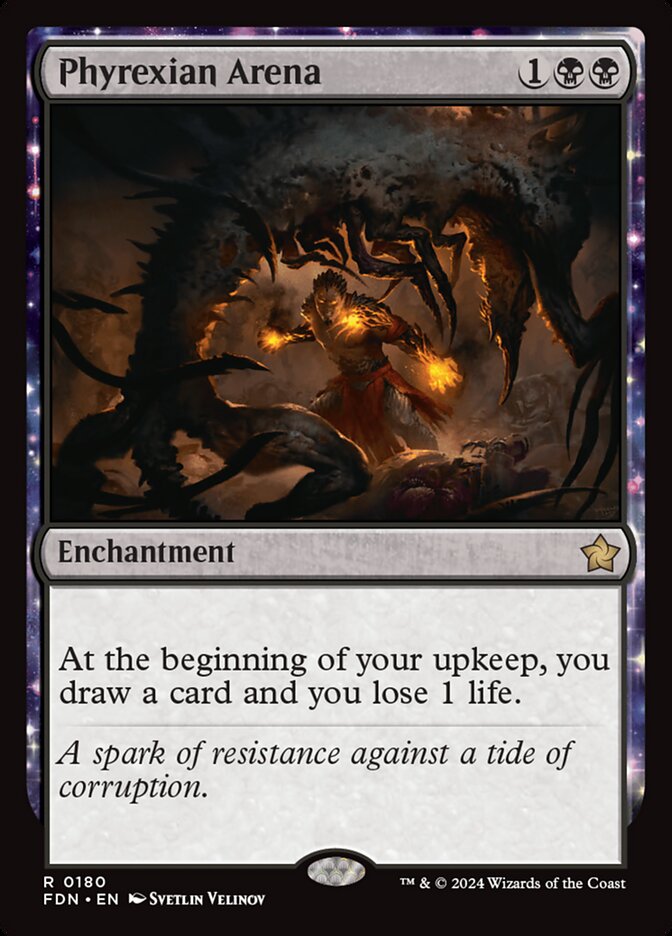 Phyrexian Arena
At the beginning of your upkeep, Phyrexian Arena triggers to draw you a card and lose life. Since this ability does not target an opponent or any of their permanents, it does not constitute a crime. You will not receive a Mercenary token from At Knifepoint via this interaction. To get a token, you must use a spell or ability that explicitly uses the word 'target' on an opponent or their property.
If you attack with a Mercenary token while At Knifepoint is on the battlefield, it deals damage in the first strike combat step. If an opponent destroys At Knifepoint after the first strike step but before the regular combat damage step, the Mercenary (which no longer has First Strike) will not deal damage again. You cannot 'double dip' on damage by losing First Strike mid-combat.
Guide written with AI from the official text and rulings. Official English text prevails.
How it works : At Knifepoint
Original English text — Wizards of the Coast / Scryfall
- #1· Wizards of the Coast
Creatures that deal first strike combat damage but lose first strike before regular combat damage is dealt won’t deal combat damage again unless they have double strike. This means you can’t have At Knifepoint leave the battlefield to have your outlaws deal combat damage twice in a turn.
No other card is named in this ruling.
- #2· Wizards of the Coast
A card, spell, or permanent is an outlaw if it has the Assassin, Mercenary, Pirate, Rogue, or Warlock creature type. It doesn’t matter if it has more than one of those creature types; as long as it has at least one, it’s an outlaw.
Card named in this ruling
- #3· Wizards of the Coast
Outlaw is not a creature type. If an effect asks you to choose a creature type, you can’t choose outlaw.
No other card is named in this ruling.
- #4· Wizards of the Coast
If an ability refers to an outlaw or whether a player controls an outlaw, it’s referring only to permanents with one or more of the creature types specified above. Notably, it’s not referring to any spell or card not on the battlefield. However, other abilities may refer to an “outlaw spell” or “outlaw card” in a zone other than the battlefield. Those abilities refer to spells and cards with one or more of the specified creature types.
No other card is named in this ruling.
- #5· Wizards of the Coast
A player commits a crime as they cast a spell, activate an ability, or put a triggered ability on the stack that targets at least one opponent, at least one permanent, spell, or ability an opponent controls, and/or at least one card in an opponent’s graveyard.
No other card is named in this ruling.
- #6· Wizards of the Coast
The spell or ability that constituted a crime doesn’t have to have resolved yet or at all. As soon as you’re finished casting the spell, activating the ability, or putting the triggered ability on the stack, you’ve committed a crime.
No other card is named in this ruling.
- #7· Wizards of the Coast
For example, an ability that triggers when you cast a spell that targets an opponent will trigger at the same time as an ability that triggers whenever you commit a crime. Those abilities can be put on the stack in either order (if you control them both), and they’ll both resolve before the spell that caused them to trigger.
No other card is named in this ruling.
- #8· Wizards of the Coast
A player can commit only one crime per spell or ability they control. Targeting multiple opponents, permanents, spells, abilities, and/or cards with the same spell or ability doesn’t constitute committing multiple crimes.
No other card is named in this ruling.
- #9· Wizards of the Coast
Changing the target or targets of a spell or ability won’t affect whether or not the controller of that spell or ability has committed a crime. Only the initial targets chosen for that spell or ability are used to determine whether or not its controller committed a crime.
No other card is named in this ruling.
Related cards and tokens
Legal formats
Commentaires
- Sois le premier à commenter cette carte.
Read next
Meta decks with At Knifepoint
No archived Top 8 deck with this card yet.