

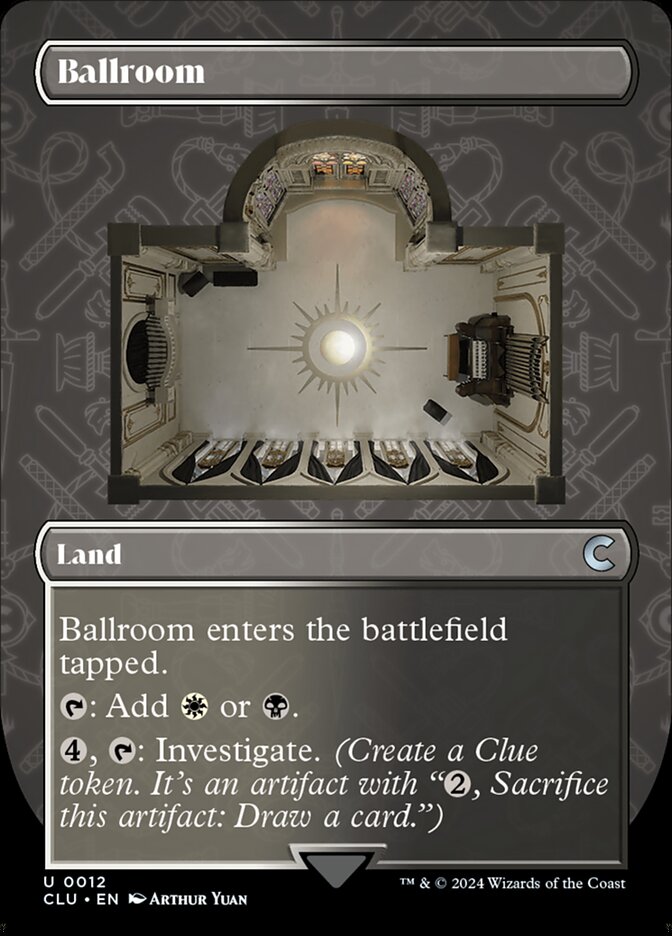
Ballroom is one of those cards players keep asking about. Here is, in plain words, what its official text says, the rulings published by Wizards of the Coast, and the combos players actually run.
Official card text
This land enters tapped.: Add
or
.
,
, Sacrifice this token: Draw a card.")
Complete guide
Ballroom is a versatile utility land that ensures you always have something to do with your mana, even when your hand is empty. It provides two colors of mana while doubling as a repeatable source of card advantage through the investigate mechanic. This land is a perfect addition to decks looking for long-term consistency in Orzhov colors.
What Ballroom Does
Ballroom is a dual land that enters the battlefield tapped, providing either White or Black mana when tapped. Its secondary ability allows you to pay four mana and tap it to 'Investigate,' which creates a Clue token. This Clue is a colorless artifact that can later be sacrificed for two mana to draw a card, providing a reliable way to sink extra mana during the late game.
Resolving the Ability Step-by-Step
To use the Investigate ability, you must first have four mana available and Ballroom must be untapped. You activate the ability by paying the mana and tapping the land; this goes on the stack and can be responded to by opponents. When the ability resolves, you create a Clue token. Once the token is on the battlefield, you can activate its own ability at any time you have priority by paying two mana and sacrificing it to draw a card.
Common Mistakes
A common point of confusion involves the Clue type. While Clue is an artifact type, it is not a land type, so Ballroom itself is not a Clue. Additionally, remember that you cannot sacrifice a single Clue token to pay for two different costs simultaneously. If an effect asks you to sacrifice a Clue, and you choose to do so, you cannot also use that same Clue to pay for its own 'draw a card' ability.
When to Play Ballroom
Ballroom is best utilized in slower, control-oriented decks or midrange strategies where the game is expected to go long. Since it enters the battlefield tapped, it is best played on early turns when you don't have a proactive one-drop, or saved for later turns when you have enough mana to immediately activate its Investigate ability. It excels in environments where card draw is scarce.
Interaction examples
 Command Tower
In a Commander game, if your commander is White and Black, Ballroom serves as a vital color source. While Command Tower provides any color in your identity immediately, Ballroom ensures that even if you face a board wipe or run out of spells, you can use the mana from Command Tower to activate Ballroom's investigate ability and find new threats.
 Exotic Orchard
If your opponent controls Ballroom, your Exotic Orchard can tap for either White or Black mana because Ballroom is capable of producing those colors. This interaction highlights how Ballroom's mana-producing capabilities benefit not just you, but potentially your opponents' rainbow lands as well.
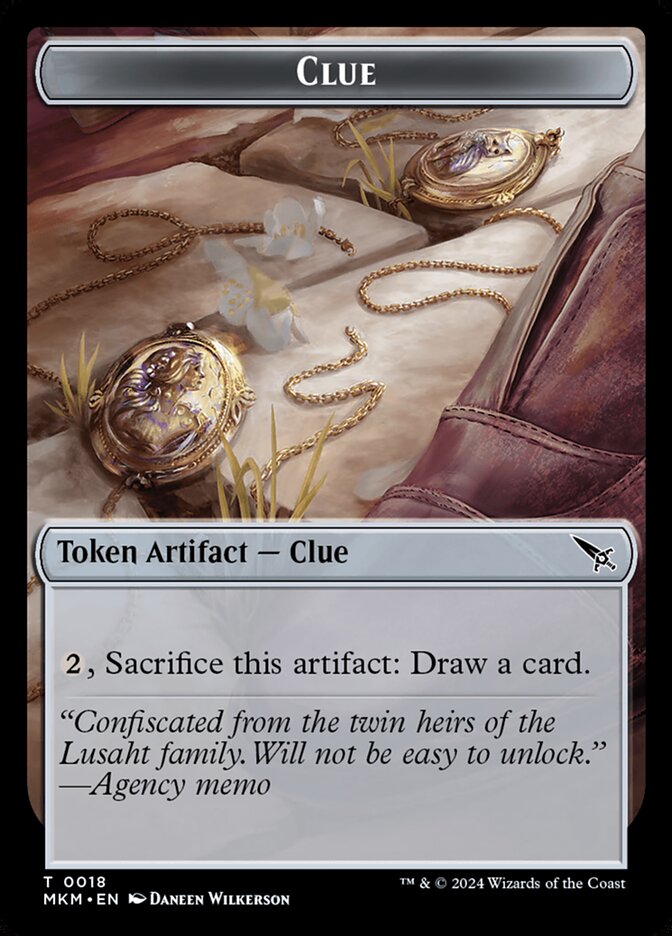 Clue
When you activate Ballroom for four mana, you create a Clue token. This token sits on the battlefield until you decide to use it. By paying two more mana and sacrificing the Clue, you replace the token with a card from your library. This effectively turns Ballroom into a repeatable 'six-mana draw a card' engine spread across two different turns.
Guide written with AI from the official text and rulings. Official English text prevails.
How it works : Ballroom
Original English text — Wizards of the Coast / Scryfall
- #1· Wizards of the Coast
Clue is an artifact type. Even though it appears on some cards with other permanent types, it's never a creature type, a land type, or anything but an artifact type.
Card named in this ruling
- #2· Wizards of the Coast
If an effect refers to a Clue, it means any Clue artifact, not just a Clue artifact token. For example, you can sacrifice Wrench to pay for Alquist Proft, Master Sleuth's activated ability.
Card named in this ruling
- #3· Wizards of the Coast
You can't sacrifice a Clue to pay multiple costs. For example, you can't sacrifice a Clue token to activate its own ability and also to activate Alquist Proft, Master Sleuth's ability.
Card named in this ruling
- #4· Wizards of the Coast
Some spells and abilities that investigate may require targets. If each target chosen is an illegal target as that spell or ability tries to resolve, it won't resolve. You won't create any Clue tokens.
Card named in this ruling
- #5· Wizards of the Coast
Some abilities trigger "whenever you sacrifice a Clue". Those abilities trigger whenever you sacrifice a Clue for any reason, not just to activate a Clue's activated ability.
Card named in this ruling
Related cards and tokens
Legal formats
Commentaires
- Sois le premier à commenter cette carte.
Read next
Meta decks with Ballroom
No archived Top 8 deck with this card yet.