

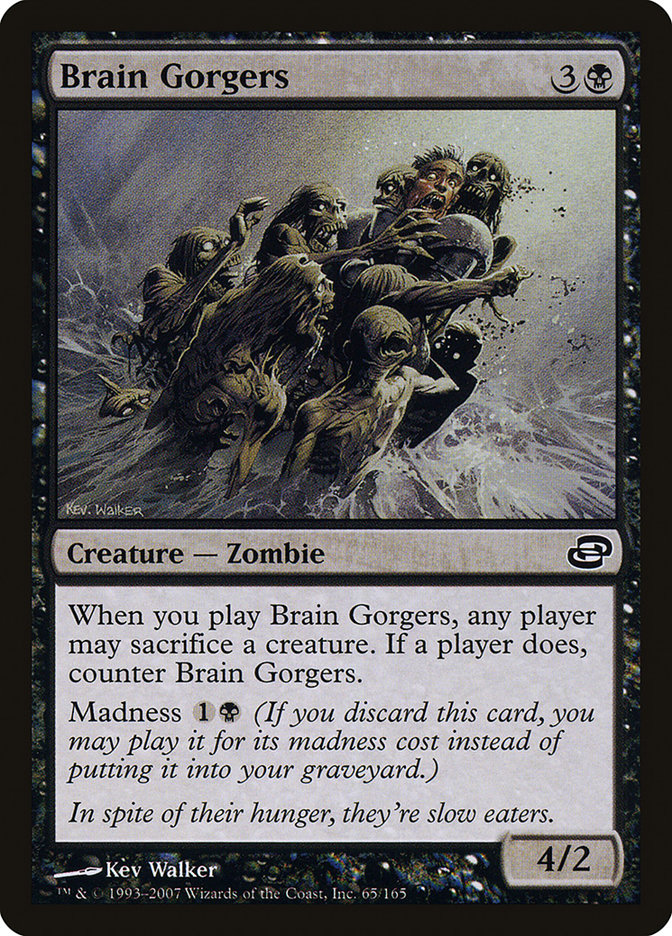
Brain Gorgers is one of those cards players keep asking about. Here is, in plain words, what its official text says, the rulings published by Wizards of the Coast, and the combos players actually run.
Official card text
When you cast this spell, any player may sacrifice a creature of their choice. If a player does, counter Brain Gorgers. Madness(If you discard this card, discard it into exile. When you do, cast it for its madness cost or put it into your graveyard.)

Complete guide
Brain Gorgers is a unique Zombie that presents your opponents with a difficult choice: let it enter the battlefield or lose a resource to stop it. This card combines the risk of an 'opponent's choice' trigger with the graveyard utility of the Madness mechanic.
A Choice at the Gate
Brain Gorgers features a cast trigger that occurs before the spell even resolves. When you cast it, any player—starting with the active player and proceeding in turn order—has the opportunity to sacrifice a creature. If any player chooses to do so, Brain Gorgers is countered immediately. This means that against a deck with many small creatures, this card might never hit the table, but it can force an opponent to lose a key piece of their board.
Timing and Resolution
When you cast Brain Gorgers for its mana cost or its Madness cost, the ability triggers and goes on the stack on top of the creature spell. Players must decide whether to sacrifice a creature while the ability is resolving. If someone sacrifices a creature, the spell is countered and goes straight to the graveyard. If no one sacrifices anything, the ability finishes resolving, and then Brain Gorgers itself will eventually resolve and enter the battlefield.
Mastering Madness
Madness allows you to cast Brain Gorgers for a reduced cost of {1}{B} if you discard it. When discarded, the card moves to exile instead of the graveyard. You then get a triggered ability that lets you cast it for its Madness cost. If you choose not to cast it at that moment, it is put into your graveyard. Remember: you cannot discard a card just because you want to; you must have an effect or cost that requires a discard.
Strategic Considerations
Since the sacrifice choice is made by your opponents, Brain Gorgers is most effective when your opponents have no creatures or only have high-value creatures they are unwilling to lose. If an opponent has a creature they want to die, such as one with a 'dies' trigger, they will likely use it to counter your Gorgers and gain an extra benefit.
Interaction examples
 Solemn Simulacrum
You cast Brain Gorgers. Your opponent controls Solemn Simulacrum. When the Gorgers' cast trigger resolves, your opponent chooses to sacrifice Solemn Simulacrum. Brain Gorgers is countered and goes to your graveyard. However, because Solemn Simulacrum died, its owner still gets to draw a card from its own triggered ability.
 Roaming Throne
You have Roaming Throne on the battlefield with 'Zombie' chosen as the creature type. When you cast Brain Gorgers, its ability triggers twice because of the Throne. This forces your opponents to potentially sacrifice two creatures—one for each trigger—if they want to ensure the Gorgers is countered, though only one successful sacrifice is needed to counter the spell initially.
During your opponent's turn, an effect forces you to discard Brain Gorgers. You discard it into exile and choose to pay {1}{B} to cast it. The 'when you cast' trigger goes on the stack. Even though it is a creature and not your turn, Madness ignores normal timing rules, allowing you to potentially put a 4/2 body onto the field—or force a sacrifice—during an opponent's combat step.
Guide written with AI from the official text and rulings. Official English text prevails.
How it works : Brain Gorgers
Original English text — Wizards of the Coast / Scryfall
- #1· Wizards of the Coast
If you discard a card with madness while a spell or ability is resolving, it moves immediately to exile. Continue resolving that spell or ability, noting that the card you discarded is not in your graveyard at this time. Its madness triggered ability will be placed onto the stack once that spell or ability has completely resolved.
No other card is named in this ruling.
- #2· Wizards of the Coast
To determine the total cost of a spell, start with the mana cost or alternative cost (such as a madness cost) you're paying, add any cost increases, then apply any cost reductions. The mana value of the spell is determined by only its mana cost, no matter what the total cost to cast that spell was.
No other card is named in this ruling.
- #3· Wizards of the Coast
If you choose not to cast a card with madness when the madness triggered ability resolves, it's put into your graveyard. Madness doesn't give you another chance to cast it later.
No other card is named in this ruling.
- #4· Wizards of the Coast
If you discard a card with madness to pay the cost of a spell or activated ability, that card's madness triggered ability (and the spell that card becomes, if you choose to cast it) will resolve before the spell or ability the discard paid for.
No other card is named in this ruling.
- #5· Wizards of the Coast
Cards are discarded in a Magic game only from a player's hand. Effects that put cards into a player's graveyard from anywhere else do not cause those cards to be discarded.
No other card is named in this ruling.
- #6· Wizards of the Coast
Madness works independently of why you're discarding the card. You could discard it to pay a cost, because a spell or ability tells you to, or because you have too many cards in your hand during your cleanup step. You can't discard a card with madness just because you want to, though.
No other card is named in this ruling.
- #7· Wizards of the Coast
A card with madness that's discarded counts as having been discarded even though it's put into exile rather than a graveyard. If it was discarded to pay a cost, that cost is still paid. Abilities that trigger when a card is discarded will still trigger.
No other card is named in this ruling.
- #8· Wizards of the Coast
A spell cast for its madness cost is put onto the stack like any other spell. It can be countered, copied, and so on. As it resolves, it's put onto the battlefield if it's a permanent card or into its owner's graveyard if it's an instant or sorcery card.
No other card is named in this ruling.
- #9· Wizards of the Coast
Casting a spell with madness ignores the timing rules based on the card's card type. For example, you can cast a sorcery with madness if you discard it during an opponent's turn.
No other card is named in this ruling.
- #10· Wizards of the Coast
A player can't choose to sacrifice a creature unless they actually control a creature that can be sacrificed. For example, if the action were "discard three cards," a player with two or fewer cards in hand couldn't take the option to counter the spell.
No other card is named in this ruling.
- #11· Wizards of the Coast
As the triggered ability resolves, the active player gets the option to perform the action. If that player declines, the next player in turn order gets the option. As soon as any player performs the action, the spell is countered, but the remaining players still get the option. If all players decline, the spell remains on the stack.
No other card is named in this ruling.
- #12· Wizards of the Coast
When this spell is cast, its "when you cast" ability triggers and goes on the stack on top of it.
No other card is named in this ruling.
Legal formats
Commentaires
- Sois le premier à commenter cette carte.
Read next
Meta decks with Brain Gorgers
No archived Top 8 deck with this card yet.