
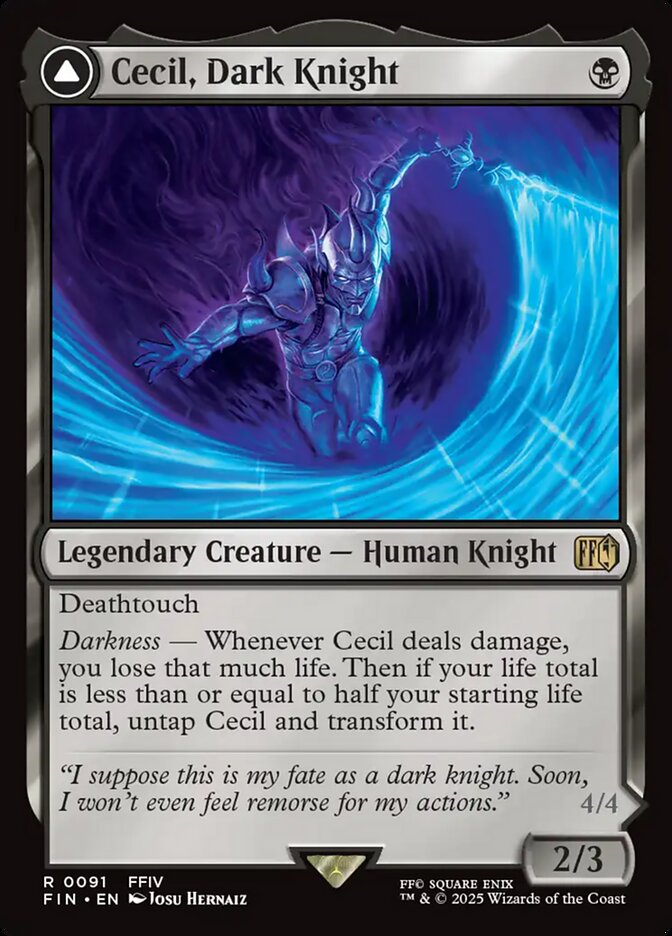
Cecil, Dark Knight // Cecil, Redeemed Paladin is one of those cards players keep asking about. Here is, in plain words, what its official text says, the rulings published by Wizards of the Coast, and the combos players actually run.
Official card text
Deathtouch Darkness — Whenever Cecil deals damage, you lose that much life. Then if your life total is less than or equal to half your starting life total, untap Cecil and transform it. Lifelink Protect — Whenever Cecil attacks, other attacking creatures gain indestructible until end of turn.
Complete guide
Cecil, Dark Knight is a powerful double-faced legendary creature that embodies a journey from darkness to light. Starting as a low-cost threat with deathtouch, he eventually transforms into a noble protector who shields your entire army. Understanding the life total threshold for his transformation is key to mastering his gameplay.
Dual Nature and Transformation
Cecil, Dark Knight is a nonmodal double-faced card, meaning he always enters the battlefield on his front (black) side by default. While on the battlefield, only the characteristics of the face that is currently up are considered. The back face, Cecil, Redeemed Paladin, features a white color indicator, giving the card a combined black and white color identity for Commander deck building.
The Darkness Trigger
Cecil, Dark Knight has a triggered ability called Darkness. Whenever he deals damage—whether to a player, a planeswalker, or another creature during combat—you lose that much life. After this life loss occurs, the game checks your current life total. If your life is less than or equal to half of your starting life total (usually 10 in Standard or 20 in Commander), Cecil untaps and transforms into Cecil, Redeemed Paladin.
Redeemed Protection
Once transformed, Cecil becomes a white creature with Lifelink and the Protect ability. When he attacks, he grants Indestructible to all other attacking creatures until the end of the turn. Note that this ability only affects creatures that are already attacking when the trigger resolves; creatures entered into combat after the trigger will not have Indestructible.
Strategic Considerations
Timing your transformation is critical. Because Cecil must survive the damage-dealing event to transform, be wary of combat trades. If Cecil deals damage but also receives lethal damage at the same time, the Darkness ability will trigger and you will lose life, but Cecil will be in the graveyard before he can transform or untap.
Interaction examples
In a Commander game, your starting life total is 40. You currently have 22 life. Cecil, Dark Knight attacks and deals 2 damage to an opponent. You lose 2 life, bringing you to 20. Because 20 is exactly half of your starting life total, Cecil's Darkness ability untaps him and transforms him into Cecil, Redeemed Paladin.
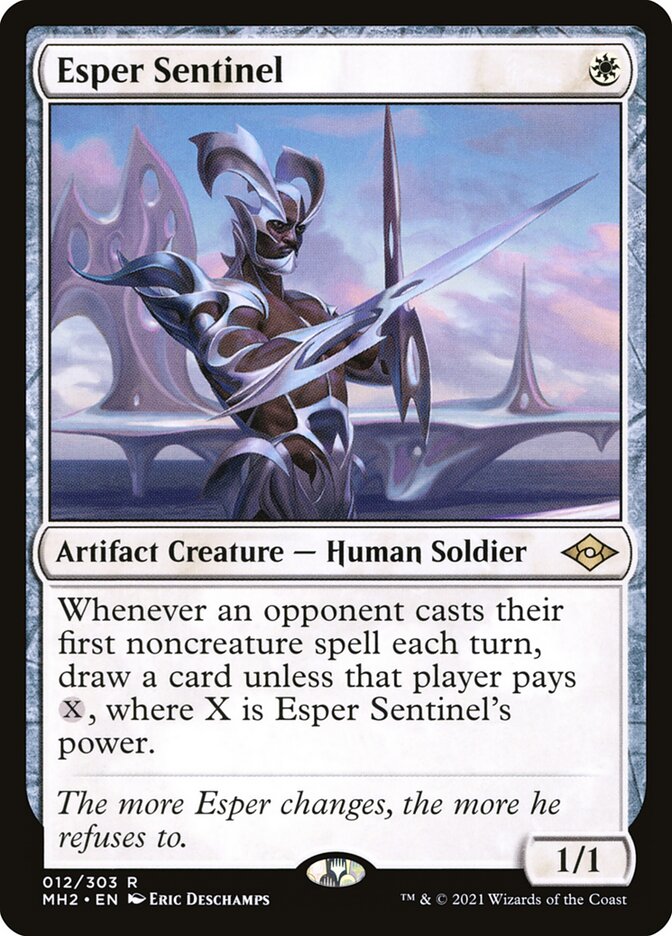 Esper Sentinel
With Cecil already transformed into Cecil, Redeemed Paladin, you declare an attack with both Cecil and Esper Sentinel. Cecil's Protect ability triggers. As it resolves, Esper Sentinel gains Indestructible until the end of the turn, allowing it to survive blocks from much larger creatures.
 Blood Artist
If Cecil, Dark Knight is blocked by a 1/1 creature and dies, he deals 1 damage. The Darkness ability triggers, causing you to lose 1 life. Because Blood Artist sees a creature die, its ability also triggers. However, since Cecil is no longer on the battlefield when the Darkness ability finishes resolving, he cannot transform, even if your life total is low enough.
Guide written with AI from the official text and rulings. Official English text prevails.
How it works : Cecil, Dark Knight // Cecil, Redeemed Paladin
Original English text — Wizards of the Coast / Scryfall
- #1· Wizards of the Coast
Each nonmodal double-faced card in this release is cast face up. In every zone other than the battlefield, consider only the characteristics of its front face. If it is on the battlefield, consider only the characteristics of the face that's up; the other face's characteristics are ignored.
No other card is named in this ruling.
- #2· Wizards of the Coast
If Cecil, Dark Knight is dealt lethal damage at the same time it deals damage (probably because it blocked or became blocked), its last ability will still trigger. You'll still lose life, but you won't untap or transform Cecil, Dark Knight because it won't be on the battlefield anymore.
No other card is named in this ruling.
- #3· Wizards of the Coast
A token that is created as a copy of a double-faced permanent or a double-faced card in another zone is a double-faced token. It will have both the front face and back face of whatever object it's copying. If it's copying a double-faced permanent whose back face is up, the token will enter with its back face up. It can transform if instructed to do so.
No other card is named in this ruling.
- #4· Wizards of the Coast
The mana value of a nonmodal double-faced card is the mana value of its front face, no matter which face is up.
No other card is named in this ruling.
- #5· Wizards of the Coast
A nonmodal double-faced card enters with its front face up by default, unless a spell or ability instructs you to put it onto the battlefield transformed or allows you to cast it transformed, in which case it enters with its back face up.
No other card is named in this ruling.
- #6· Wizards of the Coast
Each face of a nonmodal double-faced card has its own set of characteristics: name, types, subtypes, abilities, and so on. While a nonmodal double-faced permanent is on the battlefield, consider only the characteristics of the face that's currently up. The other set of characteristics is ignored.
No other card is named in this ruling.
- #7· Wizards of the Coast
In the Commander variant, a double-faced card's color identity is determined by the mana costs and mana symbols in the rules text of both faces combined. If either face has a color indicator or basic land type, those are also considered. For example, Cecil, Dark Knight's color identity is black and white, since its front face is black and its back face has a white color indicator.
No other card is named in this ruling.
- #8· Wizards of the Coast
The back face of a nonmodal double-faced card usually has a color indicator that defines its color.
No other card is named in this ruling.
- #9· Wizards of the Coast
If you are instructed to put a card that isn't a double-faced card onto the battlefield transformed, it will not enter at all. In that case, it stays in the zone it was previously in. For example, if a single-faced card is a copy of Crystal Fragments, it will be exiled during the resolution of its second ability and remain in exile.
No other card is named in this ruling.
Legal formats
Commentaires
- Sois le premier à commenter cette carte.