


De-evolve is one of those cards players keep asking about. Here is, in plain words, what its official text says, the rulings published by Wizards of the Coast, and the combos players actually run.
Official card text
Enchant creature Enchanted creature gets -4/-0, can't block, and is a Salamander. (It loses all other creature types.) Threshold — At the beginning of each upkeep, if there are seven or more cards in your graveyard, exile enchanted creature.
Complete guide
De-evolve is a versatile black Aura that serves as both a powerful debuff and a ticking time bomb for your opponent's most dangerous threats. By stripping a creature of its identity and strength, it paves the way for your victory before eventually removing the creature from the game entirely. Mastering the timing of its Threshold ability is key to maximizing its value.
Shrinking the Threat
When De-evolve is attached to a creature, it immediately applies three continuous effects: the creature gets -4/-0, it loses the ability to block, and its creature types are replaced. Specifically, the creature becomes a Salamander and loses all other creature types, such as Human, Elf, or Dragon. This is particularly effective against tribal decks that rely on specific creature types for synergies.
Reaching the Threshold
The final ability of De-evolve is a triggered ability that checks for the Threshold condition—having seven or more cards in your graveyard. This ability triggers at the beginning of every upkeep, not just yours. If the condition is met when the upkeep starts, the ability goes on the stack. If you still have seven or more cards when the ability resolves, the enchanted creature is exiled.
Strategic Considerations
A common mistake is forgetting that De-evolve only removes creature types, not abilities. The enchanted creature will still keep its keywords like Flying or Lifelink, even though it is now a Salamander. Additionally, because the exile effect happens at the start of the upkeep, you cannot use cards drawn during that same upkeep to reach Threshold in time for the trigger.
When to Cast
You should play De-evolve when you need to neutralize a high-power attacker or a creature that is providing tribal bonuses to an opponent's army. If your graveyard is already near seven cards, you can use it as a slow-motion removal spell to permanently exile a creature without giving the opponent a chance to recur it from their graveyard.
Interaction examples
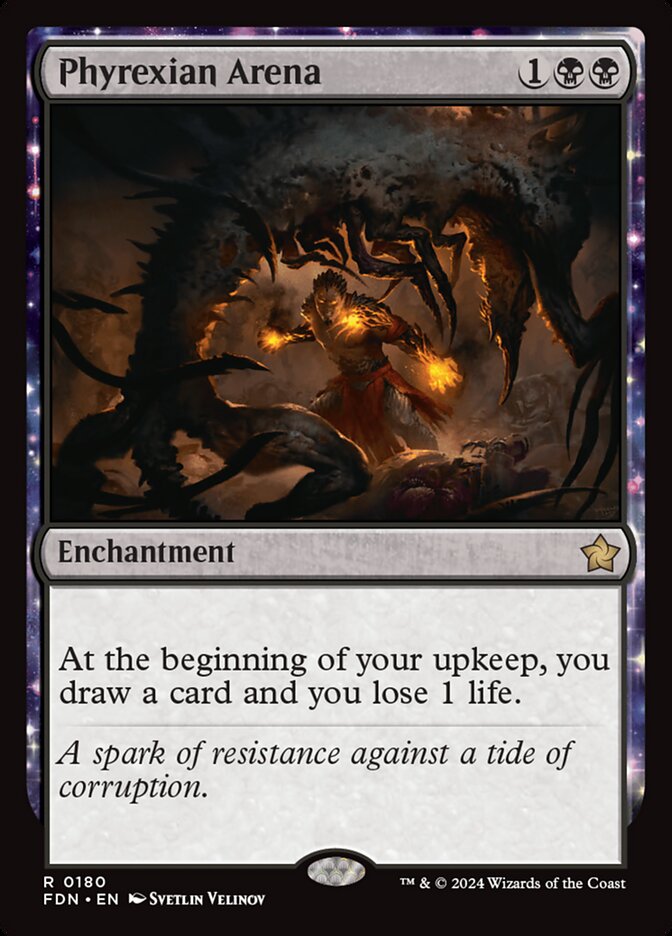 Phyrexian Arena
If you have Phyrexian Arena on the battlefield, both it and De-evolve will trigger at the beginning of your upkeep. As the controller of both triggers, you choose the order they are put on the stack. However, note that De-evolve's Threshold ability has an 'intervening if' clause; it won't even trigger unless you already have seven cards in your graveyard when the upkeep begins. You cannot use the card drawn from Phyrexian Arena to reach the seven-card count for that specific upkeep trigger.
 Black Market Connections
If your opponent creates a 3/2 Shapeshifter token with Black Market Connections, it has Changeling and is every creature type. If you enchant it with De-evolve, the token becomes a -1/2 Salamander that cannot block. Because De-evolve states the creature 'is a Salamander' and 'loses all other creature types,' the Changeling ability is effectively overwritten, and it loses all other types it previously had.
Guide written with AI from the official text and rulings. Official English text prevails.
How it works : De-evolve
Original English text — Wizards of the Coast / Scryfall
No additional ruling has been published for this card.
Legal formats
Commentaires
- Sois le premier à commenter cette carte.
Read next
Meta decks with De-evolve
No archived Top 8 deck with this card yet.