

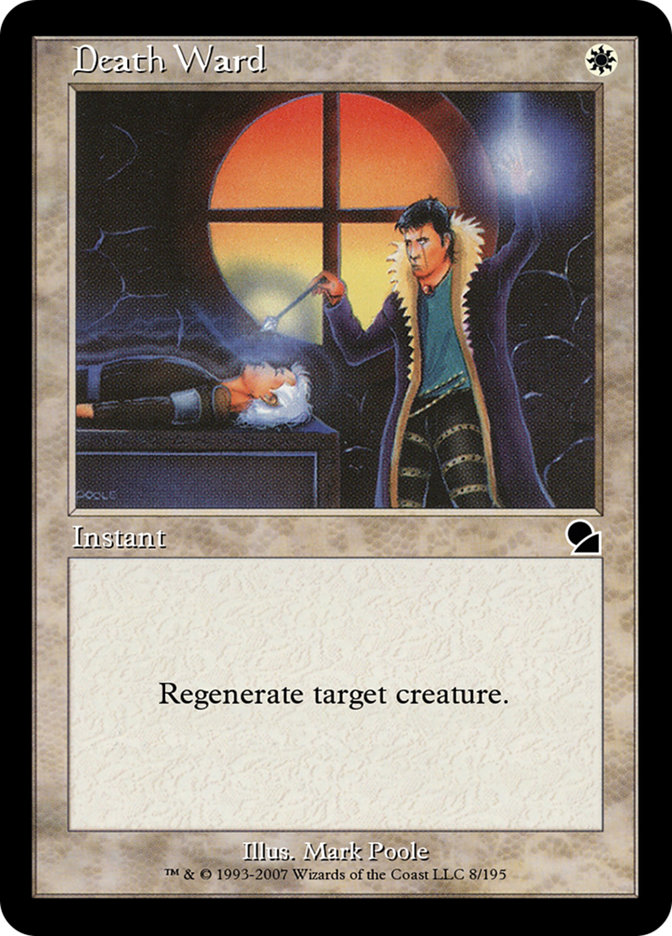
Death Ward is one of those cards players keep asking about. Here is, in plain words, what its official text says, the rulings published by Wizards of the Coast, and the combos players actually run.
Official card text
Regenerate target creature.
Complete guide
Death Ward is a classic white instant that provides a protective shield for your most valuable creatures. By using this spell, you can ensure that a creature survives a brush with death that would otherwise send it to the graveyard. Understanding the regeneration mechanic is key to mastering this card's defensive capabilities.
What Death Ward Does
Death Ward applies a regeneration shield to a target creature. This shield acts as a replacement effect that waits for the creature to be destroyed by either lethal damage or an effect that explicitly says 'destroy.' If the creature would be destroyed while the shield is active, it instead stays on the battlefield, is tapped, has all damage removed from it, and is removed from combat.
How It Resolves Step by Step
First, you cast Death Ward targeting a creature and pay the mana cost. Once the spell resolves, the creature gains a 'regeneration shield' that lasts for the remainder of the turn. If the creature faces lethal damage later that turn, the shield is consumed. The creature is not destroyed; instead, it is tapped (if it wasn't already), all marked damage is cleared, and it is removed from combat if it was attacking or blocking.
Common Mistakes
A frequent error is trying to use Death Ward after a creature has already been destroyed or moved to the graveyard; you must cast it before the destruction event occurs. Additionally, regeneration only replaces destruction. It does not help against effects that reduce toughness to zero, sacrifice effects, or exile effects. If a creature is exiled, Death Ward's shield will not trigger because the creature was never technically destroyed.
When to Play It
The best time to cast Death Ward is during the declare blockers step or in response to a destruction spell like a board wipe. Since the shield lasts until the end of the turn, you can even cast it during your main phase if you anticipate trouble, though waiting until the last possible moment usually keeps your opponent guessing.
Interaction examples
 Swords to Plowshares
If your opponent casts Swords to Plowshares on your creature, casting Death Ward in response will not save it. Swords to Plowshares exiles the creature rather than destroying it. Because the creature is not being destroyed, the regeneration shield from Death Ward has no event to replace, and the creature is removed from the game.
 Path to Exile
Similar to other exile effects, if you target a creature with Death Ward and it is subsequently targeted by Path to Exile, the creature will still be exiled. Regeneration only protects against destruction. You will still get to search for a basic land card as Path to Exile instructs, but your creature will not remain on the battlefield.
If your creature is blocking a much larger attacker that would deal lethal damage, you cast Death Ward on your blocker. When combat damage is dealt, the regeneration shield is used. Your creature remains on the battlefield, becomes tapped, and is removed from combat, surviving a fight it would have otherwise lost.
Guide written with AI from the official text and rulings. Official English text prevails.
How it works : Death Ward
Original English text — Wizards of the Coast / Scryfall
No additional ruling has been published for this card.
Legal formats
Commentaires
- Sois le premier à commenter cette carte.
Read next
Meta decks with Death Ward
No archived Top 8 deck with this card yet.