
Deepmuck Desperado is one of those cards players keep asking about. Here is, in plain words, what its official text says, the rulings published by Wizards of the Coast, and the combos players actually run.
Official card text
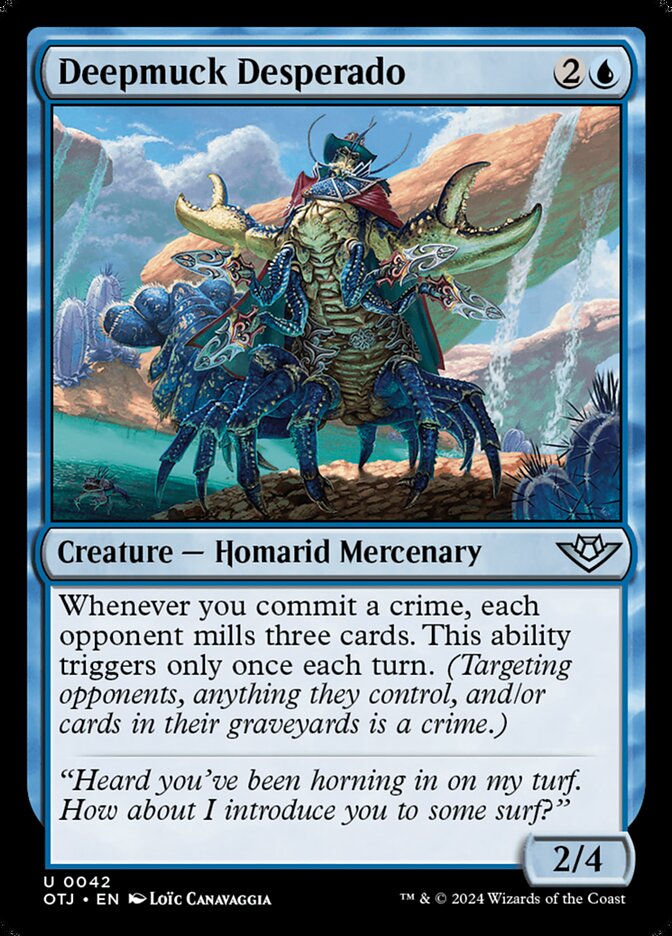
Whenever you commit a crime, each opponent mills three cards. This ability triggers only once each turn. (Targeting opponents, anything they control, and/or cards in their graveyards is a crime.)
Complete guide
Deepmuck Desperado is a cunning Homarid Mercenary that punishes your opponents every time you interact with their side of the board. By turning your spells and abilities into milling engines, this blue creature can quickly deplete an enemy's library. Knowing how to time your 'crimes' is the key to maximizing this Desperado's impact.
Understanding Crimes
In Magic: The Gathering, you commit a crime when you cast a spell, activate an ability, or put a triggered ability on the stack that targets an opponent, a permanent they control, a spell they control, or a card in their graveyard. Deepmuck Desperado watches for these specific interactions and triggers immediately once the targeting happens. Note that the crime is considered committed as soon as the spell or ability is fully cast or put on the stack; it does not need to resolve for the Desperado to trigger.
The One-Turn Limit
The most important restriction on Deepmuck Desperado is that its ability triggers only once each turn. This means if you target an opponent's creature with a spell and then target their graveyard with an ability in the same turn, only the first action will cause the mill effect. To maximize your strategy, you should aim to commit one crime during your turn and another crime during each of your opponents' turns if possible.
Common Mistakes
A frequent misconception is that targeting multiple things with one spell counts as multiple crimes. It does not; a single spell or ability counts as one crime regardless of how many eligible targets you choose. Additionally, changing the targets of a spell later (such as with a redirection effect) does not count as a new crime; only the initial targeting choice at the moment of casting or activating matters for the Desperado.
Strategic Timing
Because Deepmuck Desperado triggers on the stack, the mill happens before your crime-committing spell or ability actually resolves. If your goal is to mill specific cards to then target them in the graveyard, remember that the mill occurs first. In multiplayer games, this ability is particularly potent because it forces each opponent to mill three cards, not just the one you targeted.
Interaction examples
 Roaming Throne
If you have Roaming Throne on the battlefield with 'Homarid' or 'Mercenary' chosen as the creature type, Deepmuck Desperado's ability will trigger an additional time. When you commit a crime, each opponent will mill three cards, and then each opponent will mill three more cards. Even though the Desperado usually only triggers once per turn, Roaming Throne's replacement effect allows you to get two instances of the mill from that single crime.
 Solemn Simulacrum
If you play Solemn Simulacrum while Deepmuck Desperado is on the battlefield, you do not commit a crime. Searching your library for a land or drawing a card when the Golem dies does not target an opponent, their permanents, or their graveyard. Therefore, the Desperado's mill ability will not trigger because no crime was committed.
If you cast a spell like 'Murder' targeting an opponent's creature, the Desperado sees this crime as you finish casting the spell. The mill ability goes on the stack above 'Murder'. Each opponent mills three cards, then 'Murder' resolves and destroys the creature. If you try to cast another 'Murder' later in the same turn, the Desperado will not trigger again due to its 'once each turn' restriction.
Guide written with AI from the official text and rulings. Official English text prevails.
How it works : Deepmuck Desperado
Original English text — Wizards of the Coast / Scryfall
- #1· Wizards of the Coast
A player commits a crime as they cast a spell, activate an ability, or put a triggered ability on the stack that targets at least one opponent, at least one permanent, spell, or ability an opponent controls, and/or at least one card in an opponent’s graveyard.
No other card is named in this ruling.
- #2· Wizards of the Coast
The spell or ability that constituted a crime doesn’t have to have resolved yet or at all. As soon as you’re finished casting the spell, activating the ability, or putting the triggered ability on the stack, you’ve committed a crime.
No other card is named in this ruling.
- #3· Wizards of the Coast
For example, an ability that triggers when you cast a spell that targets an opponent will trigger at the same time as an ability that triggers whenever you commit a crime. Those abilities can be put on the stack in either order (if you control them both), and they’ll both resolve before the spell that caused them to trigger.
No other card is named in this ruling.
- #4· Wizards of the Coast
A player can commit only one crime per spell or ability they control. Targeting multiple opponents, permanents, spells, abilities, and/or cards with the same spell or ability doesn’t constitute committing multiple crimes.
No other card is named in this ruling.
- #5· Wizards of the Coast
Changing the target or targets of a spell or ability won’t affect whether or not the controller of that spell or ability has committed a crime. Only the initial targets chosen for that spell or ability are used to determine whether or not its controller committed a crime.
No other card is named in this ruling.
Legal formats
Commentaires
- Sois le premier à commenter cette carte.
Read next
Meta decks with Deepmuck Desperado
No archived Top 8 deck with this card yet.