

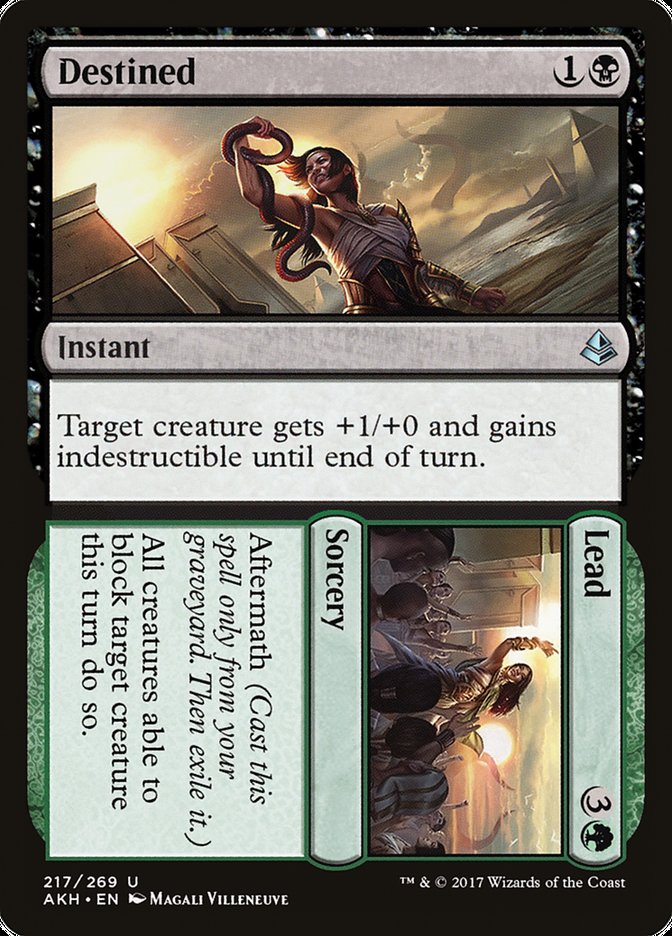
Destined // Lead is one of those cards players keep asking about. Here is, in plain words, what its official text says, the rulings published by Wizards of the Coast, and the combos players actually run.
Official card text
Target creature gets +1/+0 and gains indestructible until end of turn. Aftermath (Cast this spell only from your graveyard. Then exile it.) All creatures able to block target creature this turn do so.
Complete guide
Destined // Lead is a versatile split card from the Amonkhet block that utilizes the Aftermath mechanic to provide both protection and a strategic combat advantage. This two-part spell allows you to save a key creature in the early game and force your opponent's hand during a decisive attack later on.
Dual Roles and Aftermath
Destined // Lead consists of two distinct halves. Destined is an instant you cast from your hand to give a creature +1/+0 and indestructible. Lead is a sorcery with Aftermath, meaning you can only cast it from your graveyard by paying its mana cost. Once Lead resolves or leaves the stack, the card is exiled. While in your hand, library, or graveyard, the card has the combined characteristics of both halves, meaning it is a Black and Green card with a total mana value of 6.
Resolving the Combat Lure
When you cast Lead, you target a creature. During the next declare blockers step of that turn, every creature your opponent controls that is legally able to block that target must do so. Lead does not grant creatures the ability to block (such as Reach or the ability to block an additional creature); it simply mandates that if a block is possible, it must be performed. If a creature is tapped or has a cost associated with blocking, it is not forced to block.
Timing and Priority
If you cast Destined during your turn, you receive priority again immediately after it finishes resolving. Since Lead is a sorcery, you can cast it from your graveyard right away before your opponent can use an effect like a graveyard exile ability to remove it. However, if you cast Destined on an opponent's turn, you must wait until your next main phase when the stack is empty to cast Lead.
Common Misconceptions
A common mistake is miscalculating the mana value when the card is not on the stack. Effects that look for a specific mana value see the sum of both halves (6), not just the half you intend to cast. Additionally, remember that Lead only forces blockers that are 'able' to block. If your creature has Menace, your opponent must still block it with at least two creatures if they are able, but if they only have one creature, that creature isn't 'able' to block alone and won't be forced to.
Interaction examples
 Ad Nauseam
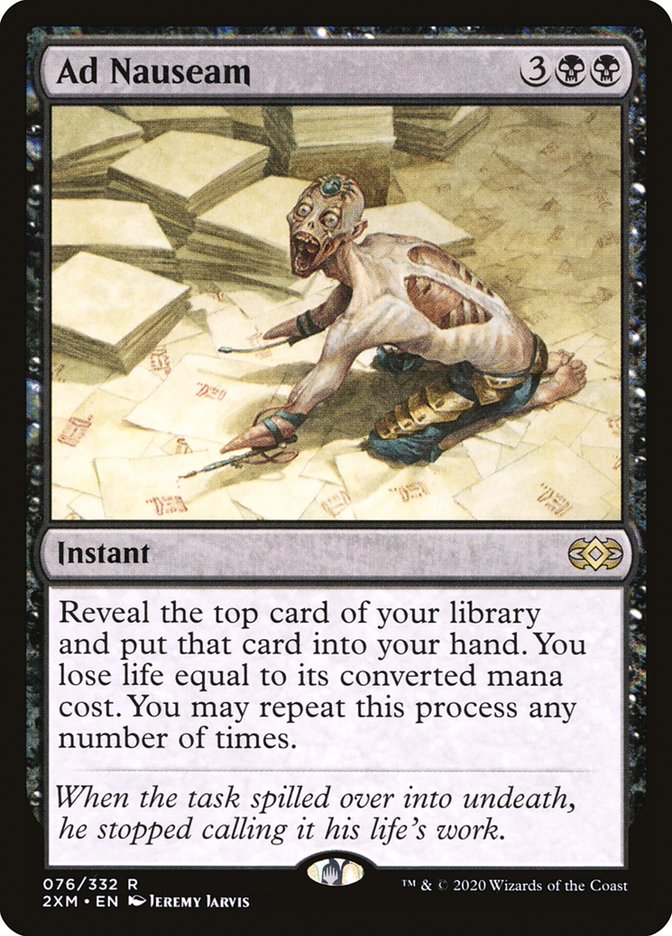
If you reveal Destined // Lead while resolving Ad Nauseam, you lose 6 life. Even though Destined costs 2 and Lead costs 4, the rules for split cards state that in all zones except the stack, the mana value is the combined total of both halves.
 Return of the Wildspeaker
Suppose you control a 5/5 non-Human creature. You cast Destined targeting it, making it a 6/5. You then cast Return of the Wildspeaker's first mode. Because Destined increased the creature's power, you will draw 6 cards instead of 5. Later, you can cast Lead from your graveyard to force a block, potentially clearing the way for your other attackers.
Guide written with AI from the official text and rulings. Official English text prevails.
How it works : Destined // Lead
Original English text — Wizards of the Coast / Scryfall
- #1· Wizards of the Coast
Once you've started to cast a spell with aftermath from your graveyard, the card is immediately moved to the stack. Opponents can't try to stop the ability by exiling the card with an effect such as that of Crook of Condemnation.
No other card is named in this ruling.
- #2· Wizards of the Coast
All split cards have two card faces on a single card, and you put a split card onto the stack with only the half you're casting. The characteristics of the half of the card you didn't cast are ignored while the spell is on the stack. For example, if an effect prevents you from casting green spells, you can cast Destined of Destined // Lead, but not Lead.
No other card is named in this ruling.
- #3· Wizards of the Coast
Each split card is a single card. For example, if you discard one, you've discarded one card, not two. If an effect counts the number of instant and sorcery cards in your graveyard, Destined // Lead counts once, not twice.
No other card is named in this ruling.
- #4· Wizards of the Coast
Each split card has two names. If an effect instructs you to choose a card name, you may choose one, but not both.
No other card is named in this ruling.
- #5· Wizards of the Coast
While not on the stack, the characteristics of a split card are the combination of its two halves. For example, Destined // Lead is a green and black card, it is both an instant card and a sorcery card, and its mana value is 6. This means that if an effect allows you to cast a card with mana value 2 from your hand, you can't cast Destined. This is a change from the previous rules for split cards.
No other card is named in this ruling.
- #6· Wizards of the Coast
If you cast the first half of a split card with aftermath during your turn, you'll have priority immediately after it resolves. You can cast the half with aftermath from your graveyard before any player can take any other action if it's legal for you to do so.
No other card is named in this ruling.
- #7· Wizards of the Coast
Split cards with aftermath have a new frame treatment—the half you can cast from your hand is oriented the same as other cards you'd cast from your hand, while the half you can cast from your graveyard is a traditional split card half. This frame treatment is for your convenience and has no rules significance.
No other card is named in this ruling.
- #8· Wizards of the Coast
If another effect allows you to cast a split card with aftermath from a graveyard, you may cast either half. If you cast the half that has aftermath, you'll exile the card if it would leave the stack.
No other card is named in this ruling.
- #9· Wizards of the Coast
A spell with aftermath cast from a graveyard will always be exiled afterward, whether it resolves, it's countered, or it leaves the stack in some other way.
No other card is named in this ruling.
- #10· Wizards of the Coast
Lead doesn't give any creatures the ability to block the target creature. It just forces those creatures that are already able to block the creature to do so.
No other card is named in this ruling.
- #11· Wizards of the Coast
As blockers are declared, any creature that's tapped or affected by a spell or ability that says it can't block doesn't block. If there's a cost associated with having the creature block, no player is forced to pay that cost, so it doesn't block if that cost isn't paid.
No other card is named in this ruling.
- #12· Wizards of the Coast
If another effect allows you to cast a split card with aftermath from any zone other than a graveyard, you can't cast the half with aftermath.
No other card is named in this ruling.
Legal formats
Commentaires
- Sois le premier à commenter cette carte.
Read next
Meta decks with Destined // Lead
No archived Top 8 deck with this card yet.