

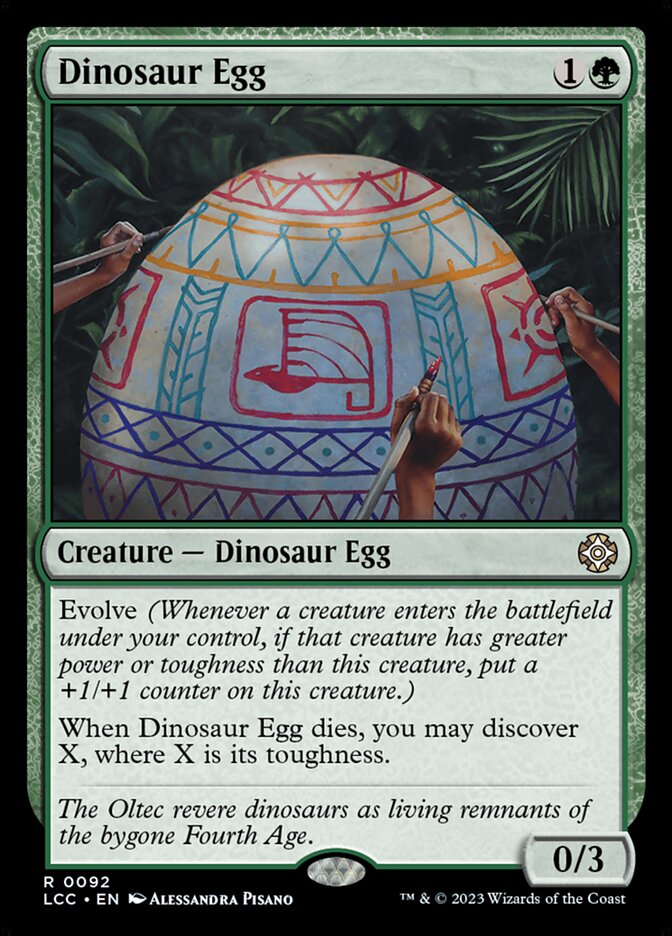
Dinosaur Egg is one of those cards players keep asking about. Here is, in plain words, what its official text says, the rulings published by Wizards of the Coast, and the combos players actually run.
Official card text
Evolve (Whenever a creature you control enters, if that creature has greater power or toughness than this creature, put a +1/+1 counter on this creature.) When this creature dies, you may discover X, where X is its toughness.
How it works : Dinosaur Egg
Original English text — Wizards of the Coast / Scryfall
- #1· Wizards of the Coast
When comparing the stats of the two creature for evolve, you always compare power to power and toughness to toughness.
No other card is named in this ruling.
- #2· Wizards of the Coast
Whenever a creature enters the battlefield under your control, check its power and toughness against the power and toughness of the creature with evolve. If neither stat of the new creature is greater, evolve won't trigger at all.
No other card is named in this ruling.
- #3· Wizards of the Coast
If evolve triggers, the stat comparison will happen again when the ability tries to resolve. If neither stat of the new creature is greater, the ability will do nothing. If the creature that entered the battlefield leaves the battlefield before evolve tries to resolve, use its last known power and toughness to compare the stats.
No other card is named in this ruling.
- #4· Wizards of the Coast
If multiple creatures enter the battlefield at the same time, evolve may trigger multiple times, although the stat comparison will take place each time one of those abilities tries to resolve. For example, if you control a 2/2 creature with evolve and two 3/3 creatures enter the battlefield, evolve will trigger twice. The first ability will resolve and put a +1/+1 counter on the creature with evolve. When the second ability tries to resolve, neither the power nor the toughness of the new creature is greater than that of the creature with evolve, so that ability does nothing.
No other card is named in this ruling.
- #5· Wizards of the Coast
Multiple instances of evolve trigger separately and, similar to above, the stat comparison takes place for each one independently as they try to resolve.
No other card is named in this ruling.
- #6· Wizards of the Coast
When comparing the stats as the evolve ability resolves, it's possible that the stat that's greater changes from power to toughness or vice versa. If this happens, the ability will still resolve and you'll put a +1/+1 counter on the creature with evolve. For example, if you control a 2/2 creature with evolve and a 1/3 creature enters the battlefield under your control, its toughness is greater so evolve will trigger. In response, the 1/3 creature gets +2/-2. When the evolve trigger tries to resolve, its power is greater. You'll put a +1/+1 counter on the creature with evolve.
No other card is named in this ruling.
- #7· Wizards of the Coast
A spell's mana value is determined only by its mana cost. Ignore any alternative costs, additional costs, cost increases, or cost reductions.
No other card is named in this ruling.
- #8· Wizards of the Coast
When you discover, you must exile cards. The only optional part of the ability is whether you cast the exiled card or put it into your hand.
No other card is named in this ruling.
- #9· Wizards of the Coast
You exile the cards face up. All players will be able to see them.
No other card is named in this ruling.
- #10· Wizards of the Coast
If you cast a spell "without paying its mana cost", you can't choose to cast it for any alternative costs. You can, however, pay additional costs. If the spell has any mandatory additional costs, you must pay those to cast it.
No other card is named in this ruling.
- #11· Wizards of the Coast
If the discovered card has
 in its mana cost, you must choose 0 as the value of X when casting it without paying its mana cost.
No other card is named in this ruling.
- #12· Wizards of the Coast
If you can't cast the discovered card (perhaps because there are no legal targets for the spell), you'll put it into your hand.
No other card is named in this ruling.
- #13· Wizards of the Coast
Some spells and abilities that cause you to discover may require targets. If each target chosen is an illegal target as that spell or ability tries to resolve, it won't resolve and you won't discover.
No other card is named in this ruling.
- #14· Wizards of the Coast
The mana value of a split card is determined by the combined mana cost of its two halves. If discover allows you to cast a split card, you may cast either half (as long as its mana value is less than or equal to the effect's discover value) but not both halves.
No other card is named in this ruling.
- #15· Wizards of the Coast
If you discover an adventurer card, split card, or modal double-faced card, you might be able to cast that card with either set of characteristics depending on the effect's discover value. For example, if you discover 4 and reveal Galvanic Giant (an adventurer card from Wilds of Eldraine with a mana value of 4), you could cast Galvanic Giant, but not Storm Reading (its Adventure, which has a mana value of 7). If you discover 7 and reveal Galvanic Giant, you could cast either Galvanic Giant or Storm Reading.
No other card is named in this ruling.
Interactions with other cards
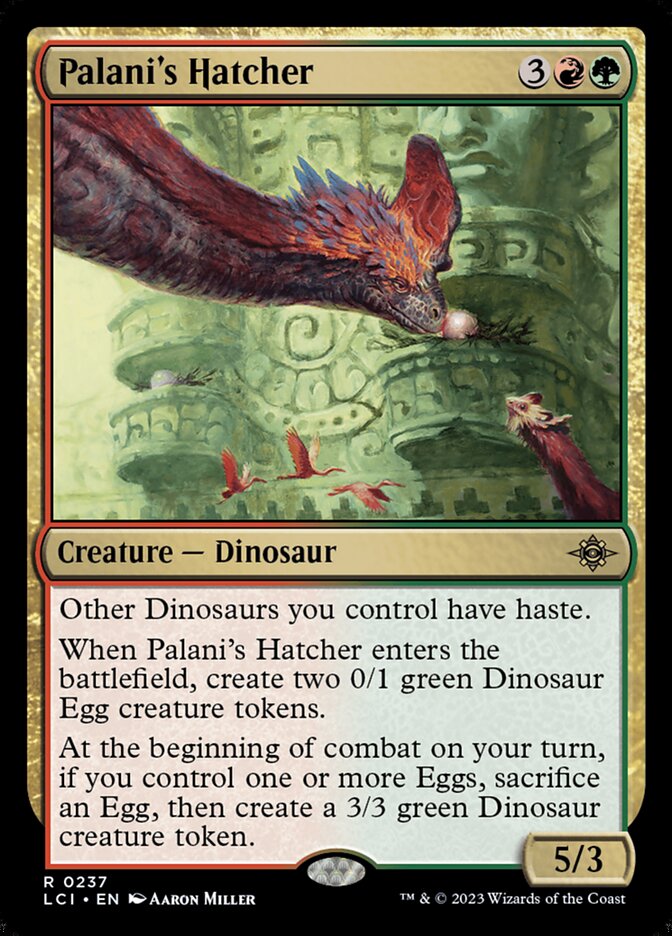
These cards' text mentions Dinosaur Egg.
Legal formats
Commentaires
- Sois le premier à commenter cette carte.
Read next

Meta decks with Dinosaur Egg
No archived Top 8 deck with this card yet.