


Disrupt Decorum is one of those cards players keep asking about. Here is, in plain words, what its official text says, the rulings published by Wizards of the Coast, and the combos players actually run.
Official card text
Goad all creatures you don't control. (Until your next turn, those creatures attack each combat if able and attack a player other than you if able.)
Complete guide
Looking to turn a crowded board state into a chaotic free-for-all? Disrupt Decorum is the ultimate social engineering tool in Magic, forcing your opponents to turn their armies against one another. This red sorcery ensures that for one full round of turns, you are the only safe person at the table.
What It Does
Disrupt Decorum applies the goad keyword to every creature you do not control at the moment the spell resolves. A goaded creature is under two requirements: it must attack each combat if able, and it must attack a player other than the player who cast Disrupt Decorum if able. This effect lasts until your next turn, meaning it persists even if the creature loses its abilities or changes controllers.
How It Resolves Step by Step
First, you cast the spell and it goes on the stack. Upon resolution, it checks every creature currently on the battlefield that you do not control and marks them as goaded. If a creature is tapped, has summoning sickness, or is affected by an effect saying it cannot attack, it is exempt from the requirement. If the creature can attack but cannot attack a player other than you (perhaps because all other players have protection), it must still attack a planeswalker or you if those are the only legal options.
Common Mistakes
A common error is assuming Disrupt Decorum affects creatures that enter the battlefield after the spell has finished resolving; it does not, as the set of affected creatures is determined only once. Another mistake involves costs: if an opponent has an effect like Ghostly Prison, the controller of a goaded creature is not forced to pay mana to attack. If they choose not to pay, the creature simply doesn't attack.
When to Play It
The best time to cast this is when your opponents have established large boards but haven't attacked yet. It is particularly effective during the mid-to-late game to force utility creatures or large blockers into unfavorable combat, clearing the way for your own future attacks while lowering the life totals of all your opponents.
Interaction examples
 Mana Geyser
On a turn where your opponents have many tapped lands, you cast Mana Geyser to generate a large pool of red mana. You spend four of that mana to cast Disrupt Decorum. This sequence allows you to force a massive board of creatures to attack each other while leaving your remaining mana open to cast further threats or protection spells.
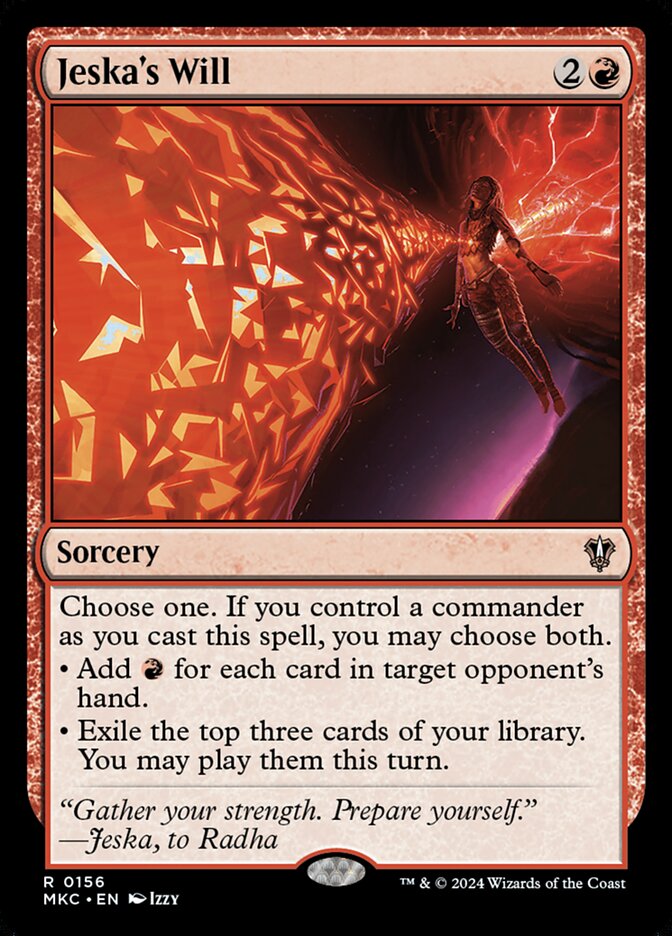 Jeska's Will
If you control your commander, you cast Jeska's Will choosing both modes. You target an opponent with a full hand to add a significant amount of red mana and exile the top three cards of your library. If Disrupt Decorum is among those three cards, you use the mana generated by Jeska's Will to cast it from exile. This allows you to goad the table without using any of the lands you started the turn with.
Guide written with AI from the official text and rulings. Official English text prevails.
How it works : Disrupt Decorum
Original English text — Wizards of the Coast / Scryfall
- #1· Wizards of the Coast
If, during a player's declare attackers step, a creature that player controls that's been goaded is tapped, is affected by a spell or ability that says it can't attack, or hasn't been under that player's control continuously since the turn began (and doesn't have haste), then it doesn't attack. If there's a cost associated with having a creature attack a player, its controller isn't forced to pay that cost, so it doesn't have to attack that player.
No other card is named in this ruling.
- #2· Wizards of the Coast
If the creature doesn't meet any of the above exceptions and can attack, it must attack a player other than the controller of the spell or ability that goaded it if able. If the creature can't attack any of those players but could otherwise attack, it must attack a planeswalker an opponent controls, a battle an opponent controls, or a player who goaded it.
No other card is named in this ruling.
- #3· Wizards of the Coast
Being goaded isn't an ability the creature has. Once it's been goaded, it must attack as detailed above even if it loses all abilities.
No other card is named in this ruling.
- #4· Wizards of the Coast
Attacking with a goaded creature doesn't cause it to stop being goaded. If there is an additional combat phase that turn, or if another player gains control of it before it stops being goaded, it must attack again if able.
No other card is named in this ruling.
- #5· Wizards of the Coast
If a creature you control has been goaded by multiple opponents, it must attack one of your opponents that hasn't goaded it, as that fulfills the maximum number of goad requirements. If a creature you control has been goaded by each of your opponents, the creature must attack an opponent (rather than a planeswalker or battle), but you choose which opponent it attacks.
No other card is named in this ruling.
- #6· Wizards of the Coast
Creatures that enter the battlefield after Disrupt Decorum resolves won't be goaded.
No other card is named in this ruling.
Legal formats
Commentaires
- Sois le premier à commenter cette carte.
Read next
Meta decks with Disrupt Decorum
No archived Top 8 deck with this card yet.