

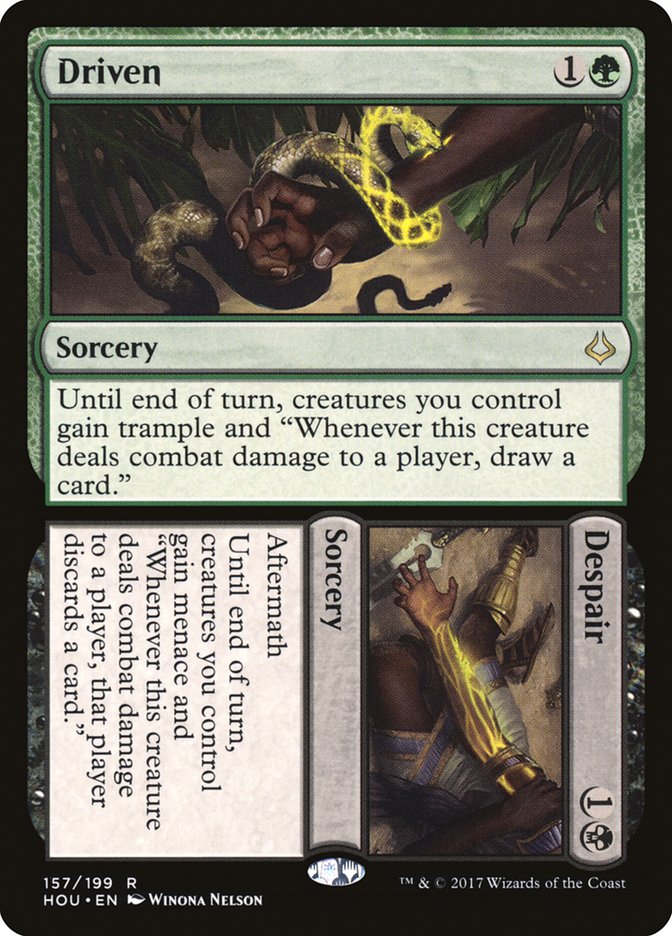
Driven // Despair is one of those cards players keep asking about. Here is, in plain words, what its official text says, the rulings published by Wizards of the Coast, and the combos players actually run.
Official card text
Until end of turn, creatures you control gain trample and "Whenever this creature deals combat damage to a player, draw a card." Aftermath (Cast this spell only from your graveyard. Then exile it.) Until end of turn, creatures you control gain menace and "Whenever this creature deals combat damage to a player, that player discards a card."
Complete guide
Driven // Despair is a powerful split card featuring the Aftermath mechanic, offering a dual-pronged approach to winning the game. By utilizing both its green and black halves, you can overwhelm your opponent's defenses with trample and menace while refilling your hand and emptying theirs.
Dual-Phase Dominance
Driven is cast from your hand for {1}{G}, granting your current creatures trample and a card-draw trigger upon dealing combat damage to a player. Despair is the Aftermath half, cast only from your graveyard for {1}{B}, which provides menace and a discard trigger. Because Aftermath cards move to the stack immediately when cast, your opponents cannot exile the card from your graveyard in response to you beginning to cast the second half.
Resolving the Effects
When either half resolves, it creates a continuous effect that modifies the characteristics of creatures you control at that exact moment. It is important to note that any creatures that enter the battlefield after the spell has resolved will not gain these bonuses. If you manage to resolve multiple copies of either half, the triggered abilities stack—meaning you could draw two cards or force two discards per creature—though the keyword abilities like trample and menace remain redundant.
Aftermath Timing and Rules
While in your graveyard, Driven // Despair has the combined characteristics of both halves, such as a total mana value of 4 and being both green and black. However, you can only cast Despair if the card is already in your graveyard. If you cast Driven from your hand, you receive priority again after it resolves, allowing you to cast Despair immediately before an opponent can use an effect like a graveyard exile ability to remove it.
Strategic Implementation
The best time to use this card is during your pre-combat main phase when you have a wide board of creatures ready to attack. Use Driven first to ensure your creatures can push damage through blockers via trample; once it is in the graveyard, cast Despair to make those creatures even harder to block with menace, ensuring the combat damage triggers successfully strip resources from your opponent's hand.
Interaction examples
 Cultivate
After using Cultivate to ensure you have the necessary green and black mana sources, you cast Driven during your main phase. Your creatures gain trample. You then immediately cast Despair from your graveyard. Your creatures now have trample, menace, and two separate triggers: one to draw a card and one to force a discard when they hit a player. The menace makes it difficult for opponents to block, while trample ensures that even if they do block with a single creature, the excess damage triggers your card draw.
 Kodama's Reach
While Driven // Despair is in your library, its mana value is 4 (the sum of both halves). If an effect allowed you to search for a card with mana value 2, you could not choose Driven // Despair. However, after using Kodama's Reach to fix your mana, you can easily pay for both halves in a single turn. Even if an opponent attempts to counter Despair, the card will still be exiled due to the Aftermath rule, which states the card is exiled regardless of whether the spell resolves or leaves the stack in another way.
Guide written with AI from the official text and rulings. Official English text prevails.
How it works : Driven // Despair
Original English text — Wizards of the Coast / Scryfall
- #1· Wizards of the Coast
If you resolve multiples of Driven or of Despair in one turn, your creatures have that many instances of the appropriate triggered ability. Each instance triggers separately.
No other card is named in this ruling.
- #2· Wizards of the Coast
Multiple instances of trample or menace are redundant.
No other card is named in this ruling.
- #3· Wizards of the Coast
Driven and Despair each affect only creatures you control at the time it resolves. Creatures you begin to control later in the turn won't gain the keyword ability or the triggered ability.
No other card is named in this ruling.
- #4· Wizards of the Coast
Once you've started to cast a spell with aftermath from your graveyard, the card is immediately moved to the stack. Opponents can't try to stop the ability by exiling the card with an effect such as that of Crook of Condemnation.
No other card is named in this ruling.
- #5· Wizards of the Coast
While not on the stack, the characteristics of a split card are the combination of its two halves. For example, Destined // Lead is a green and black card, it is both an instant card and a sorcery card, and its mana value is 6. This means that if an effect allows you to cast a card with mana value 2 from your hand, you can't cast Destined. This is a change from the previous rules for split cards.
No other card is named in this ruling.
- #6· Wizards of the Coast
If you cast the first half of a split card with aftermath during your turn, you'll have priority immediately after it resolves. You can cast the half with aftermath from your graveyard before any player can take any other action if it's legal for you to do so.
No other card is named in this ruling.
- #7· Wizards of the Coast
Split cards with aftermath have a new frame treatment—the half you can cast from your hand is oriented the same as other cards you'd cast from your hand, while the half you can cast from your graveyard is a traditional split card half. This frame treatment is for your convenience and has no rules significance.
No other card is named in this ruling.
- #8· Wizards of the Coast
If another effect allows you to cast a split card with aftermath from a graveyard, you may cast either half. If you cast the half that has aftermath, you'll exile the card if it would leave the stack.
No other card is named in this ruling.
- #9· Wizards of the Coast
A spell with aftermath cast from a graveyard will always be exiled afterward, whether it resolves, it's countered, or it leaves the stack in some other way.
No other card is named in this ruling.
- #10· Wizards of the Coast
If another effect allows you to cast a split card with aftermath from any zone other than a graveyard, you can't cast the half with aftermath.
No other card is named in this ruling.
- #11· Wizards of the Coast
All split cards have two card faces on a single card, and you put a split card onto the stack with only the half you're casting. The characteristics of the half of the card you didn't cast are ignored while the spell is on the stack. For example, if an effect prevents you from casting green spells, you can cast Destined of Destined // Lead, but not Lead.
No other card is named in this ruling.
- #12· Wizards of the Coast
Each split card is a single card. For example, if you discard one, you've discarded one card, not two. If an effect counts the number of instant and sorcery cards in your graveyard, Destined // Lead counts once, not twice.
No other card is named in this ruling.
- #13· Wizards of the Coast
Each split card has two names. If an effect instructs you to choose a card name, you may choose one, but not both.
No other card is named in this ruling.
Legal formats
Commentaires
- Sois le premier à commenter cette carte.
Read next
Meta decks with Driven // Despair
No archived Top 8 deck with this card yet.