

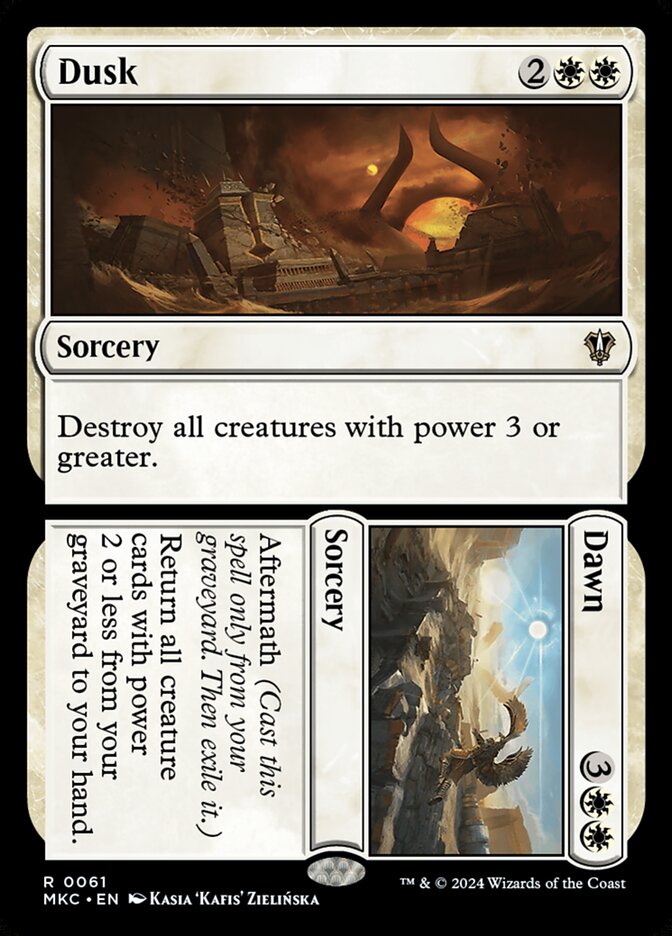
Dusk // Dawn is one of those cards players keep asking about. Here is, in plain words, what its official text says, the rulings published by Wizards of the Coast, and the combos players actually run.
Official card text
Destroy all creatures with power 3 or greater. Aftermath (Cast this spell only from your graveyard. Then exile it.) Return all creature cards with power 2 or less from your graveyard to your hand.
Complete guide
Dusk // Dawn is a powerful split card featuring the aftermath mechanic, allowing you to sweep the board and later recover your resources. This sorcery serves as a selective board wipe that favors small-creature strategies while punishing heavy hitters. Understanding how its two halves interact with the stack and graveyard is key to maximizing its value.
What It Does
The first half, Dusk, is a four-mana sorcery that destroys all creatures with power 3 or greater. The second half, Dawn, has aftermath, meaning it can only be cast from your graveyard. Dawn returns all creature cards with power 2 or less from your graveyard to your hand, then the card is exiled. While in your hand or graveyard, the card has the combined characteristics of both halves, including a total mana value of 9.
How It Resolves Step by Step
When you cast Dusk, it goes to the stack and checks the power of all creatures currently on the battlefield. Upon resolution, every creature with power 3 or greater is destroyed and placed in the graveyard. Once Dusk is in your graveyard, you may cast Dawn by paying its aftermath cost. When Dawn resolves, it checks the power of creature cards in your graveyard; those with power 2 or less return to your hand, and the card is then exiled.
Common Mistakes
A common error is trying to cast Dawn from your hand; the aftermath keyword strictly limits casting that half to the graveyard zone unless another effect specifically overrides this. Also, remember that while the card is in your graveyard, its mana value is 9. However, once you cast one half, only that half exists on the stack. If an opponent wants to exile Dusk // Dawn from your graveyard, they must do so before you announce you are casting Dawn, as the card moves to the stack immediately once the casting process begins.
When to Play It
Dusk is ideal when your opponent has a board of large threats while you are playing 'Weenie' or utility creatures with low power. Dawn is best saved for the late game after your small creatures have been traded in combat or destroyed by other effects. Because it returns cards to your hand rather than the battlefield, it is a great tool for rebuilding after a full board wipe.
Interaction examples
 Vanquish the Horde
If the battlefield is cluttered with many creatures, Vanquish the Horde might be cheaper to cast to destroy everything. However, if you have a board of 1/1 tokens and your opponent has several 4/4 Dragons, casting Dusk allows you to keep your army while destroying theirs. Unlike Vanquish the Horde, Dusk leaves your small utility creatures untouched.
 Organic Extinction
In an artifact-heavy deck, Organic Extinction might be your primary wipe to save your artifact creatures. If your nonartifact utility creatures (like mana dorks with power 1) are destroyed by Organic Extinction, you can later cast Dawn from your graveyard to return those specific low-power creatures to your hand, providing a recursive engine that Organic Extinction lacks on its own.
Guide written with AI from the official text and rulings. Official English text prevails.
How it works : Dusk // Dawn
Original English text — Wizards of the Coast / Scryfall
- #1· Wizards of the Coast
Once you've started to cast a spell with aftermath from your graveyard, the card is immediately moved to the stack. Opponents can't try to stop the ability by exiling the card with an effect such as that of Crook of Condemnation.
No other card is named in this ruling.
- #2· Wizards of the Coast
All split cards have two card faces on a single card, and you put a split card onto the stack with only the half you're casting. The characteristics of the half of the card you didn't cast are ignored while the spell is on the stack. For example, if an effect prevents you from casting green spells, you can cast Destined of Destined // Lead, but not Lead.
No other card is named in this ruling.
- #3· Wizards of the Coast
Each split card is a single card. For example, if you discard one, you've discarded one card, not two. If an effect counts the number of instant and sorcery cards in your graveyard, Destined // Lead counts once, not twice.
No other card is named in this ruling.
- #4· Wizards of the Coast
Each split card has two names. If an effect instructs you to choose a card name, you may choose one, but not both.
No other card is named in this ruling.
- #5· Wizards of the Coast
While not on the stack, the characteristics of a split card are the combination of its two halves. For example, Destined // Lead is a green and black card, it is both an instant card and a sorcery card, and its mana value is 6. This means that if an effect allows you to cast a card with mana value 2 from your hand, you can't cast Destined. This is a change from the previous rules for split cards.
No other card is named in this ruling.
- #6· Wizards of the Coast
Split cards with aftermath have a new frame treatment—the half you can cast from your hand is oriented the same as other cards you'd cast from your hand, while the half you can cast from your graveyard is a traditional split card half. This frame treatment is for your convenience and has no rules significance.
No other card is named in this ruling.
- #7· Wizards of the Coast
If another effect allows you to cast a split card with aftermath from any zone other than a graveyard, you can't cast the half with aftermath.
No other card is named in this ruling.
- #8· Wizards of the Coast
If another effect allows you to cast a split card with aftermath from a graveyard, you may cast either half. If you cast the half that has aftermath, you'll exile the card if it would leave the stack.
No other card is named in this ruling.
- #9· Wizards of the Coast
A spell with aftermath cast from a graveyard will always be exiled afterward, whether it resolves, it's countered, or it leaves the stack in some other way.
No other card is named in this ruling.
- #10· Wizards of the Coast
If you cast the first half of a split card with aftermath during your turn, you'll have priority immediately after it resolves. You can cast the half with aftermath from your graveyard before any player can take any other action if it's legal for you to do so.
No other card is named in this ruling.
Legal formats
Commentaires
- Sois le premier à commenter cette carte.
Read next
Meta decks with Dusk // Dawn
No archived Top 8 deck with this card yet.