

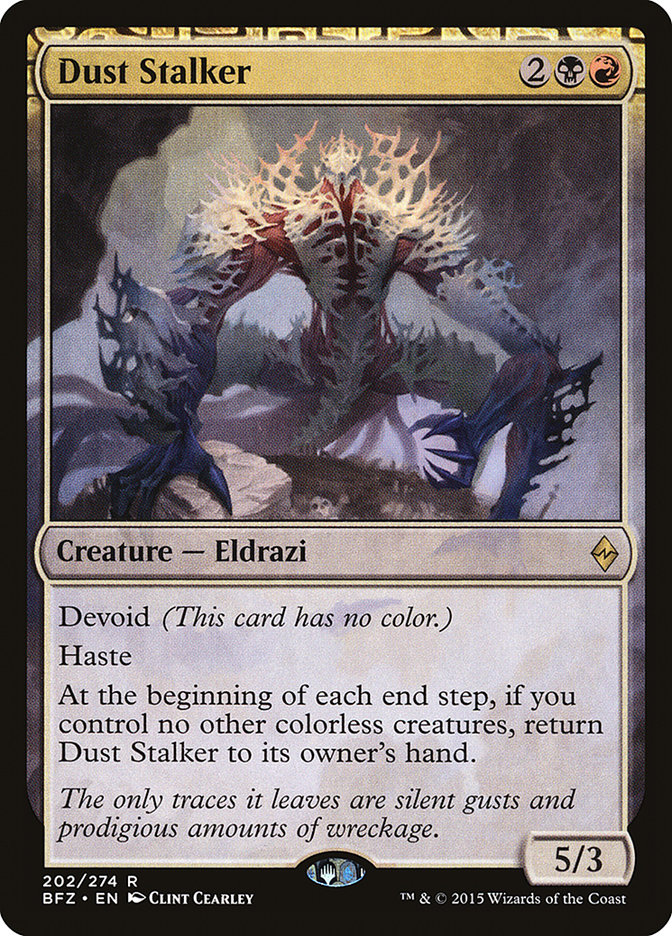
Dust Stalker is one of those cards players keep asking about. Here is, in plain words, what its official text says, the rulings published by Wizards of the Coast, and the combos players actually run.
Official card text
Devoid (This card has no color.) Haste At the beginning of each end step, if you control no other colorless creatures, return this creature to its owner's hand.
Complete guide
Dust Stalker is a fast, aggressive Eldrazi that brings immediate pressure to the battlefield thanks to Haste. However, its efficiency comes with a unique downside that requires a careful board state to manage. To keep this creature in the fight, you will need to master the timing of its end-step trigger and the company it keeps.
What Dust Stalker Does
Dust Stalker is a 5/3 Eldrazi creature with Devoid, meaning it is colorless in every zone, regardless of the mana used to cast it. It features Haste, allowing it to attack the turn it arrives. Its most critical feature is a conditional triggered ability: at the beginning of each end step, if you do not control another colorless creature, Dust Stalker returns to your hand.
Resolving the End Step Trigger
The return-to-hand ability uses an 'intervening if' clause. This means the game checks if you control another colorless creature at two specific times: exactly when the end step begins, and again when the ability tries to resolve. If you control another colorless creature when the end step starts, the ability never even goes on the stack. If you don't, but somehow gain a colorless creature while the ability is waiting to resolve, Dust Stalker stays on the battlefield.
Common Mistakes
A frequent error is assuming Dust Stalker's own colorless status counts for its requirement; the ability explicitly looks for 'another' colorless creature. Additionally, remember that Devoid is not a characteristic-defining ability that can be easily stripped away to make it colored. Even if Dust Stalker loses the Devoid ability, it remains colorless because color-setting effects are processed before abilities are lost.
When to Play It
Dust Stalker is best utilized in aggressive decks that already feature artifact creatures or other Eldrazi. Because it returns to your hand if left alone, it can be used to dodge board wipes that occur during an opponent's turn, provided you have the mana to recast it. It is a powerful tool for constant pressure if you can maintain a colorless board presence.
Interaction examples
 Solemn Simulacrum
You have Solemn Simulacrum on the battlefield and cast Dust Stalker. When the end step begins, the game checks if you control another colorless creature. Since Solemn Simulacrum is an artifact creature (and therefore colorless), the 'if' condition for Dust Stalker's ability is not met. The ability does not trigger, and Dust Stalker remains on the battlefield.
 Roaming Throne
If you control Roaming Throne with 'Eldrazi' chosen as the type, it is a colorless creature. This prevents Dust Stalker's ability from triggering. However, if Roaming Throne is removed before the end step and you control no other colorless creatures, Dust Stalker's ability will trigger. Because Roaming Throne is an Eldrazi, it would normally cause the trigger to happen twice, but since the first resolution returns Dust Stalker to your hand, the second trigger will do nothing as the creature is no longer on the battlefield.
Guide written with AI from the official text and rulings. Official English text prevails.
How it works : Dust Stalker
Original English text — Wizards of the Coast / Scryfall
- #1· Wizards of the Coast
Dust Stalker’s last ability checks to see if you control another colorless creature as the end step begins. If you do, the ability won’t trigger. If you don’t, the ability will check again as it tries to resolve. If you somehow control another colorless creature at that time, the ability won’t do anything. You won’t return Dust Stalker to its owner’s hand.
No other card is named in this ruling.
- #2· Wizards of the Coast
Dust Stalker’s last ability doesn’t depend on Dust Stalker being colorless. If it gains one or more colors, the ability will still look for another creature you control that’s colorless.
No other card is named in this ruling.
- #3· Wizards of the Coast
Like most abilities, Dust Stalker’s last ability functions only while Dust Stalker is on the battlefield.
No other card is named in this ruling.
- #4· Wizards of the Coast
Cards with devoid use frames that are variations of the transparent frame traditionally used for Eldrazi. The top part of the card features some color over a background based on the texture of the hedrons that once imprisoned the Eldrazi. This coloration is intended to aid deckbuilding and game play.
No other card is named in this ruling.
- #5· Wizards of the Coast
A card with devoid is just colorless. It’s not colorless and the colors of mana in its mana cost.
No other card is named in this ruling.
- #6· Wizards of the Coast
Other cards and abilities can give a card with devoid color. If that happens, it’s just the new color, not that color and colorless.
No other card is named in this ruling.
- #7· Wizards of the Coast
Devoid works in all zones, not just on the battlefield.
No other card is named in this ruling.
- #8· Wizards of the Coast
If a card loses devoid, it will still be colorless. This is because effects that change an object’s color (like the one created by devoid) are considered before the object loses devoid.
No other card is named in this ruling.
Legal formats
Commentaires
- Sois le premier à commenter cette carte.
Read next
Meta decks with Dust Stalker
No archived Top 8 deck with this card yet.