

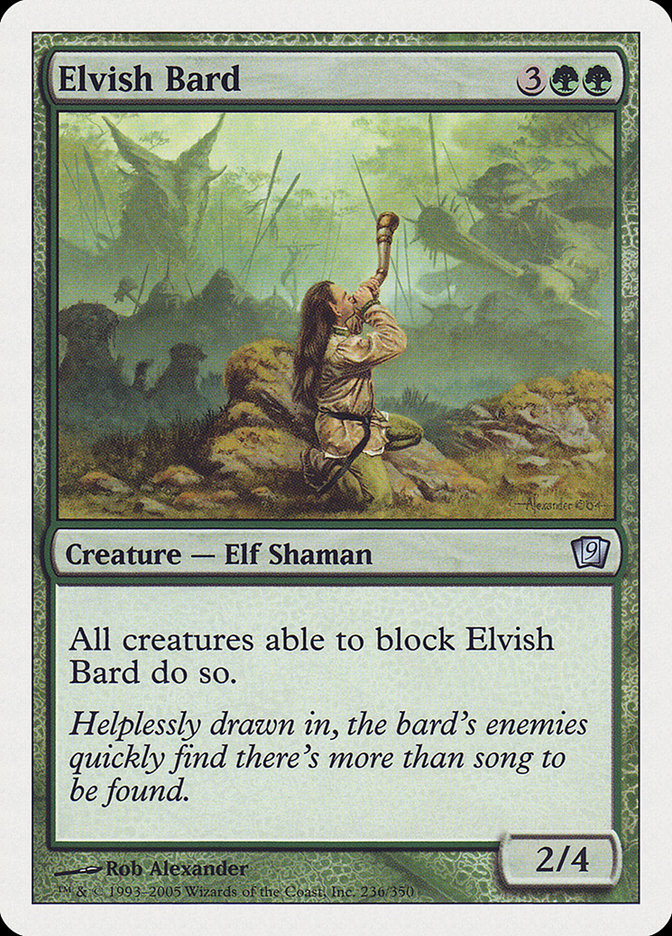
Elvish Bard is one of those cards players keep asking about. Here is, in plain words, what its official text says, the rulings published by Wizards of the Coast, and the combos players actually run.
Official card text
All creatures able to block this creature do so.
Complete guide
Elvish Bard is a classic green creature that acts as a magnetic force on the battlefield, demanding the attention of every enemy combatant. By forcing opponents to commit their entire defense to one blocker, it clears the way for your other attackers to strike unhindered. This Elf Shaman Bard turns combat into a strategic sacrifice that can end games in a single swing.
The Magnetic Lure
The core ability of Elvish Bard is a requirement that affects how your opponent declares blockers. While most creatures can be ignored during combat, Elvish Bard states that all creatures able to block it must do so. This doesn't mean your opponent is forced to untap their creatures or pay costs to block, but if a creature is legally able to be declared as a blocker for the Bard, it cannot be assigned to block anything else or sit the combat out.
Step-by-Step Resolution
When you enter the Declare Blockers step, the defending player must check which of their creatures can legally block Elvish Bard. They must satisfy as many requirements as possible without violating any restrictions. If they have three creatures that are untapped and have no 'can't block' restrictions, all three must be assigned to block Elvish Bard simultaneously. Once these requirements are met, the Bard will deal its damage to the blockers (ordered by the attacker), and the blockers deal their damage to the Bard.
Legality and Evasion
A common mistake is assuming this card forces a block regardless of other effects. If Elvish Bard gains flying and the opponent only has ground creatures, those creatures are not 'able' to block, so the requirement does nothing. Similarly, if an effect says a creature 'can't block this turn,' that creature is exempt. The Bard only compels creatures that currently have a legal path to intercepting it.
When to Perform
Play Elvish Bard when you have a wide board of other high-power creatures. Since the Bard absorbs every possible blocker, your other creatures will go unblocked, dealing their damage directly to the opponent's life total. It is less about the Bard surviving combat and more about it being the ultimate distraction for your army.
Interaction examples
 Solemn Simulacrum
If you attack with both Elvish Bard and Solemn Simulacrum, and your opponent has two untapped creatures, they are required to block Elvish Bard with both. Because they must satisfy the Bard's requirement first, no creatures are left 'able' to block the Solemn Simulacrum, allowing the Golem to deal its 2 damage directly to the opponent.
 Roaming Throne
If you play Roaming Throne and choose 'Elf' or 'Shaman', note that Elvish Bard has a static ability, not a triggered one (it doesn't start with 'When', 'Whenever', or 'At'). Therefore, Roaming Throne does not cause the ability to happen twice. However, as an artifact creature, Roaming Throne is still subject to the Bard's effect if an opponent controls it; if you attack with the Bard, their Roaming Throne must block it if able.
Guide written with AI from the official text and rulings. Official English text prevails.
How it works : Elvish Bard
Original English text — Wizards of the Coast / Scryfall
No additional ruling has been published for this card.
Legal formats
Commentaires
- Sois le premier à commenter cette carte.
Read next
Meta decks with Elvish Bard
No archived Top 8 deck with this card yet.