


Fracture is one of those cards players keep asking about. Here is, in plain words, what its official text says, the rulings published by Wizards of the Coast, and the combos players actually run.
Official card text
Destroy target artifact, enchantment, or planeswalker.
Complete guide
Fracture is a highly efficient removal spell that targets three of the most impactful permanent types in Magic: The Gathering. For just two mana, it offers Orzhov players a versatile answer to non-creature threats that can otherwise dominate a game. Understanding its limitations and timing is key to mastering its defensive utility.
What Fracture Does
Fracture is a targeted destruction spell. It specifically targets one artifact, enchantment, or planeswalker. Unlike some other Orzhov removal spells, it cannot target creatures or lands. Because it says "destroy," the targeted permanent is moved from the battlefield to its owner's graveyard. Note that if a permanent has indestructible, Fracture will resolve but fail to destroy it.
Step-by-Step Resolution
First, you cast Fracture by paying one white and one black mana and choosing a legal target. Second, the spell is put onto the stack and players may respond. Third, if the target is still legal upon resolution, the permanent is destroyed. If the target has become illegal (for example, by gaining hexproof or leaving the battlefield), Fracture is removed from the stack and does nothing.
Common Mistakes
The most common error is attempting to target a creature. Even if a creature has an artifact or enchantment subtype (like an Artifact Creature), it is still a creature, and Fracture can target it because it is an artifact. However, a standard creature with no other types is an illegal target. Another mistake is forgetting that Fracture destroys rather than exiles; cards with recursion or 'dies' triggers will still function normally.
When to Play It
Since Fracture is an instant, it is best used at the end of an opponent's turn or in response to a specific ability. For planeswalkers, you can cast it in response to them activating an ability, though the ability will still resolve. Against artifacts and enchantments, it is often best to wait until the permanent is about to provide a benefit to your opponent.
Interaction examples
 Swords to Plowshares
If your opponent controls both a powerful creature and a dangerous enchantment, you cannot use Fracture on the creature. You would use Swords to Plowshares to exile the creature and save Fracture for the enchantment, as Swords to Plowshares cannot hit non-creature permanents.
 Path to Exile
Imagine your opponent has a Planeswalker and a creature. While Path to Exile is excellent for removing the creature at the cost of giving the opponent a land, it cannot touch the Planeswalker. You use Fracture to destroy the Planeswalker directly, ensuring you have answers for multiple card types across your hand.
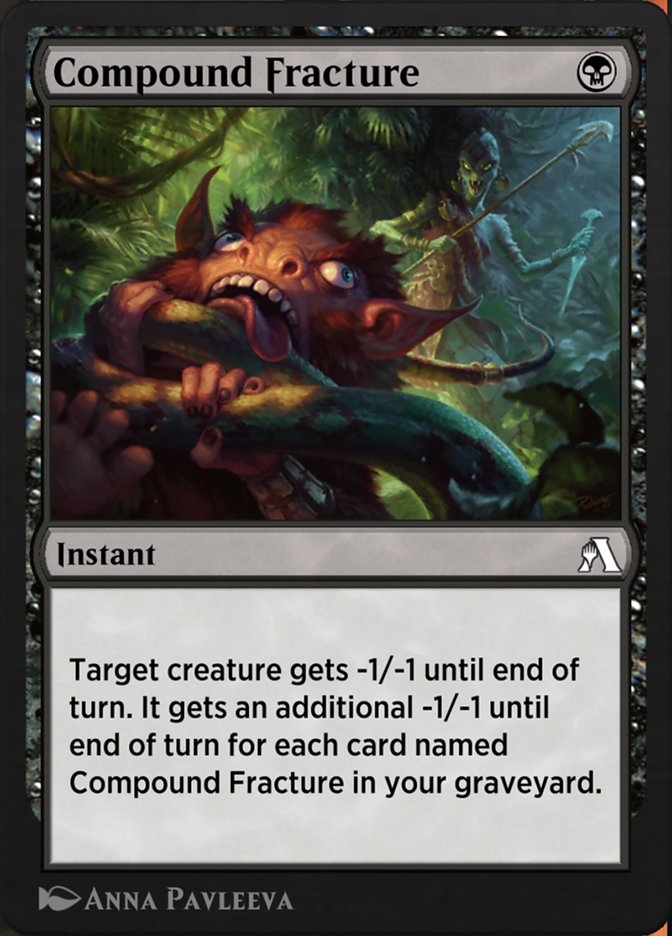 Compound Fracture
If you cast Fracture to destroy an opponent's artifact, it goes to your graveyard upon resolution. While Fracture itself doesn't boost Compound Fracture (which only counts other cards named Compound Fracture), using Fracture to clear the way of blockers or utility artifacts ensures your creature-debuffing spells like Compound Fracture are used effectively on the remaining threats.
Guide written with AI from the official text and rulings. Official English text prevails.
How it works : Fracture
Original English text — Wizards of the Coast / Scryfall
No additional ruling has been published for this card.
Interactions with other cards
These cards' text mentions Fracture.
Legal formats
Commentaires
- Sois le premier à commenter cette carte.
Read next
Meta decks with Fracture
No archived Top 8 deck with this card yet.