

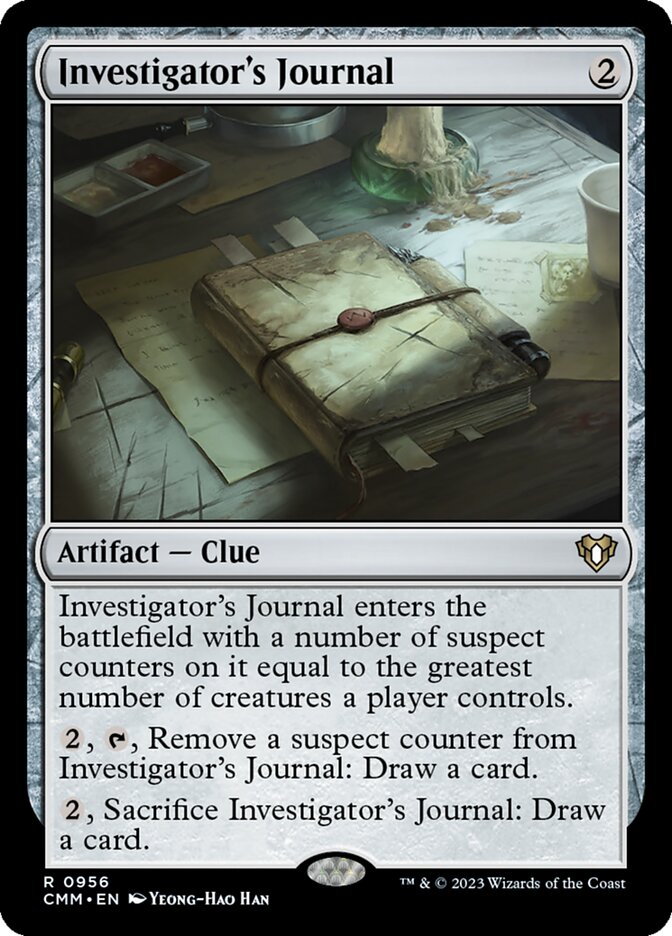
Investigator's Journal is one of those cards players keep asking about. Here is, in plain words, what its official text says, the rulings published by Wizards of the Coast, and the combos players actually run.
Official card text
This artifact enters with a number of suspect counters on it equal to the greatest number of creatures a player controls.,
, Remove a suspect counter from this artifact: Draw a card.
Complete guide
Investigator's Journal is a versatile artifact that rewards you for playing against wide boards while providing consistent card advantage. As a Clue, it offers multiple ways to keep your hand full throughout the game. This book is the perfect tool for any player looking to turn an opponent's numerical advantage into their own strategic resource.
A Wealth of Evidence
When Investigator's Journal enters the battlefield, it checks the number of creatures controlled by each player. It gains a number of suspect counters equal to the highest count found among all players, including yourself. Once on the field, you can spend two mana, tap it, and remove a counter to draw a card. If the journal has served its purpose or you are out of counters, you can also sacrifice it using its Clue ability to draw one last card.
Resolving the Entry Effect
The first ability is a replacement effect that happens as the Journal enters the battlefield. You do not choose a specific opponent; the game simply looks at the board state and identifies the player with the most creatures. For example, if you have two creatures, Opponent A has zero, and Opponent B has five, the Journal enters with five suspect counters. Because this happens as it enters, players cannot respond to the choice of how many counters it gets once the spell begins to resolve.
Timing and Strategy
Common mistakes involve forgetting that the Journal is also a Clue. Even if it enters with zero suspect counters (because no one controls any creatures), you can still pay two mana and sacrifice it immediately to draw a card. However, the most efficient use is to wait for a board stall where a player has many creatures, allowing you to draw multiple cards over several turns for a low activation cost.
Interaction examples
 Sol Ring
If you have a Sol Ring on the battlefield, you can use its ability to add two colorless mana, which perfectly covers the cost to activate the Journal's ability. By tapping the Ring and the Journal while removing a suspect counter, you effectively draw a card without spending any colored mana from your lands.
 Arcane Signet
In a Commander game, you might use Arcane Signet to produce the mana needed to cast Investigator's Journal early. If an opponent later builds a large army of tokens, the Journal will enter with many counters, and you can use the mana from the Signet to help pay for the repeated card draw activations every turn.
Guide written with AI from the official text and rulings. Official English text prevails.
How it works : Investigator's Journal
Original English text — Wizards of the Coast / Scryfall
- #1· Wizards of the Coast
You don't choose an opponent to determine how many suspect counters are placed on Investigator's Journal as it enters the battlefield. You always use the greatest number possible.
No other card is named in this ruling.
Legal formats
Commentaires
- Sois le premier à commenter cette carte.
Read next
Meta decks with Investigator's Journal
No archived Top 8 deck with this card yet.