
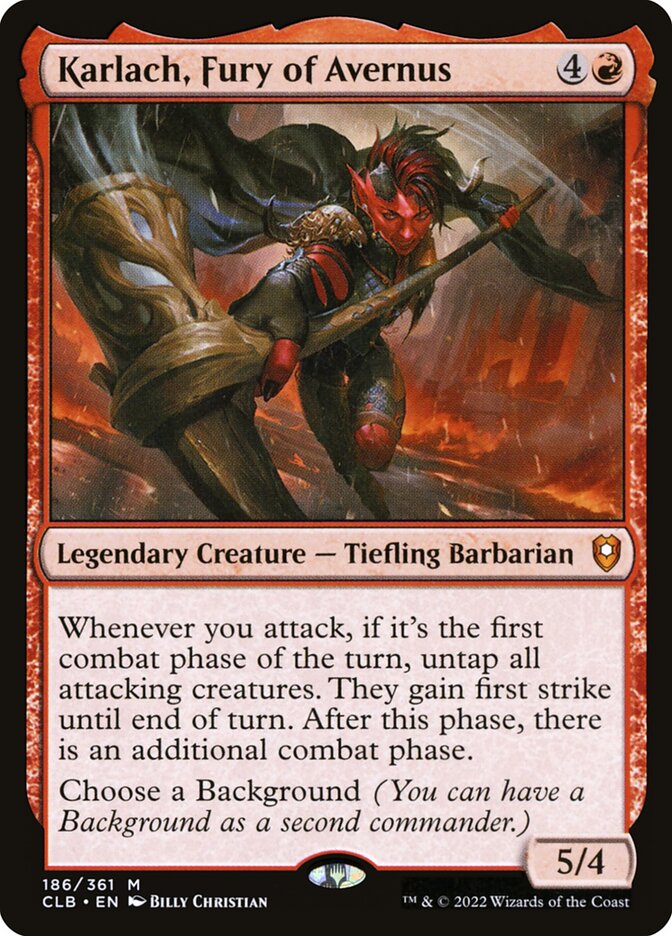
Karlach, Fury of Avernus is one of those cards players keep asking about. Here is, in plain words, what its official text says, the rulings published by Wizards of the Coast, and the combos players actually run.
Official card text
Whenever you attack, if it's the first combat phase of the turn, untap all attacking creatures. They gain first strike until end of turn. After this phase, there is an additional combat phase. Choose a Background (You can have a Background as a second commander.)
Complete guide
Karlach, Fury of Avernus is a powerhouse Tiefling Barbarian that turns every first attack into a relentless double-strike of turns. By untapping your forces and granting them First Strike, she ensures your army is ready for a second wave of carnage. Whether she is leading the charge or shouting orders from the sidelines, Karlach is a master of sustained aggression.
Unpacking the Fury
Karlach's primary ability triggers whenever you declare attackers, provided it is the first combat phase of the turn. It performs three distinct actions: it untaps every creature currently attacking, grants them First Strike until the end of the turn, and schedules an additional combat phase to occur immediately after the current one. Note that Karlach herself does not need to be attacking for this to trigger; she simply needs to be on the battlefield when you declare your attackers.
The Step-by-Step Resolution
When you enter your first combat phase and declare one or more attackers, Karlach's ability goes on the stack. Once it resolves, all your attacking creatures untap and gain First Strike. You then proceed to the Combat Damage step. Crucially, after the current combat phase ends, you do not move to your second main phase. Instead, you move directly into the Beginning of Combat step of your additional combat phase. Because your creatures were untapped by the previous trigger, they are ready to be declared as attackers once again.
Common Pitfalls
A common mistake is assuming you get an extra main phase to cast sorcery-speed spells between the two combats. Karlach's ability does not grant an additional main phase, so you move straight from the end of the first combat to the start of the second. Additionally, remember that the untap happens during the first combat. If you gain another combat phase later via a different card, Karlach will not trigger again because it is no longer the 'first combat phase' of the turn.
When to Play Karlach
Karlach is best deployed when you have a board full of creatures that benefit from attacking twice or have 'whenever this creature attacks' abilities. Since she provides First Strike, she makes it difficult for opponents to block effectively in the first round, often leaving them with a depleted board for your second strike. Her 'Choose a Background' ability also allows her to be a versatile Commander, pairing with various enchantments to add a second color or powerful passive buffs.
Interaction examples
 Roaming Throne
If you control Roaming Throne and chose 'Tiefling' or 'Barbarian' as it entered, Karlach's ability triggers twice during your first combat. Each trigger will resolve, untapping your creatures and granting First Strike. More importantly, each trigger adds an additional combat phase. This results in a total of three combat phases for the turn, though the untap only occurs during the first one, so you will need another way to untap for the third combat!
 Solemn Simulacrum
When you attack with Solemn Simulacrum while Karlach is on the battlefield, the Golem is untapped by Karlach's ability and gains First Strike. After the first combat damage is dealt, you immediately enter a second combat phase where Solemn Simulacrum can attack again. This is a great way to use utility creatures for chip damage without leaving yourself defenseless, as they remain untapped after the first swing.
Guide written with AI from the official text and rulings. Official English text prevails.
How it works : Karlach, Fury of Avernus
Original English text — Wizards of the Coast / Scryfall
- #1· Wizards of the Coast
Notably, the triggered ability of Karlach doesn't give you any additional main phases. This means that you will move directly from the end of combat step of one combat phase to the beginning of combat step of the next one.
No other card is named in this ruling.
- #2· Wizards of the Coast
Karlach doesn't have to be among the attacking creatures.
No other card is named in this ruling.
- #3· Wizards of the Coast
Choose a Background is a variant of the partner ability. You may have two commanders if one of them is a legendary creature with the choose a background ability and the other is a legendary Background enchantment. Backgrounds and cards with choose a Background do not interact with cards which have any other partner ability.
No other card is named in this ruling.
- #4· Wizards of the Coast
If your Commander deck has two commanders, you can include only cards whose own color identities are also found in your commanders’ combined color identities.
No other card is named in this ruling.
- #5· Wizards of the Coast
Both commanders start in the command zone, and the remaining 98 cards (or 58 cards in a Commander Draft game) of your deck are shuffled to become your library.
No other card is named in this ruling.
- #6· Wizards of the Coast
If your commander loses the choose a Background ability or stops being a Background during the game, as appropriate, it is still your commander.
No other card is named in this ruling.
- #7· Wizards of the Coast
Once the game begins, your two commanders are tracked separately. If you cast one, you won’t have to pay an additional
 the first time you cast the other. A player loses the game after having been dealt 21 combat damage from any one of them, not from both of them combined (although your Background won’t usually be a creature anyway).
No other card is named in this ruling.
- #8· Wizards of the Coast
If something refers to your commander while you have two commanders, it refers to one of them of your choice. If you are instructed to perform an action on your commander (e.g. put it from the command zone into your hand due to Command Beacon), you choose one of your commanders at the time the effect happens.
No other card is named in this ruling.
- #9· Wizards of the Coast
An effect that checks whether you control your commander is satisfied if you control one or both of your two commanders.
No other card is named in this ruling.
- #10· Wizards of the Coast
You can choose two commanders that are the same color or colors.
No other card is named in this ruling.
- #11· Wizards of the Coast
If a card refers to a commander creature you own, a Background won't usually be counted or included for that effect. If another spell or ability causes your Background to become a creature, however, it will be included. Any effect that refers to your commander or a commander you own or control without specifying creature will apply to a Background that is your commander, as appropriate.
No other card is named in this ruling.
- #12· Wizards of the Coast
If you control a Background that grants an ability to commander creatures you own, and you own more than one commander creature, each of them will have that ability.
No other card is named in this ruling.
Legal formats
Commentaires
- Sois le premier à commenter cette carte.
Read next
Meta decks with Karlach, Fury of Avernus

