


Kavu Primarch is one of those cards players keep asking about. Here is, in plain words, what its official text says, the rulings published by Wizards of the Coast, and the combos players actually run.
Official card text
Kicker(You may pay an additional
or one mana of that creature's color.) If this creature was kicked, it enters with four +1/+1 counters on it.
Complete guide
Kavu Primarch is a versatile green creature that demonstrates how two powerful keywords can work in perfect harmony. By combining Kicker and Convoke, this Kavu allows you to turn your board state into a massive threat without needing vast amounts of mana in your land pool.
What It Does
Kavu Primarch is a 3/3 creature that can be enhanced as you cast it. It features Kicker {4}, an additional cost you can choose to pay to give it four +1/+1 counters, making it a 7/7. To help pay these costs, it has Convoke, which allows you to tap your untapped creatures to pay for {1} or one mana of that creature's color for each creature tapped.
How It Resolves Step by Step
First, you declare you are casting Kavu Primarch and decide if you are using the Kicker ability. Second, you calculate the total cost: {3}{G} for the base spell, plus {4} if you kicked it, for a total of {7}{G}. Third, you activate mana abilities and use Convoke. You tap creatures to reduce the cost; for example, tapping a green creature covers {G}, while tapping a non-green creature covers {1}. Finally, the spell is cast. When it enters the battlefield, if you paid the Kicker cost, it receives the counters immediately.
Common Mistakes
A common misconception is that Convoke changes the mana value of the spell; it does not. Whether you pay with lands or by tapping creatures, the mana value remains 4. Additionally, you cannot tap a creature for a mana ability (like a mana elf) and then also use it for Convoke for the same spell. You must choose one or the other.
When to Play It
Kavu Primarch is best utilized in go-wide decks where you have many small creatures available to tap. In the early game, it functions as a respectable 3/3 for four mana. In the late game, those same small creatures can 'pay' for the Kicker cost, allowing you to drop a 7/7 powerhouse while still keeping your lands untapped for interaction or other spells.
Interaction examples
 Solemn Simulacrum
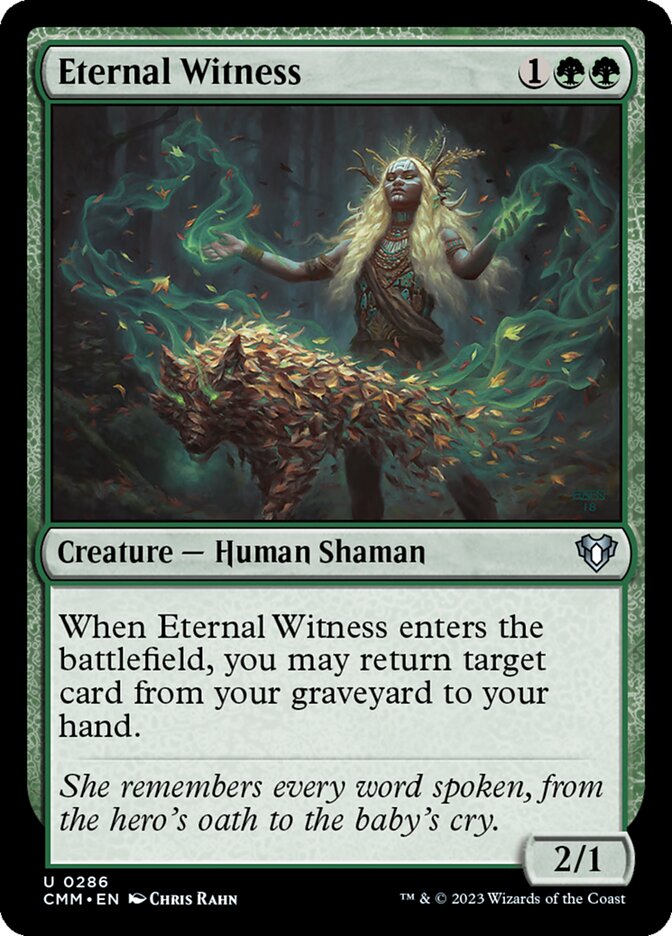 Eternal Witness
Suppose you have Solemn Simulacrum and Eternal Witness on the battlefield. When casting Kavu Primarch, you can tap Eternal Witness to pay for the {G} in the cost and tap Solemn Simulacrum to pay {1}. This reduces the remaining mana needed from your lands to just {2} for the base spell, or {6} if you choose to kick it.
If you have five untapped creatures including Eternal Witness, you can tap all five to pay for {G} and {4} of the Kicker cost. This leaves you only needing to pay {3} mana from your lands to put a 7/7 Kavu Primarch onto the battlefield. Even though Eternal Witness was just played, you can tap it for Convoke because Convoke does not use the tap symbol {T} associated with summoning sickness.
Guide written with AI from the official text and rulings. Official English text prevails.
How it works : Kavu Primarch
Original English text — Wizards of the Coast / Scryfall
- #1· Wizards of the Coast
To determine a spell's total cost, start with the mana cost (or an alternative cost if another card's effect allows you to pay one instead), add any cost increases (such as kicker), then apply any cost reductions. The spell's mana value remains unchanged, no matter what the total cost to cast it was.
No other card is named in this ruling.
- #2· Wizards of the Coast
If a spell's kicker cost was paid, the spell is "kicked."
No other card is named in this ruling.
- #3· Wizards of the Coast
The kicker ability doesn't let you pay a kicker cost more than once.
No other card is named in this ruling.
- #4· Wizards of the Coast
If you put a permanent with a kicker ability onto the battlefield without casting it, you can't kick it.
No other card is named in this ruling.
- #5· Wizards of the Coast
If you copy a kicked spell on the stack, the copy is also kicked. If the copied spell is a permanent spell, the token the copy of that spell becomes when it enters is also kicked.
No other card is named in this ruling.
- #6· Wizards of the Coast
If a card or token enters as a copy of a permanent, the new permanent isn't kicked, even if the original was.
No other card is named in this ruling.
- #7· Wizards of the Coast
You can tap any untapped creature you control to convoke a spell, even one you haven't controlled continuously since the beginning of your most recent turn.
No other card is named in this ruling.
- #8· Wizards of the Coast
Tapping an untapped creature that's attacking or blocking to convoke a spell won't cause that creature to stop attacking or blocking.
No other card is named in this ruling.
- #9· Wizards of the Coast
When calculating a spell's total cost, include any alternative costs, additional costs, or anything else that increases or reduces the cost to cast the spell. Convoke applies after the total cost is calculated. Convoke doesn't change a spell's mana cost or mana value.
No other card is named in this ruling.
- #10· Wizards of the Coast
If a creature you control has a mana ability with
 in the cost, activating that ability while casting a spell with convoke will result in the creature being tapped before you pay the spell's costs. You won't be able to tap it again for convoke. Similarly, if you sacrifice a creature to activate a mana ability while casting a spell with convoke, that creature won't be on the battlefield when you pay the spell's costs, so you won't be able to tap it for convoke.
No other card is named in this ruling.
- #11· Wizards of the Coast
Because convoke isn't an alternative cost, it can be used in conjunction with alternative costs.
No other card is named in this ruling.
- #12· Wizards of the Coast
Tapping a multicolored creature using convoke will pay for
or one mana of your choice of any of that creature's colors.No other card is named in this ruling.
Legal formats
Commentaires
- Sois le premier à commenter cette carte.
Read next
Meta decks with Kavu Primarch
No archived Top 8 deck with this card yet.