

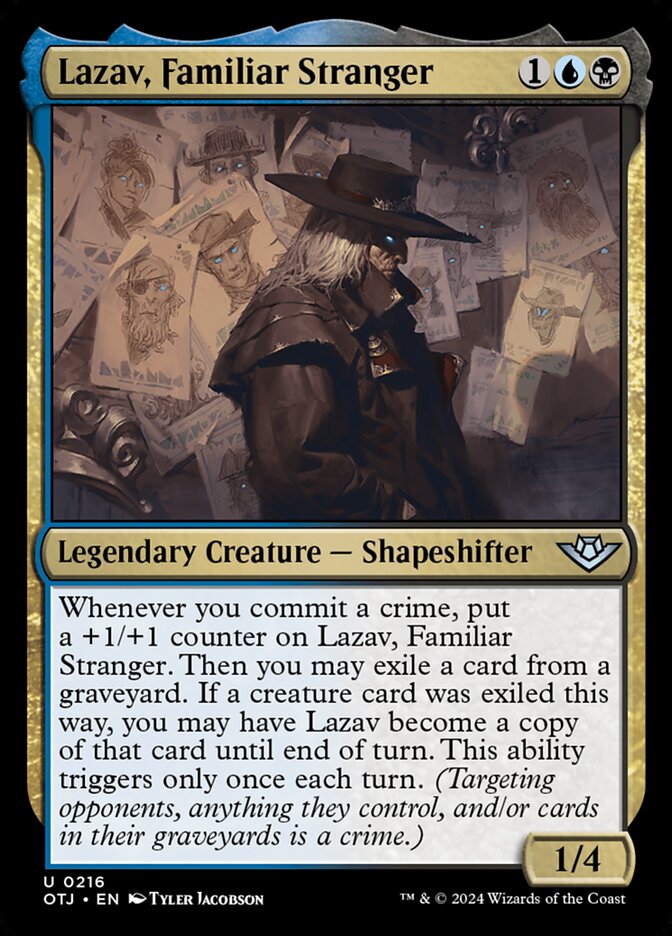
Lazav, Familiar Stranger is one of those cards players keep asking about. Here is, in plain words, what its official text says, the rulings published by Wizards of the Coast, and the combos players actually run.
Official card text
Whenever you commit a crime, put a +1/+1 counter on Lazav. Then you may exile a card from a graveyard. If a creature card was exiled this way, you may have Lazav become a copy of that card until end of turn. This ability triggers only once each turn. (Targeting opponents, anything they control, and/or cards in their graveyards is a crime.)
How it works : Lazav, Familiar Stranger
Original English text — Wizards of the Coast / Scryfall
- #1· Wizards of the Coast
Lazav copies exactly what was printed on the original card and nothing else. It doesn't copy any information about the object the card was before it was put into a graveyard.
No other card is named in this ruling.
- #2· Wizards of the Coast
Any effects that applied to Lazav before it becomes a copy of another card will continue to apply once it becomes a copy. The same is true of any counters that are on Lazav.
No other card is named in this ruling.
- #3· Wizards of the Coast
When Lazav becomes a copy of an exiled creature card, it's neither entering nor leaving the battlefield. Any enters-the-battlefield or leaves-the-battlefield abilities won't trigger.
No other card is named in this ruling.
- #4· Wizards of the Coast
A player commits a crime as they cast a spell, activate an ability, or put a triggered ability on the stack that targets at least one opponent, at least one permanent, spell, or ability an opponent controls, and/or at least one card in an opponent's graveyard.
No other card is named in this ruling.
- #5· Wizards of the Coast
The spell or ability that constituted a crime doesn't have to have resolved yet or at all. As soon as you're finished casting the spell, activating the ability, or putting the triggered ability on the stack, you've committed a crime.
No other card is named in this ruling.
- #6· Wizards of the Coast
For example, an ability that triggers when you cast a spell that targets an opponent will trigger at the same time as an ability that triggers whenever you commit a crime. Those abilities can be put on the stack in either order (if you control them both), and they'll both resolve before the spell that caused them to trigger.
No other card is named in this ruling.
- #7· Wizards of the Coast
A player can commit only one crime per spell or ability they control. Targeting multiple opponents, permanents, spells, abilities, and/or cards with the same spell or ability doesn't constitute committing multiple crimes.
No other card is named in this ruling.
- #8· Wizards of the Coast
Changing the target or targets of a spell or ability won't affect whether or not the controller of that spell or ability has committed a crime. Only the initial targets chosen for that spell or ability are used to determine whether or not its controller committed a crime.
No other card is named in this ruling.
Legal formats
Commentaires
- Sois le premier à commenter cette carte.

