
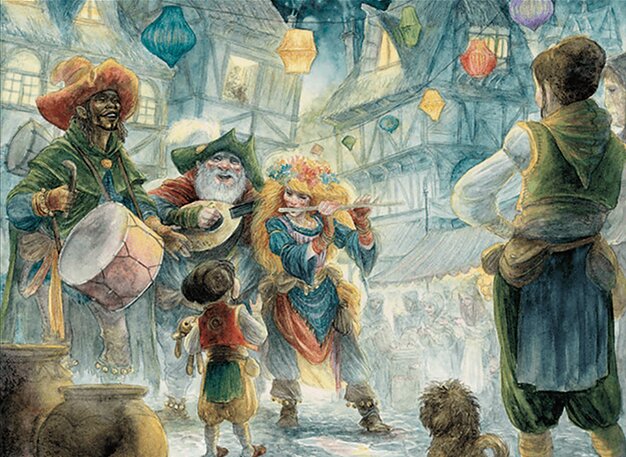
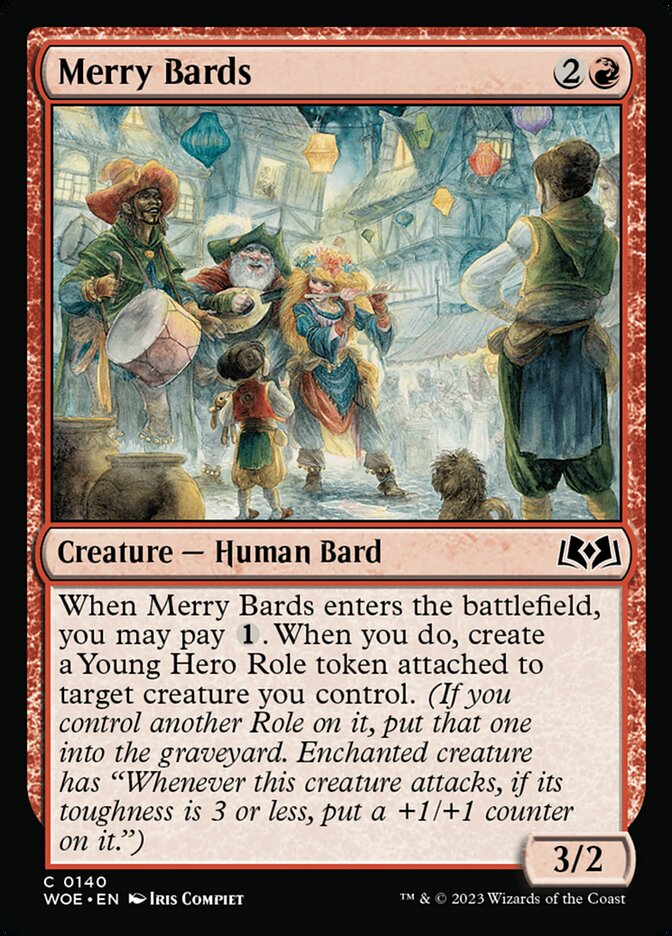
Merry Bards is one of those cards players keep asking about. Here is, in plain words, what its official text says, the rulings published by Wizards of the Coast, and the combos players actually run.
Official card text
When this creature enters, you may pay. When you do, create a Young Hero Role token attached to target creature you control. (If you control another Role on it, put that one into the graveyard. Enchanted creature has "Whenever this creature attacks, if its toughness is 3 or less, put a +1/+1 counter on it.")
Complete guide
Merry Bards is a versatile Human Bard from Wilds of Eldraine that brings both board presence and potential growth to your team. By utilizing the Young Hero Role, this card allows your smaller creatures to transform into formidable threats over the course of several turns.
The Reflexive Trigger
Merry Bards features a 'reflexive' triggered ability. When it enters the battlefield, the initial ability goes on the stack. You do not choose a target yet. Once that ability resolves, you decide whether to pay {1}. If you do pay the mana, a second ability triggers immediately, and it is at this point you choose a target creature to receive the Young Hero Role.
Managing Role Tokens
Roles are unique Aura tokens. A creature can only have one Role controlled by the same player at any time. If you attach a Young Hero Role to a creature that already has a Role you control (such as Royal), the old Role is put into the graveyard as a state-based action. However, a creature can have multiple Roles if they are controlled by different players.
Becoming a Young Hero
The Young Hero Role specifically benefits creatures with a toughness of 3 or less. Whenever the enchanted creature attacks, the ability checks its toughness. If it is 3 or less, it receives a +1/+1 counter. Once the creature's toughness grows to 4 or higher, the ability will still trigger when it attacks, but it will not grant any more counters upon resolution.
Strategic Timing
Because the targeting happens only after you pay the {1}, your opponents cannot know for sure which creature you intend to buff until the second ability triggers. This allows you to bait out removal spells or wait to see if Merry Bards itself survives before investing your mana into the Role token.
Interaction examples
 Solemn Simulacrum
You have Solemn Simulacrum on the battlefield (a 2/2). You cast Merry Bards and it enters. You pay {1}, triggering the reflexive ability to attach the Young Hero Role to the Simulacrum. When you next attack with the Simulacrum, the game checks its toughness. Since 2 is less than 3, it gets a +1/+1 counter and becomes a 3/3. The next time it attacks, it is a 3/3, which still satisfies the '3 or less' condition, so it will grow to a 4/4. After that, it will no longer gain counters from this Role.
 Roaming Throne
With Roaming Throne on the battlefield (naming Human), Merry Bards enters the battlefield. Because of the Throne, the enter-the-battlefield ability triggers twice. You can pay {1} for the first trigger to create a Young Hero Role on a creature. Then, you can pay {1} for the second trigger. Note that if you target the same creature both times, the second Role will cause the first one to be put into the graveyard immediately.
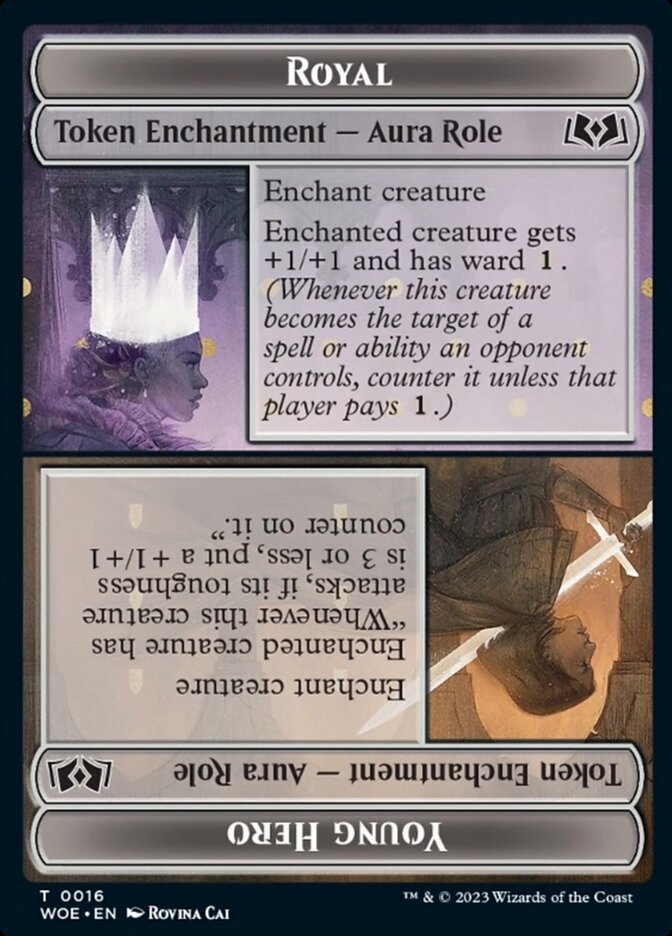 Royal // Young Hero
If your creature is already enchanted by a Royal Role (giving it +1/+1 and ward {1}), and you use Merry Bards to attach a Young Hero Role to that same creature, the Royal Role is moved to the graveyard. The creature loses the ward ability and the +1/+1 buff from Royal, but gains the attacking growth potential of the Young Hero.
Guide written with AI from the official text and rulings. Official English text prevails.
How it works : Merry Bards
Original English text — Wizards of the Coast / Scryfall
- #1· Wizards of the Coast
You don't choose a target for Merry Bards's ability at the time its enters-the-battlefield ability triggers. Rather, a second "reflexive" ability triggers when you pay
this way. You choose a target for that ability as it goes on the stack. Each player may respond to this triggered ability as normal.No other card is named in this ruling.
- #2· Wizards of the Coast
Roles are colorless enchantment tokens. Each one has the Aura and Role subtypes and the enchant creature ability.
No other card is named in this ruling.
- #3· Wizards of the Coast
If a permanent has more than one Role attached to it controlled by the same player, each of those Roles except the one with the most recent timestamp is put into its owner’s graveyard. This is a state-based action.
No other card is named in this ruling.
- #4· Wizards of the Coast
If two or more Roles controlled by the same player become attached to a permanent at the same time (perhaps due to an effect such as that of Doubling Season), that player chooses which one to keep and which are put into their owners’ graveyards.
No other card is named in this ruling.
- #5· Wizards of the Coast
A permanent can have multiple Roles attached to it if each one is controlled by a different player.
No other card is named in this ruling.
- #6· Wizards of the Coast
Some spells and abilities that create Role tokens require targets. If each target chosen is an illegal target as that spell or ability tries to resolve, it won’t resolve. The Role token won’t be created.
No other card is named in this ruling.
- #7· Wizards of the Coast
In rare cases, a spell or ability might attempt to create a Role token enchanting a permanent that it can’t legally enchant (because of an ability like protection from enchantments). In such cases, the Role token isn’t created.
No other card is named in this ruling.
- #8· Wizards of the Coast
Hexproof and shroud won’t prevent a Role from becoming attached to a permanent if the ability creating that Role attached to that permanent doesn’t target it.
No other card is named in this ruling.
- #9· Wizards of the Coast
Cards in the Wilds of Eldraine main set create six different Role tokens: Cursed, Monster, Royal, Sorcerer, Wicked, and Young Hero. A seventh Role token, Virtuous, is created by Ellivere of the Wild Court, the commander of the “Virtue and Valor” Commander Deck.
No other card is named in this ruling.
Related cards and tokens
Legal formats
Commentaires
- Sois le premier à commenter cette carte.
Read next
Meta decks with Merry Bards
No archived Top 8 deck with this card yet.