
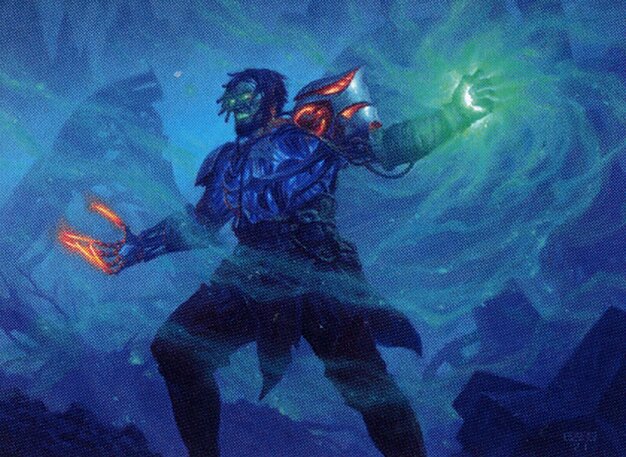
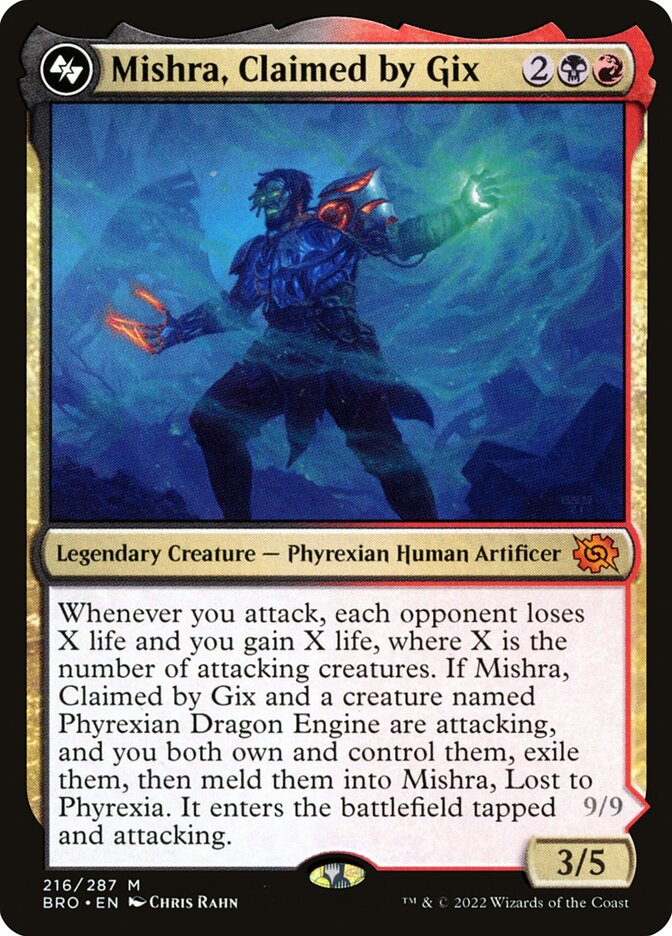
Mishra, Claimed by Gix is one of those cards players keep asking about. Here is, in plain words, what its official text says, the rulings published by Wizards of the Coast, and the combos players actually run.
Official card text
Whenever you attack, each opponent loses X life and you gain X life, where X is the number of attacking creatures. If Mishra, Claimed by Gix and a creature named Phyrexian Dragon Engine are attacking, and you both own and control them, exile them, then meld them into Mishra, Lost to Phyrexia. It enters tapped and attacking.
Complete guide
Mishra, Claimed by Gix is a powerhouse of the Phyrexian invasion, designed to drain your opponents dry while setting the stage for a terrifying transformation. When paired with his mechanical dragon, he ceases to be a mere man and becomes a towering engine of war. Understanding the timing of his triggered abilities and the unique mechanics of Meld is key to dominating your next match.
The Drain and the Meld
Mishra features a triggered ability that occurs whenever you attack. First, it calculates X, which is the total number of creatures you declared as attackers. Every opponent loses X life, and you gain X life. This trigger doesn't just care about Mishra; it rewards you for every creature charging into battle. The second part of the ability checks if both Mishra, Claimed by Gix and Phyrexian Dragon Engine are among those attackers. If you own and control both, they are exiled and returned as the singular, massive Mishra, Lost to Phyrexia.
Step-by-Step Resolution
When you move to combat and declare your attackers, Mishra's ability triggers. First, the life drain is calculated based on the current number of attacking creatures. Immediately after that life total shift, the game checks if the Meld requirements are met. If they are, Mishra and the Phyrexian Dragon Engine are exiled. They return to the battlefield as one combined permanent: Mishra, Lost to Phyrexia. Because this new permanent 'enters the battlefield,' its own enters-the-battlefield ability will trigger immediately, allowing you to choose three powerful modes.
Common Mistakes
A common point of confusion is how the melded creature interacts with 'attack' triggers. Since Mishra, Lost to Phyrexia enters the battlefield 'tapped and attacking,' it was not declared as an attacker during the declare attackers step. This means it will not trigger its own 'whenever this creature attacks' ability on the turn it is formed; however, it still triggers its 'whenever this creature enters' ability, which has the same set of modes. Also, remember that if Mishra or the Engine is removed from combat before the trigger resolves, the Meld will fail.
When to Play It
Mishra is best utilized in aggressive decks that can go wide with many creatures to maximize the life drain. Because Phyrexian Dragon Engine has Unearth, you can often surprise opponents by bringing the Engine back from the graveyard for a single turn to trigger the Meld. Once melded, use the versatility of Mishra, Lost to Phyrexia to dismantle your opponent's board, whether by destroying their artifacts or shrinking their blockers with the -1/-1 mode.
Interaction examples
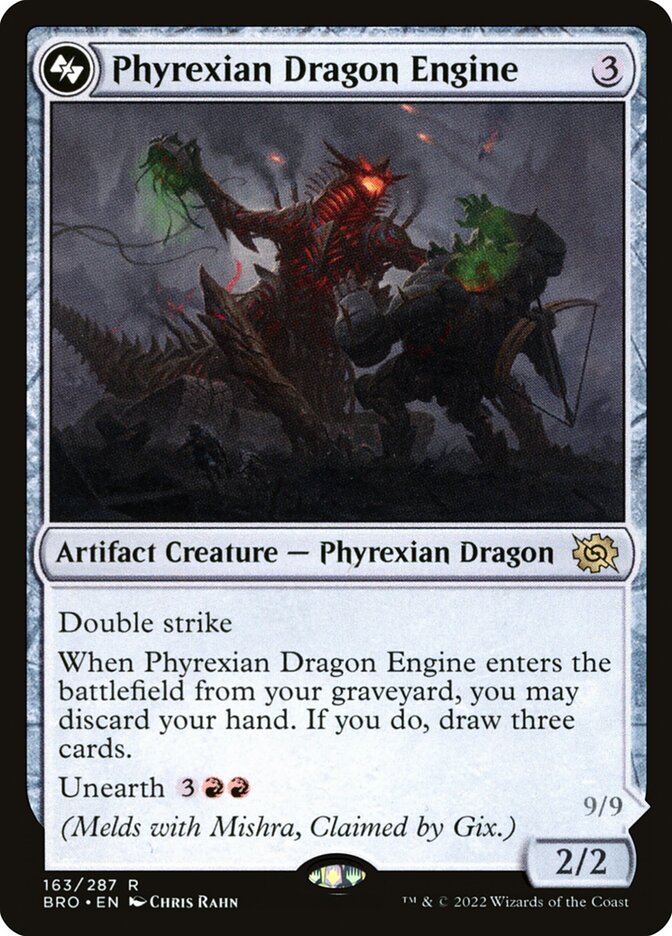 Phyrexian Dragon Engine
 Solemn Simulacrum
You declare all three creatures as attackers. Mishra's ability triggers. First, each opponent loses 3 life and you gain 3 life (since 3 creatures are attacking). Then, Mishra and the Engine are exiled and meld into Mishra, Lost to Phyrexia. The melded creature enters the battlefield tapped and attacking. You then choose three modes from the new Mishra's ability, such as dealing 3 damage, making the opponent discard, and creating Powerstone tokens.
 Roaming Throne
With Roaming Throne on the battlefield naming 'Phyrexian' or 'Human,' Mishra's attack ability triggers twice. The first trigger resolves, causing life drain based on your attackers and melding Mishra with a Phyrexian Dragon Engine you control. Because the original Mishra is now gone (exiled to meld), the second instance of the drain ability still resolves using the last known information about the number of attackers, but it cannot meld anything since the cards are already gone.
After melding into Mishra, Lost to Phyrexia, you choose the mode to create two tapped Powerstone tokens. These tokens provide colorless mana that can be used to activate abilities or cast artifact spells. This is particularly useful for paying the Unearth cost of other artifact creatures in your graveyard or fueling expensive activated abilities on your board.
Guide written with AI from the official text and rulings. Official English text prevails.
How it works : Mishra, Claimed by Gix
Original English text — Wizards of the Coast / Scryfall
- #1· Wizards of the Coast
Mishra, Lost to Phyrexia enters the battlefield tapped and attacking, but since it wasn't declared as an attacker, no abilities that trigger when a creature attacks will trigger.
Card named in this ruling
- #2· Wizards of the Coast
You choose which player or planeswalker Mishra, Lost to Phyrexia is attacking as it enters the battlefield.
Card named in this ruling
- #3· Wizards of the Coast
When a pair of cards are melded, the result is a single creature that's represented by two cards. If the melded creature dies, both cards are put into your graveyard. As it leaves the battlefield, both of those cards are turned face up again. If the cards are put on the top or bottom of your library, you choose their relative order.
No other card is named in this ruling.
- #4· Wizards of the Coast
One card in each pair of meld cards has an ability that instructs you to exile the two cards and meld them. If you control more than one object with one of those names, you select one object with that name to exile.
No other card is named in this ruling.
- #5· Wizards of the Coast
When two cards are exiled and melded, they each leave the battlefield, then return together as one new object with no relation to either of the objects that left the battlefield. Counters, Auras, Equipment, and other effects that affected those two cards don't affect the melded permanent.
No other card is named in this ruling.
- #6· Wizards of the Coast
Only two cards belonging to the same meld pair can be melded. Tokens, cards that aren't meld cards, or meld cards that don't form a meld pair can't be melded. If an effect instructs a player to meld cards that can't be melded, those cards remain in exile.
No other card is named in this ruling.
- #7· Wizards of the Coast
While a meld card is in any zone other than the battlefield, it has only the characteristics of its front face. The same is true while it's on the battlefield with its front face up.
No other card is named in this ruling.
- #8· Wizards of the Coast
While a melded permanent is on the battlefield, it has only the characteristics of its combined back face. Any effects that modify how the new object enters the battlefield will consider only the combined back face.
No other card is named in this ruling.
- #9· Wizards of the Coast
Note that the permanent represented by the combined back faces has a color indicator.
No other card is named in this ruling.
- #10· Wizards of the Coast
The mana value of a melded permanent is the sum of the mana values of its front faces. A creature that becomes a copy of a melded permanent has only the characteristics of that combined back face, and its mana value is 0.
No other card is named in this ruling.
- #11· Wizards of the Coast
A player prompted to name a card may name the combined back face, and each player has the right to know that combined back face's characteristics at all times.
No other card is named in this ruling.
- #12· Wizards of the Coast
If an effect moves a melded permanent to a new zone and then affects "that card," it affects both cards.
No other card is named in this ruling.
- #13· Wizards of the Coast
In the Commander variant, a meld card's color identity is determined only by the mana costs and mana symbols in the rules text of its front face. No symbols or rules text of the permanent it melds into are considered.
No other card is named in this ruling.
- #14· Wizards of the Coast
Powerstone tokens are a kind of predefined token. Each one has the artifact subtype "Powerstone" and the ability "
 : Add
 . This mana can't be spent to cast a nonartifact spell."
No other card is named in this ruling.
- #15· Wizards of the Coast
You can use the
added by a Powerstone token on anything that isn't a nonartifact spell. This includes paying costs to activate abilities of both artifact and nonartifact permanents, paying ward costs, and so on.No other card is named in this ruling.
- #16· Wizards of the Coast
Although all the cards in The Brothers' War that create Powerstone tokens create a tapped Powerstone token, entering the battlefield tapped isn't part of the token's definition. Notably, if you create a token that is a copy of a Powerstone token, the token copy won't enter the battlefield tapped.
No other card is named in this ruling.
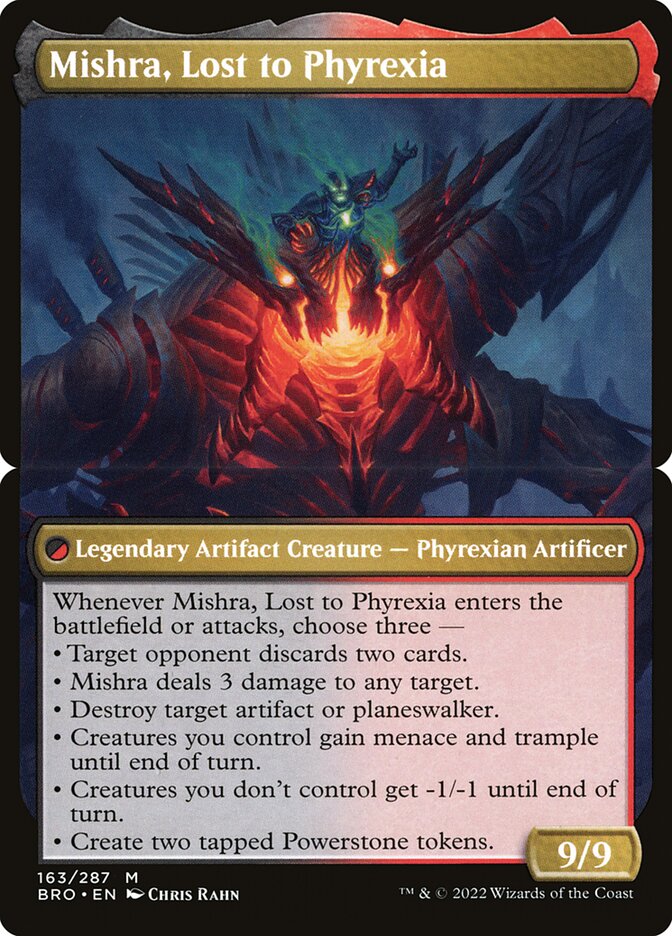
Related cards and tokens
Legal formats
Commentaires
- Sois le premier à commenter cette carte.
Read next
Meta decks with Mishra, Claimed by Gix
No archived Top 8 deck with this card yet.