


Mouth of the Storm is one of those cards players keep asking about. Here is, in plain words, what its official text says, the rulings published by Wizards of the Coast, and the combos players actually run.
Official card text
Flying Ward(Whenever this creature becomes the target of a spell or ability an opponent controls, counter it unless that player pays
Complete guide
Mouth of the Storm is a massive Elemental that descends from the clouds to silence the battlefield. This creature serves as both a defensive wall and a flying threat, ensuring your opponents' offenses are thoroughly dampened for a full turn cycle. With its protective Ward ability and board-wide debuff, it is a formidable inclusion for any blue-based control deck.
What It Does
Mouth of the Storm is a 7-mana creature with Flying and Ward {2}. Its most impactful feature is its enters-the-battlefield ability, which reduces the power of all creatures controlled by your opponents by 3 until your next turn. This effect is powerful because it persists through your opponent's combat phase, making it very difficult for them to push damage through or engage in favorable trades.
How It Resolves Step by Step
When Mouth of the Storm enters the battlefield, its triggered ability goes on the stack. Upon resolution, it checks for all creatures currently controlled by your opponents. Those specific creatures receive -3/-0. This effect is locked in at the moment of resolution; it does not continue to apply to new creatures that enter the battlefield or change control later in the turn.
Common Mistakes
A common mistake is assuming this ability works like an aura or a continuous static effect. It is a one-time trigger. If an opponent plays a new creature after Mouth of the Storm has already entered, that new creature will have its full power. Additionally, remember that the Ward {2} cost must be paid by an opponent targeting the Elemental, or their spell or ability will be countered by the game rules.
When to Play It
You should aim to play Mouth of the Storm when your opponent has a wide board of small to mid-sized creatures. By dropping their power by 3, you can often render their entire army incapable of dealing damage. It is also an excellent tool to protect your high-value permanents by forcing the opponent to spend extra mana to remove this flying threat due to its Ward keyword.
Interaction examples
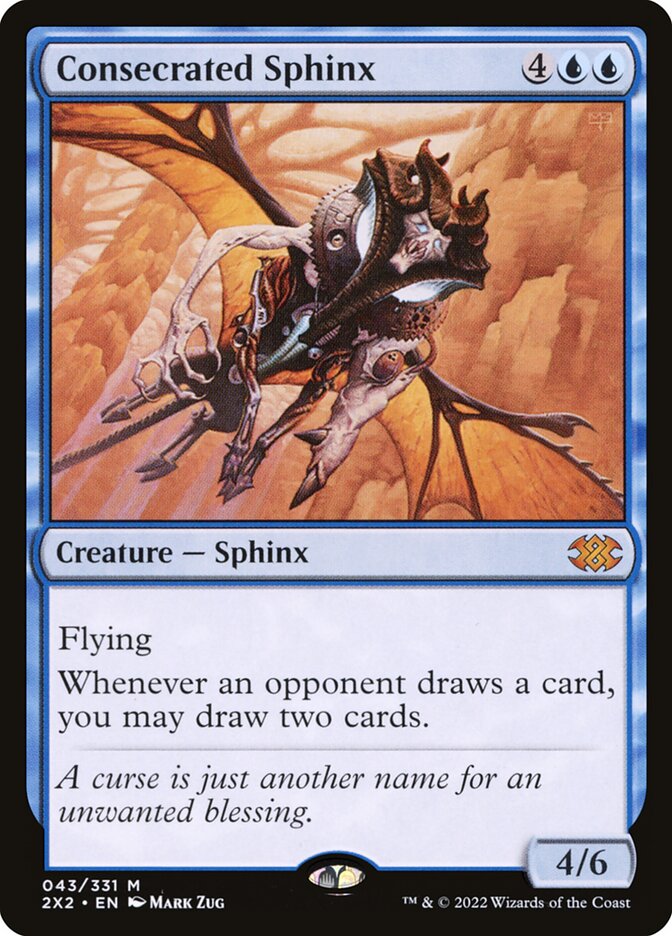 Consecrated Sphinx
If you have Consecrated Sphinx on the board, your opponent might try to attack into it to remove your card-draw engine. By casting Mouth of the Storm, you reduce their attackers' power by 3. This allows your 4/6 Sphinx to block and survive encounters that would otherwise be lethal, while Mouth of the Storm provides an additional flying blocker that is difficult to target thanks to Ward {2}.
 Hullbreaker Horror
With Hullbreaker Horror on the battlefield, you can create a repetitive loop. When you cast Mouth of the Storm, Hullbreaker Horror's ability triggers, allowing you to return a nonland permanent to its owner's hand. If you have a way to return Mouth of the Storm to your own hand later, you can repeatedly cast it to trigger Hullbreaker Horror and keep your opponents' creatures at -3/-0 indefinitely during their turns.
Guide written with AI from the official text and rulings. Official English text prevails.
How it works : Mouth of the Storm
Original English text — Wizards of the Coast / Scryfall
- #1· Wizards of the Coast
Mouth of the Storm’s last ability affects only creatures your opponents control at the time it resolves. Creatures they begin to control after the ability resolves but before your next turn begins won’t get -3/-0.
No other card is named in this ruling.
Legal formats
Commentaires
- Sois le premier à commenter cette carte.
Read next
Meta decks with Mouth of the Storm
No archived Top 8 deck with this card yet.