

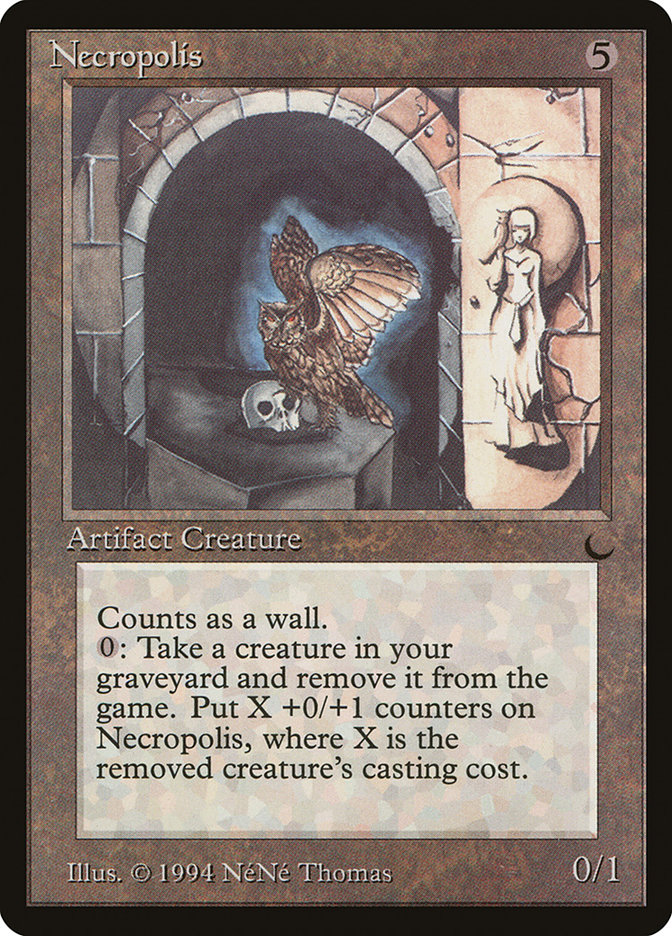
Necropolis is one of those cards players keep asking about. Here is, in plain words, what its official text says, the rulings published by Wizards of the Coast, and the combos players actually run.
Official card text
Defender (This creature can't attack.) Exile a creature card from your graveyard: Put X +0/+1 counters on this creature, where X is the exiled card's mana value.
Complete guide
Necropolis is a unique defensive artifact creature that turns your fallen allies into structural integrity. By exiling creatures from your graveyard, you can bolster this Wall's toughness to astronomical levels. It serves as a literal monument to your past board presence, growing stronger with every soul it consumes.
Converting Mana Value to Toughness
The core mechanic of Necropolis is its activated ability, which allows you to exile a creature card from your graveyard as a cost. The result is a number of +0/+1 counters equal to that card's mana value. Note that mana value is determined by the mana symbols in the upper right corner of the exiled card; for example, a card costing four mana will always grant four counters, regardless of how much you actually spent to cast it.
Resolution and Timing
Activating the ability follows standard timing rules for activated abilities. First, you announce the ability and pay the cost by exiling a creature card from your graveyard. Once the ability resolves, you check the mana value of the card that was exiled and place the corresponding number of +0/+1 counters on Necropolis. Because the exile is a cost, your opponent cannot remove the card from your graveyard in response once you have announced the activation.
Common Mistakes
A common point of confusion is how Necropolis interacts with triggered abilities. Since Necropolis uses an activated ability (indicated by the 'Cost: Effect' syntax), it does not trigger when creatures die or enter the graveyard. Additionally, players often forget that mana value includes all colors of mana; a creature costing three red mana has a mana value of three. Finally, remember that +0/+1 counters are distinct from temporary buffs; they stay on Necropolis as long as it remains on the battlefield.
When to Use the Ability
Because Necropolis has Defender, it cannot attack. Its primary role is to block the largest threats your opponent can muster. You should generally wait to use the ability until you need to survive combat or until the end of your opponent's turn. This keeps your graveyard available for other potential recursion effects until the absolute last moment.
Interaction examples
 Solemn Simulacrum
After Solemn Simulacrum dies and you draw a card, it sits in your graveyard. You can then activate Necropolis by exiling the Solemn Simulacrum. Since the Golem has a mana value of 4, Necropolis receives four +0/+1 counters, permanently increasing its toughness from 1 to 5.
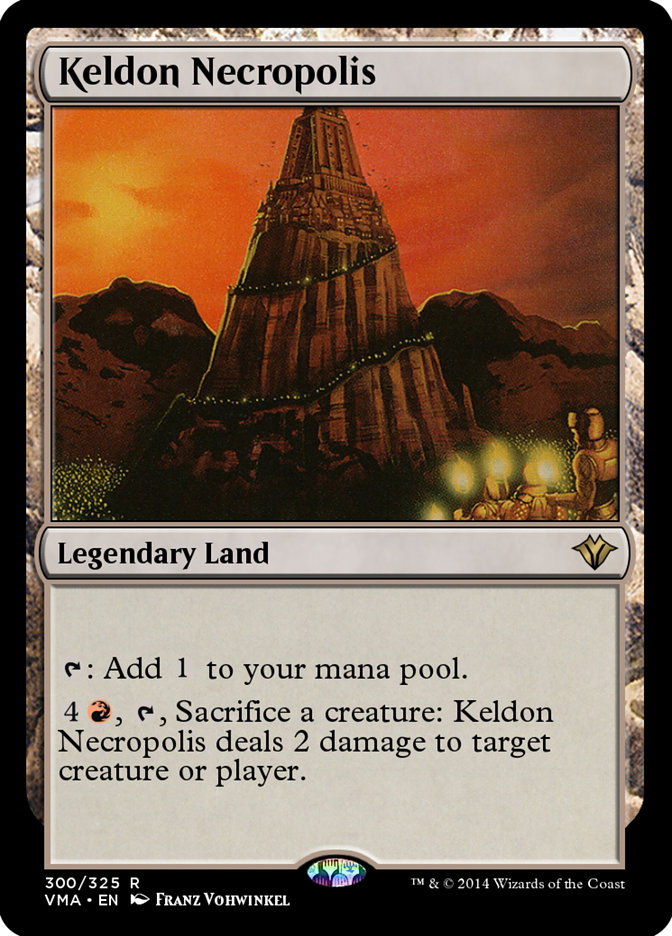 Keldon Necropolis
If you have a creature on the battlefield that you no longer need, you can use Keldon Necropolis to sacrifice it and deal 2 damage to a target. Once that creature is in the graveyard, Necropolis can exile it to gain toughness counters based on that creature's mana value, effectively recycling the same card for two different benefits.
 Roaming Throne
If you play Roaming Throne and choose 'Wall', you might expect Necropolis to gain double counters. However, Necropolis has an activated ability, not a triggered ability (it doesn't use 'when', 'whenever', or 'at'). Roaming Throne will not cause the ability of Necropolis to resolve an additional time.
Guide written with AI from the official text and rulings. Official English text prevails.
How it works : Necropolis
Original English text — Wizards of the Coast / Scryfall
No additional ruling has been published for this card.
Interactions with other cards
These cards' text mentions Necropolis.
Legal formats
Commentaires
- Sois le premier à commenter cette carte.
Read next
Meta decks with Necropolis
No archived Top 8 deck with this card yet.