
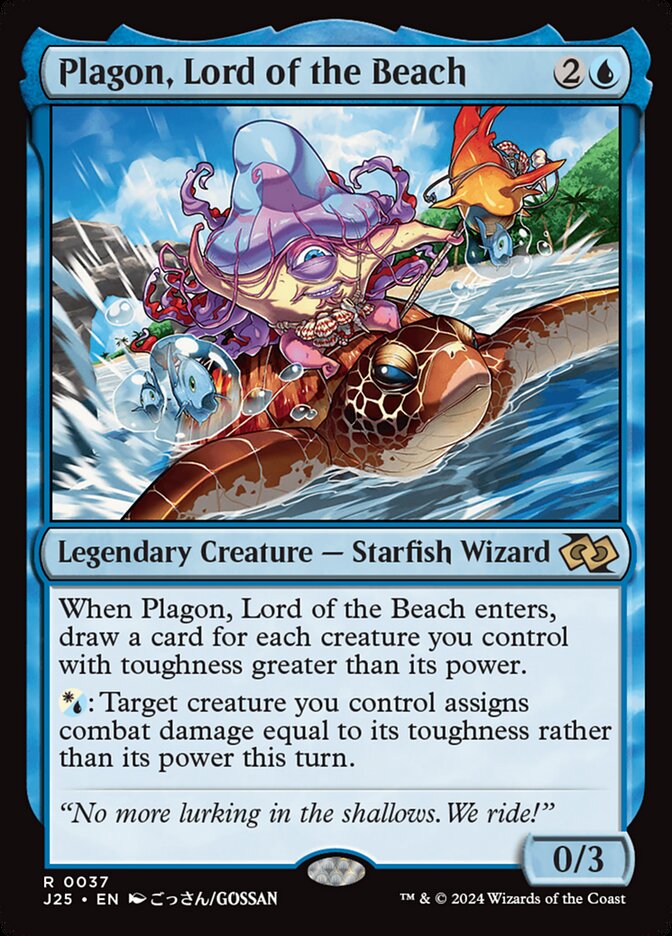
Plagon, Lord of the Beach is one of those cards players keep asking about. Here is, in plain words, what its official text says, the rulings published by Wizards of the Coast, and the combos players actually run.
Official card text
When Plagon enters, draw a card for each creature you control with toughness greater than its power.: Target creature you control assigns combat damage equal to its toughness rather than its power this turn.
Complete guide
Meet Plagon, Lord of the Beach, a legendary Starfish Wizard who turns high-toughness creatures into powerful threats and card-drawing engines. This blue and white commander rewards you for building a defensive board state by letting your creatures use their bulk to deal damage. Whether you are leading a dedicated 'toughness matters' deck or just looking for a unique card draw source, Plagon is here to lead your tide.
Toughness-Based Card Draw
When Plagon, Lord of the Beach enters the battlefield, its triggered ability checks every creature you control to see if its toughness is strictly greater than its power. For each creature that meets this condition, you draw one card. This check happens only once as the ability resolves, so changing a creature's stats in response to the trigger can affect how many cards you ultimately draw.
Assigning Combat Damage
Plagon’s activated ability costs one hybrid mana (either White or Blue) and allows a target creature to assign combat damage equal to its toughness rather than its power for the turn. It is important to note that this does not change the creature's actual power value. If another spell or ability checks the creature's power, it will still see the original number, not the toughness value being used for damage.
Strategic Timing
Because Plagon's activated ability lasts until the end of the turn, you should typically use it during the Declare Attackers or Declare Blockers step. This ensures your creatures are ready to deal maximum damage before the Combat Damage step begins. Additionally, since Plagon's enter-the-battlefield ability relies on the state of your board, try to cast Plagon after you have established several high-toughness creatures to maximize your hand size.
Common Mistakes
A common point of confusion is how this interacts with 'fight' effects or non-combat damage. Plagon's activated ability specifies 'combat damage.' If a creature deals damage via a spell or an ability that says it deals damage equal to its power, Plagon's effect will not apply, and the creature will use its actual power value instead.
Interaction examples
 Solemn Simulacrum
If you control Solemn Simulacrum (a 2/2) and then cast Plagon, Lord of the Beach, the Simulacrum does not have toughness greater than its power. You would only draw a card for Plagon itself if its own toughness is higher than its power, or for other qualifying creatures. If you can reduce the power of the Simulacrum or boost its toughness before Plagon's trigger resolves, you would then draw an additional card for it.
 Roaming Throne
With Roaming Throne on the battlefield naming 'Starfish' or 'Wizard,' Plagon's entry ability will trigger twice. As each trigger resolves, it checks how many creatures you control with toughness greater than their power. This allows you to draw two cards for every qualifying creature you control, potentially refilling your hand entirely in a single turn.
Guide written with AI from the official text and rulings. Official English text prevails.
How it works : Plagon, Lord of the Beach
Original English text — Wizards of the Coast / Scryfall
- #1· Wizards of the Coast
Plagon's last ability doesn't actually change the target creature's power. It changes only the amount of combat damage the creature assigns. All other rules and effects that check power or toughness use the real values, even if they cause damage "equal to a creature's power" to be dealt.
No other card is named in this ruling.
Legal formats
Commentaires
- Sois le premier à commenter cette carte.
Read next
Meta decks with Plagon, Lord of the Beach
