

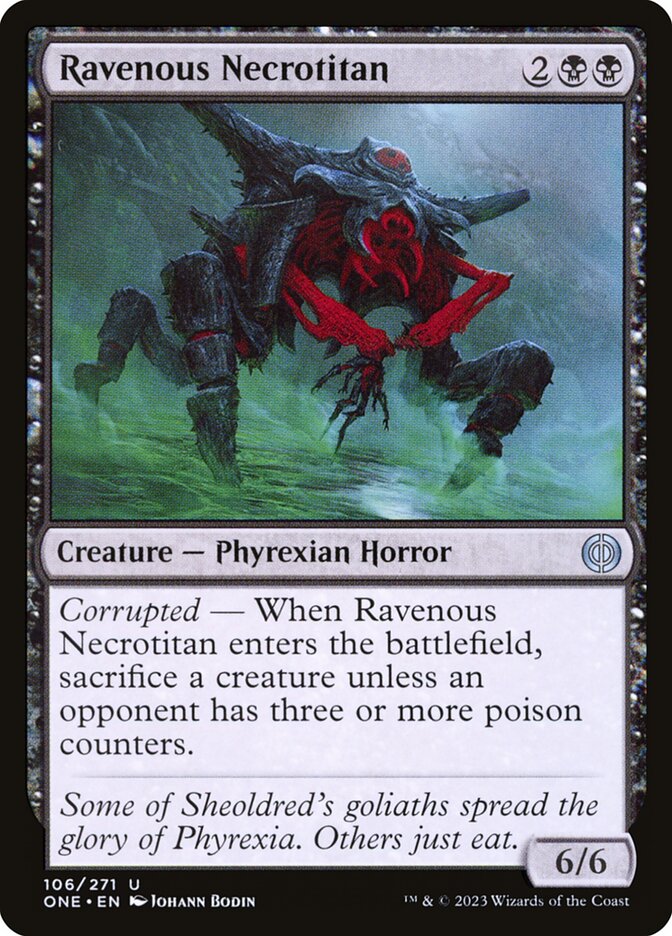
Ravenous Necrotitan is one of those cards players keep asking about. Here is, in plain words, what its official text says, the rulings published by Wizards of the Coast, and the combos players actually run.
Official card text
Corrupted — When this creature enters, sacrifice a creature unless an opponent has three or more poison counters.
Complete guide
Ravenous Necrotitan is a powerful Phyrexian Horror that offers a significant body for a low mana cost, but it demands a steep price upon arrival. This creature utilizes the Corrupted mechanic, checking the toxicity of your opponents to determine if it requires a sacrifice. Understanding how to navigate its entry trigger is key to maintaining board presence while pressuring your foes.
Understanding Corrupted
The Corrupted ability on Ravenous Necrotitan is an enters-the-battlefield trigger that checks the game state as it resolves. Specifically, it looks at whether any opponent has three or more poison counters. If no opponent meets this threshold, the ability forces you to sacrifice a creature. If at least one opponent is sufficiently poisoned, you are exempt from this cost, and the Necrotitan enters without a drawback.
Resolution Step-by-Step
First, Ravenous Necrotitan enters the battlefield, which causes its ability to trigger and be put on the stack. Second, players have a chance to respond with spells or abilities. Third, as the ability resolves, the game checks if the Corrupted condition is met. If an opponent has three or more poison counters, nothing happens. If they do not, you must choose a creature you control (which can be the Necrotitan itself) and move it to the graveyard.
Common Pitfalls
A common mistake is assuming the sacrifice is part of the casting cost; it is actually a triggered ability that happens after the creature is already on the battlefield. Additionally, note that the Corrupted check happens only during resolution. If an opponent loses poison counters in response to the trigger, or if you were counting on a poison source that gets removed, you might be forced to sacrifice a creature unexpectedly.
When to Play It
Ravenous Necrotitan is best utilized in dedicated poison decks where reaching the three-counter threshold is easy. However, it also serves as a sacrifice outlet in decks that want their creatures to die. If you have no other creatures, you will be forced to sacrifice the Necrotitan to its own ability, so timing is crucial if your opponents are not yet corrupted.
Interaction examples
 Solemn Simulacrum
If your opponent has fewer than three poison counters when Ravenous Necrotitan enters, you must sacrifice a creature. You can choose to sacrifice Solemn Simulacrum. This allows you to trigger the Simulacrum's death ability, drawing a card, while keeping your 6/6 Phyrexian Horror on the battlefield.
 Roaming Throne
If you have Roaming Throne on the battlefield with 'Phyrexian' or 'Horror' chosen, Ravenous Necrotitan's ability triggers twice. If no opponent has three poison counters, you will have to sacrifice a creature for the first trigger and another creature for the second trigger. However, if the Corrupted condition is met, both triggers resolve without requiring any sacrifice.
If Ravenous Necrotitan is the only creature you control and your opponent is not Corrupted, you must sacrifice a creature when the ability resolves. Since Ravenous Necrotitan is on the battlefield when the trigger resolves, you must choose it as the sacrifice, resulting in the creature entering and immediately heading to the graveyard.
Guide written with AI from the official text and rulings. Official English text prevails.
How it works : Ravenous Necrotitan
Original English text — Wizards of the Coast / Scryfall
No additional ruling has been published for this card.
Legal formats
Commentaires
- Sois le premier à commenter cette carte.
Read next
Meta decks with Ravenous Necrotitan
No archived Top 8 deck with this card yet.