

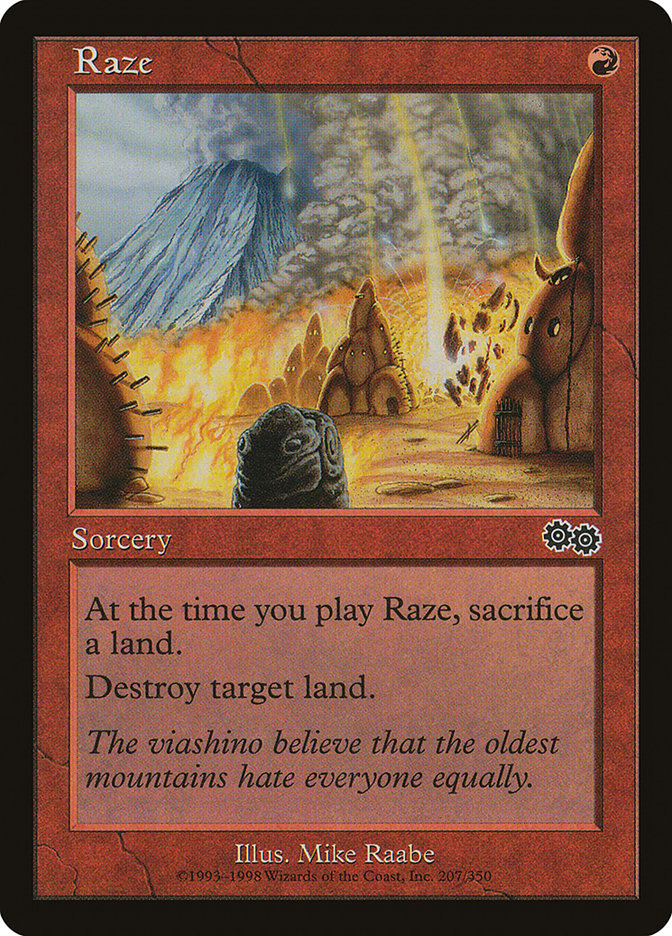
Raze is one of those cards players keep asking about. Here is, in plain words, what its official text says, the rulings published by Wizards of the Coast, and the combos players actually run.
Official card text
As an additional cost to cast this spell, sacrifice a land. Destroy target land.
Complete guide
Raze is a high-risk, high-reward Red sorcery that allows for early-game disruption of your opponent's mana base. By sacrificing one of your own resources, you can effectively starve an opponent of a specific color or stall their game plan entirely. It is a classic example of a symmetrical effect that benefits the player who is better prepared for a low-resource game.
Understanding the Additional Cost
The most important aspect of Raze is that sacrificing a land is an additional cost to cast the spell. This means the sacrifice happens at the moment you put the spell on the stack, not when it resolves. If Raze is countered by an opponent, your sacrificed land remains in the graveyard and is not returned to the battlefield.
Choosing Targets and Resolution
When you cast Raze, you must choose a target land. Upon resolution, Raze checks if the target is still legal. If the target land has gained Hexproof or has been removed from the battlefield in response, Raze will fail to resolve (fizzle). However, even if the spell is countered or fails, the land you sacrificed as a cost is already gone.
Common Pitfalls
A common mistake is forgetting that Raze requires a target to even be cast. You cannot cast Raze just to sacrifice your own land if there are no legal target lands on the battlefield. Additionally, because it is a Sorcery, you cannot use it during an opponent's turn to respond to them playing a land; you must wait for your own main phase when the stack is empty.
Strategic Timing
Raze is most effective in decks with a very low mana curve or those that utilize graveyard recursion. If you can operate on one or two lands while your opponent requires four or five to function, Raze becomes a potent tool. It is often played in 'Land Destruction' archetypes to prevent opponents from ever reaching their mid-game threats.
Interaction examples
 Faithless Looting
In an opening hand, you might use Faithless Looting to find a specific land or threat. On turn two, you can cast Raze, sacrificing your second land to destroy your opponent's only source of a specific color. This leaves both players with one land, but if your deck is designed to function with cards like Faithless Looting to filter draws, you will recover faster than an opponent whose hand is full of expensive spells.
 Vandalblast
In a scenario where an opponent has a powerful artifact land, you have choices. While Vandalblast can destroy an artifact land for one Red mana without a sacrifice, Raze serves as additional redundancy. If you have already used Vandalblast to clear a mana rock, Raze can follow up to destroy a basic land, ensuring the opponent stays behind on resources regardless of the permanent type.
If your opponent is relying on a specific utility land to generate blockers or defensive buffs, casting Raze allows you to remove that utility land. With the opponent's mana or utility restricted, you can more safely attack with Switchgrass Grazer. Even if they have a creature to block, the disruption from Raze ensures they cannot cast combat tricks or additional blockers to stop your Horse Mount.
Guide written with AI from the official text and rulings. Official English text prevails.
How it works : Raze
Original English text — Wizards of the Coast / Scryfall
No additional ruling has been published for this card.
Interactions with other cards
These cards' text mentions Raze.
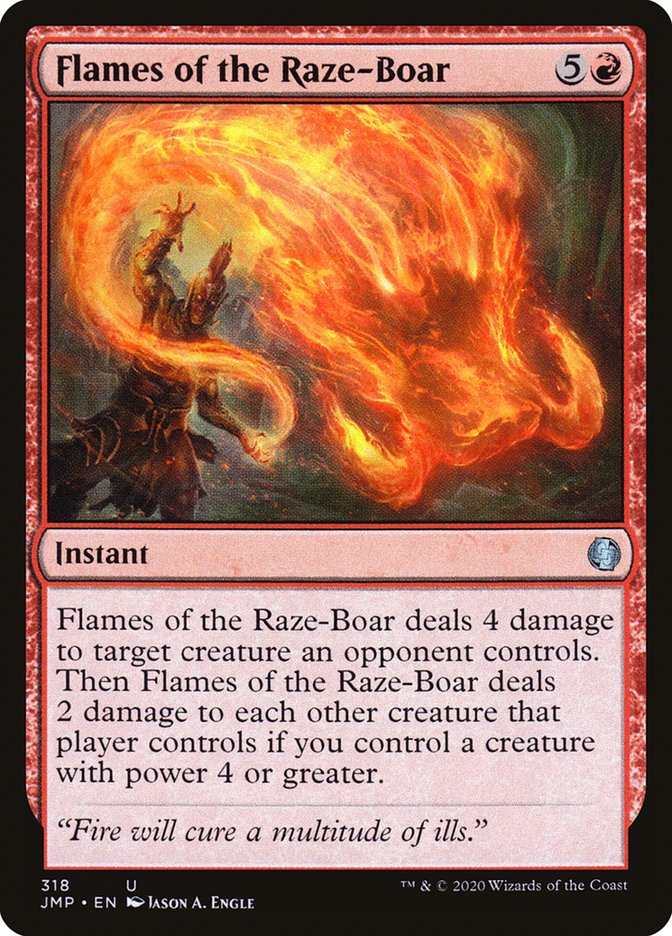
Flames of the Raze-Boar deals 4 damage to target creature an opponent controls. Then Flames of the Raze-Boar deals 2 damage to each other creature that player controls if you control a creature with power 4 or greater.
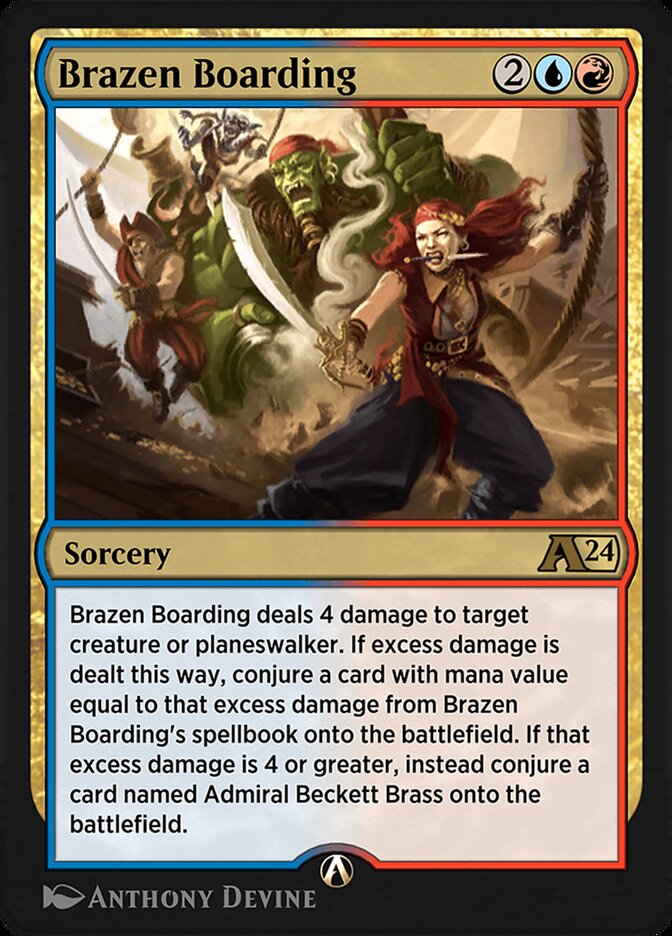
Brazen Boarding deals 4 damage to target creature or planeswalker. If excess damage is dealt this way, conjure a card with mana value equal to that excess damage from Brazen Boarding's spellbook onto the battlefield. If that excess damage is 4 or greater, instead conjure a card named Admiral Beckett Brass onto the battlefield.
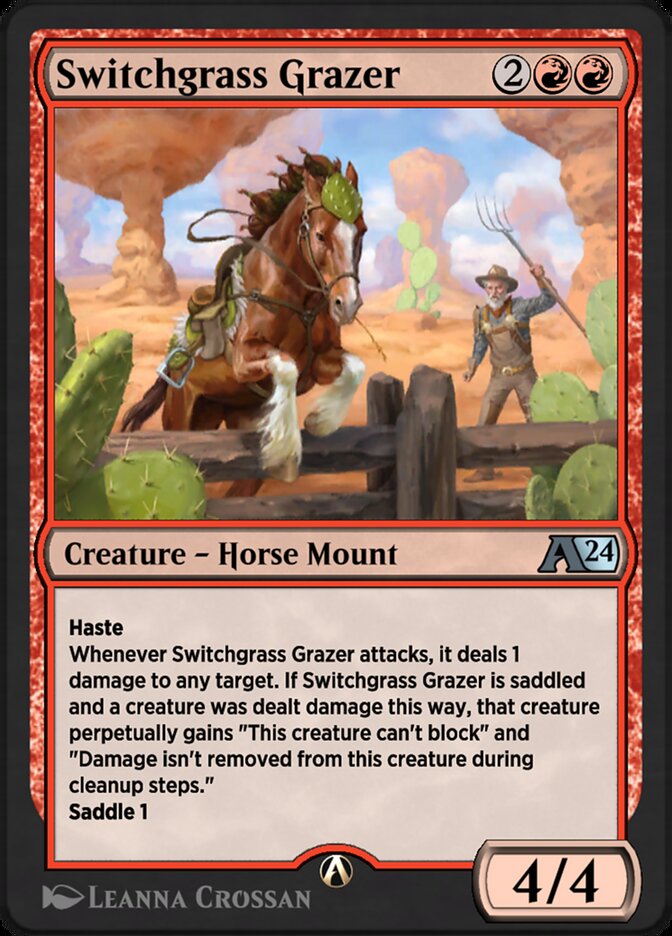
Haste Whenever Switchgrass Grazer attacks, it deals 1 damage to any target. If Switchgrass Grazer is saddled and a creature was dealt damage this way, that creature perpetually gains "This creature can't block" and "Damage isn't removed from this creature during cleanup steps." Saddle 1
Legal formats
Commentaires
- Sois le premier à commenter cette carte.
Read next
Meta decks with Raze
No archived Top 8 deck with this card yet.