


Sapphire Dragon // Psionic Pulse is one of those cards players keep asking about. Here is, in plain words, what its official text says, the rulings published by Wizards of the Coast, and the combos players actually run.
Official card text
Flying Whenever this creature attacks or blocks, scry 2. Counter target noncreature spell. (Then exile this card. You may cast the creature later from exile.)
Complete guide
Sapphire Dragon offers a powerful dual-purpose tool for blue mages, functioning as both a restrictive counterspell and a massive flying threat. By utilizing the Adventure mechanic, you can stop your opponent's key noncreature spells early and keep the card available in exile to deploy as a dragon later.
Understanding the Adventure
Psionic Pulse is the Adventure side of this card. When you cast it for {2}{U}, it functions as an Instant spell on the stack. If Psionic Pulse resolves successfully, instead of going to the graveyard, the card is exiled 'on an adventure.' While in exile, you may cast the creature portion, Sapphire Dragon, at any time you could normally cast a creature spell.
Resolving Psionic Pulse Step by Step
First, you cast Psionic Pulse by paying {2}{U} and targeting a noncreature spell. If the target is legal upon resolution, the target spell is countered. The Sapphire Dragon card then moves to the exile zone. Once in exile, you gain permission to cast Sapphire Dragon for its mana cost of {5}{U}{U}. Note that if Psionic Pulse is countered or fails to resolve because its target becomes illegal, the card goes to the graveyard instead and you lose the chance to cast the creature.
Combat and Scrying
Once Sapphire Dragon is on the battlefield, it provides significant board presence and card selection. Whenever it attacks OR blocks, its triggered ability goes on the stack, allowing you to scry 2. This happens before blockers are declared (if attacking) or before combat damage is dealt, helping you filter your draws for future turns.
Common Mistakes
Remember that while this card is in your hand, library, or graveyard, it is only a creature card with a mana value of 7; it is not an Instant. You cannot use 'search for an instant' effects to find it. Additionally, you cannot cast Psionic Pulse from exile; the Adventure mechanic only allows you to cast the creature half from the exile zone after the Adventure has resolved.
Interaction examples
 Hullbreaker Horror
If you have Hullbreaker Horror on the battlefield and cast Psionic Pulse, Hullbreaker's ability triggers. You can return a nonland permanent to its owner's hand before Psionic Pulse resolves to counter a noncreature spell. This double-disruption ensures your Sapphire Dragon safely reaches the exile zone for later use.
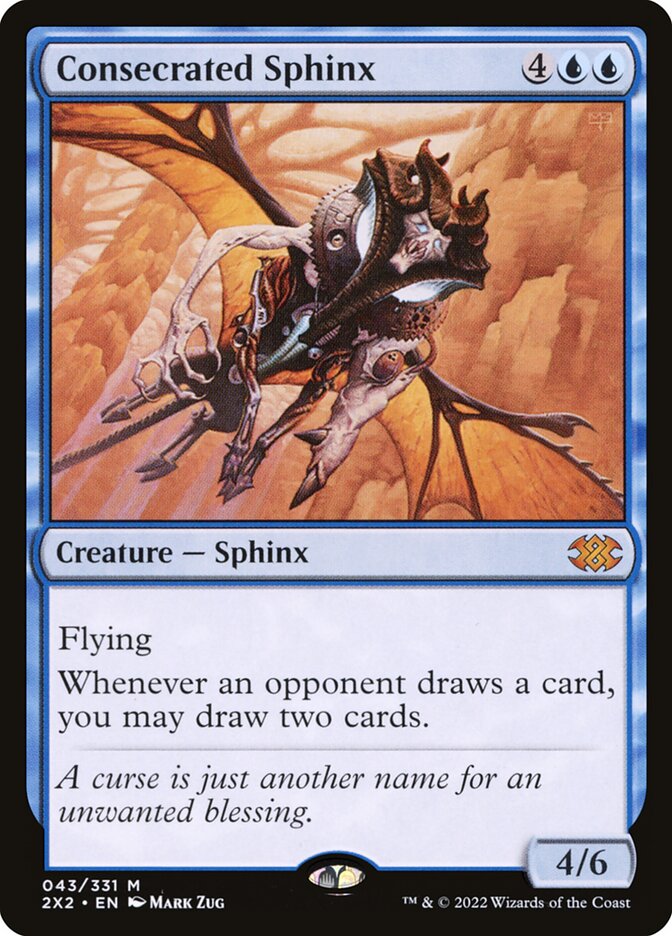 Consecrated Sphinx
If you attack with Sapphire Dragon while your opponent has a Consecrated Sphinx, Sapphire Dragon's scry 2 trigger happens first. You can look at the top two cards of your library and put them on the bottom or top. This helps you ensure that if you draw cards later in the turn, you aren't feeding your opponent's Sphinx with useless lands.
Guide written with AI from the official text and rulings. Official English text prevails.
How it works : Sapphire Dragon // Psionic Pulse
Original English text — Wizards of the Coast / Scryfall
- #1· Wizards of the Coast
An adventurer card is a permanent card in every zone except the stack, as well as while on the stack if not cast as an Adventure. Ignore its alternative characteristics in those cases. For example, while it’s in your graveyard, Altar of Bhaal is an artifact card whose mana value is 2.
No other card is named in this ruling.
- #2· Wizards of the Coast
When casting a spell as an Adventure, use the alternative characteristics and ignore all of the card’s normal characteristics. The spell’s color, mana cost, mana value, and so on are determined by only those alternative characteristics. If the spell leaves the stack, it immediately resumes using its normal characteristics.
No other card is named in this ruling.
- #3· Wizards of the Coast
If you cast an adventurer card as an Adventure, use only its alternative characteristics to determine whether it’s legal to cast that spell.
No other card is named in this ruling.
- #4· Wizards of the Coast
If a spell is cast as an Adventure, its controller exiles it instead of putting it into its owner’s graveyard as it resolves. For as long as it remains exiled, that player may cast it as a permanent spell. If an Adventure spell leaves the stack in any way other than resolving (most likely by being countered or by failing to resolve because its targets have all become illegal), that card won’t be exiled and the spell’s controller won’t be able to cast it as a permanent later.
No other card is named in this ruling.
- #5· Wizards of the Coast
If an adventurer card ends up in exile for any other reason than by exiling itself while resolving, it won’t give you permission to cast it as a permanent spell.
No other card is named in this ruling.
- #6· Wizards of the Coast
You must still follow any relevant timing rules for the permanent spell you cast from exile. Normally, you’ll be able to cast it only during your main phase while the stack is empty.
No other card is named in this ruling.
- #7· Wizards of the Coast
If an effect copies an Adventure spell, that copy is exiled as it resolves. It ceases to exist as a state-based action; it’s not possible to cast the copy from exile.
No other card is named in this ruling.
- #8· Wizards of the Coast
An effect may refer to a card, spell, or permanent that “has an Adventure.” This refers to a card, spell, or permanent that has an adventurer card’s set of alternative characteristics, even if they’re not being used and even if that card was never cast as an Adventure.
No other card is named in this ruling.
- #9· Wizards of the Coast
If an object becomes a copy of an object that has an Adventure, the copy also has an Adventure. If it changes zones, it will either cease to exist (if it’s a token) or cease to be a copy (if it’s a nontoken permanent), and so you won’t be able to cast it as an Adventure.
No other card is named in this ruling.
- #10· Wizards of the Coast
If an effect instructs you to choose a card name, you may choose the alternative Adventure name. Consider only the alternative characteristics to determine whether that is an appropriate name to choose.
No other card is named in this ruling.
- #11· Wizards of the Coast
Casting a card as an Adventure isn’t casting it for an alternative cost. Effects that allow you to cast a spell for an alternative cost or without paying its mana cost may allow you to apply those to the Adventure.
No other card is named in this ruling.
Popular combos
Real combos played by the community, sorted by popularity.


Guile + Sapphire Dragon // Psionic Pulse + Lucky Clover
- 1Cast Psionic Pulse by paying

 , targeting another noncreature spell currently on the stack.
- 2Lucky Clover triggers, copying Psionic Pulse, with the copy targeting the original Psionic Pulse.
- 3Resolve the copy of Psionic Pulse, causing you to exile the original Psionic Pulse, and cast it from exile without paying its mana cost, targeting another noncreature spell due to Guile.
- 4Repeat from step 2.

Gorion, Wise Mentor + Guile + Sapphire Dragon // Psionic Pulse
- 1Cast Psionic Pulse by paying , targeting another noncreature spell currently on the stack.
- 2Gorion triggers, copying Psionic Pulse, with the copy targeting the original Psionic Pulse.
- 3Resolve the copy of Psionic Pulse, causing you to exile the original Psionic Pulse, and cast it from exile without paying its mana cost, targeting another noncreature spell due to Guile.
- 4Repeat from step 2.
Related cards and tokens
Legal formats
Commentaires
- Sois le premier à commenter cette carte.
Read next
Meta decks with Sapphire Dragon // Psionic Pulse
No archived Top 8 deck with this card yet.