

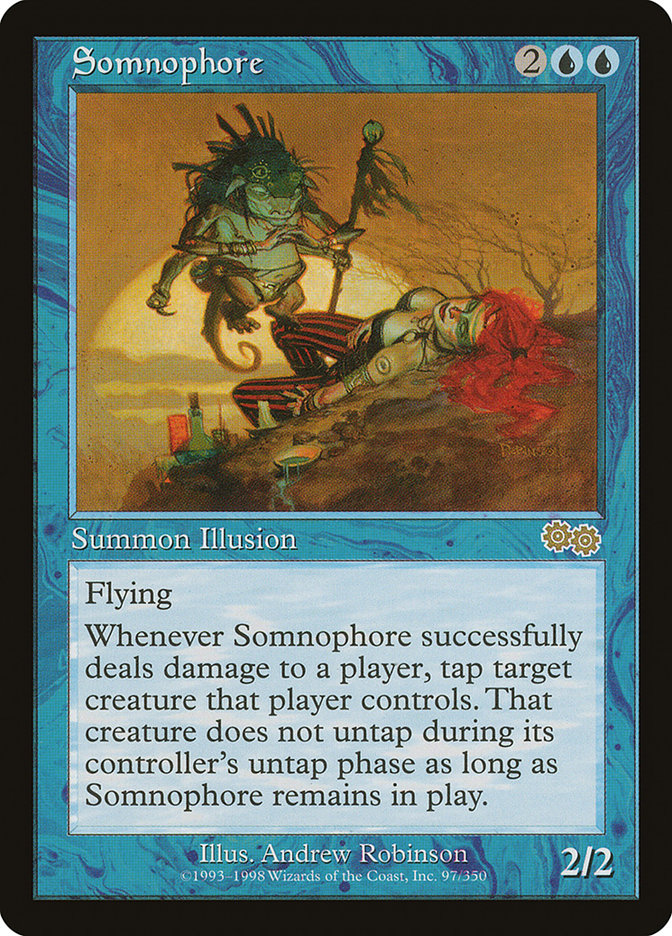
Somnophore is one of those cards players keep asking about. Here is, in plain words, what its official text says, the rulings published by Wizards of the Coast, and the combos players actually run.
Official card text
Flying Whenever this creature deals damage to a player, tap target creature that player controls. That creature doesn't untap during its controller's untap step for as long as this creature remains on the battlefield.
Complete guide
Somnophore is a blue Illusion that keeps your opponents in a permanent state of drowsiness. By utilizing its flying ability to bypass blockers, it can effectively remove multiple threats from combat for as long as it stays in play. Understanding how its 'freeze' effect persists is key to controlling the tempo of the game.
What it Does
Somnophore has a triggered ability that activates whenever it deals damage to a player. Unlike many similar effects that only last for one turn, Somnophore locks a creature down indefinitely. The target creature will not untap during its controller's untap step as long as Somnophore is on the battlefield. If Somnophore leaves the battlefield, the effect ends immediately, and the creature can untap during its next available untap step.
Step-by-Step Resolution
First, Somnophore must deal damage to a player, which usually happens during the combat damage step. Once damage is dealt, the ability triggers and you choose a target creature controlled by that player. When the ability resolves, the target creature is tapped. From that moment on, a continuous effect is created that prevents that specific creature from untapping as long as Somnophore remains in play. This process can be repeated every turn to lock down additional creatures.
Common Mistakes
A common misconception is that the effect only applies to the most recently targeted creature. In reality, Somnophore can hold multiple creatures tapped simultaneously if it deals damage over several turns. Another mistake is forgetting that if Somnophore is temporarily exiled (flickered) and returns, it is considered a new object; all previously locked-down creatures will be free to untap because the 'original' Somnophore is no longer on the battlefield.
When to Play It
Somnophore is most effective in decks that can protect it from removal, as its effect relies entirely on its presence on the board. It is particularly strong against decks that rely on a few large creatures for defense or offense. By tapping down a key blocker, Somnophore ensures it can continue to deal damage in subsequent turns, eventually neutralizing the opponent's entire board.
Interaction examples
 Solemn Simulacrum
If Somnophore deals combat damage to a player who controls a Solemn Simulacrum, you can target the Simulacrum. The Simulacrum will become tapped and will not untap during its controller's untap step as long as Somnophore is on the battlefield. Even if the player has ways to untap it with other spells, it will still fail to untap naturally during their untap step.
 Roaming Throne
If you control Roaming Throne and chose 'Illusion' as its type, Somnophore's ability will trigger twice whenever it deals damage to a player. This allows you to target and lock down two different creatures (or the same creature twice, though this has no extra benefit) for every successful attack. Both creatures will remain tapped as long as Somnophore stays on the battlefield.
Guide written with AI from the official text and rulings. Official English text prevails.
How it works : Somnophore
Original English text — Wizards of the Coast / Scryfall
- #1· Wizards of the Coast
It can end up holding more than one creature tapped.
No other card is named in this ruling.
- #2· Wizards of the Coast
You can choose the same creature more than once (for no additional effect).
No other card is named in this ruling.
Legal formats
Commentaires
- Sois le premier à commenter cette carte.
Read next
Meta decks with Somnophore
No archived Top 8 deck with this card yet.