

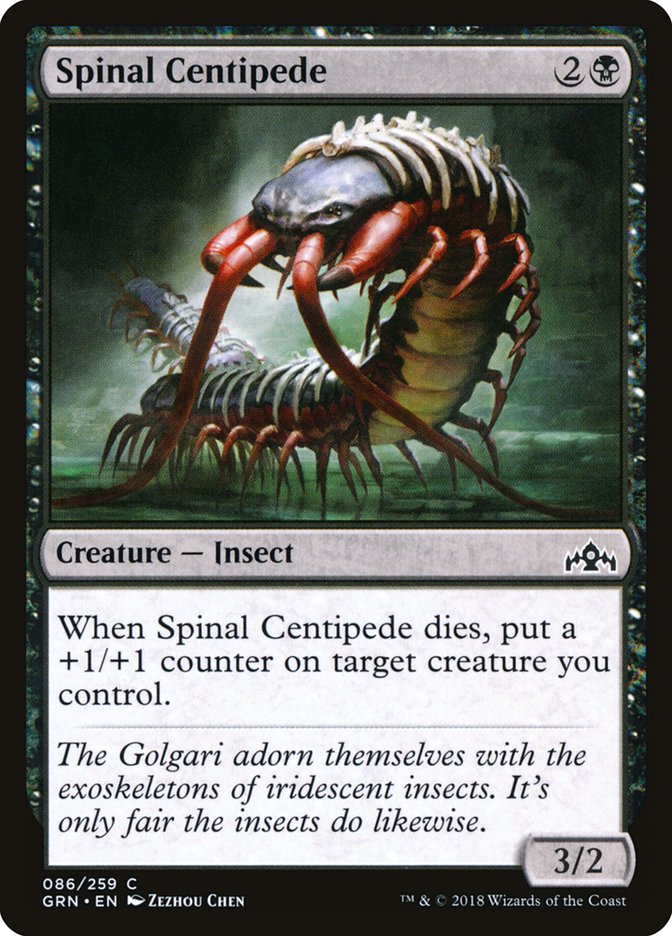
Spinal Centipede is one of those cards players keep asking about. Here is, in plain words, what its official text says, the rulings published by Wizards of the Coast, and the combos players actually run.
Official card text
When this creature dies, put a +1/+1 counter on target creature you control.
Complete guide
Spinal Centipede is a classic black utility creature that ensures your presence on the battlefield persists even after its death. By transferring its essence into a +1/+1 counter, it transforms a tactical loss into a strategic growth for your remaining forces. Understanding the timing of this 'dies' trigger is key to maximizing your board state.
Understanding the Death Trigger
Spinal Centipede features a triggered ability that looks for the specific event of it being put into a graveyard from the battlefield. When this happens, you must choose a target creature you control. This ability is mandatory; if you control at least one other creature when the Centipede dies, you must place the counter on one of them. If you control no creatures, the ability simply fizzles without effect.
Step-by-Step Resolution
First, Spinal Centipede is moved to the graveyard due to lethal damage or a sacrifice effect. Second, its ability triggers and is put onto the stack. At this point, you choose a legal target creature you control. Third, players may respond with spells or abilities. Finally, if the target is still legal, the ability resolves and a +1/+1 counter is placed on the chosen creature.
Simultaneous Deaths and Timing
A common mistake involves simultaneous destruction, such as during combat or a board wipe. If Spinal Centipede and another creature you control are destroyed at the exact same time, the other creature is already in the graveyard when the Centipede's ability attempts to target it. Because a creature must be on the battlefield to receive a counter, you cannot save a dying ally with this trigger.
Strategic Deployment
This card excels in aggressive decks where you expect to trade creatures in combat. It forces opponents into difficult choices: blocking the Centipede allows you to buff a different, perhaps more dangerous, attacker. It also serves as excellent fodder for sacrifice outlets, ensuring you get extra value beyond just the sacrifice effect itself.
Interaction examples
 Roaming Throne
If you have Roaming Throne on the battlefield and chose 'Insect' as it entered, Spinal Centipede's ability will trigger an additional time when it dies. This allows you to place two +1/+1 counters on target creatures you control—either both on the same creature or one each on two different creatures.
 Solemn Simulacrum
If both creatures are on the battlefield and an opponent casts a spell that destroys only Spinal Centipede, you can target Solemn Simulacrum with the +1/+1 counter. This makes the Simulacrum a 3/3 attacker. If both die at the same time, you will still draw a card from the Simulacrum and get the counter trigger from the Centipede, but you cannot put that counter on the Simulacrum because it is no longer on the battlefield.
Guide written with AI from the official text and rulings. Official English text prevails.
How it works : Spinal Centipede
Original English text — Wizards of the Coast / Scryfall
- #1· Wizards of the Coast
If another creature you control is dealt lethal damage at the same time as Spinal Centipede, they’re destroyed at the same time. That creature can’t receive a counter from Spinal Centipede’s ability in time to save it.
No other card is named in this ruling.
Legal formats
Commentaires
- Sois le premier à commenter cette carte.
Read next
Meta decks with Spinal Centipede
No archived Top 8 deck with this card yet.