

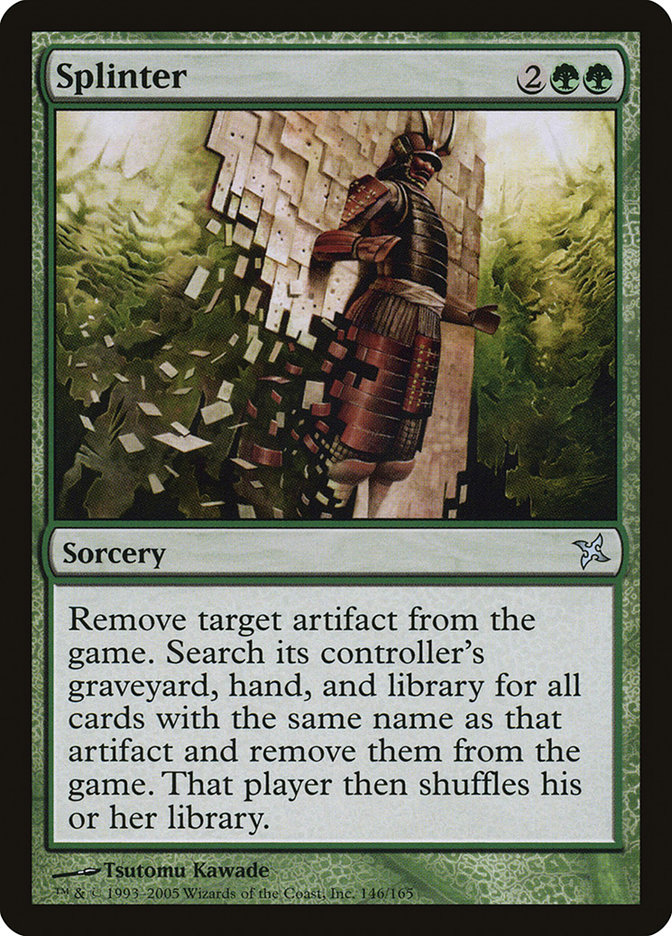
Splinter is one of those cards players keep asking about. Here is, in plain words, what its official text says, the rulings published by Wizards of the Coast, and the combos players actually run.
Official card text
Exile target artifact. Search its controller's graveyard, hand, and library for all cards with the same name as that artifact and exile them. Then that player shuffles.
Complete guide
Splinter is a devastating sorcery designed to dismantle an opponent's strategy by removing every trace of a key artifact. By targeting a single item on the battlefield, you can strip away all remaining copies from your opponent's hand, graveyard, and library. It is a surgical strike that ensures a specific threat never returns to the game.
What It Does
Splinter is a targeted removal spell that exiles an artifact on the battlefield. The unique part of its effect is the 'surgical' extraction: once the artifact is exiled, you search the controller's private and public zones—specifically the hand, graveyard, and library—for all cards with the exact same name as the exiled artifact and exile those as well. Finally, that player shuffles their library.
How It Resolves Step by Step
First, you choose a legal target artifact on the battlefield. Upon resolution, that artifact is moved to the exile zone. Next, you look through the controller's graveyard (a public zone) and exile all cards with that name. Then, you search their hand and library (private zones). While you must exile cards found in public zones, finding cards in private zones is technically optional according to official rulings. Once the search and exiling are complete, the player shuffles their library to conclude the effect.
Common Mistakes
One common misconception is that Splinter exiles other permanents on the battlefield with the same name. It does not; it only affects the single target on the field and the copies found in the hand, graveyard, and library. Another nuance is that Splinter only checks for the name of the card. If you target an object that is currently an artifact due to an effect (like an animated land) but isn't normally an artifact card, you still search for all cards with that name, even if those cards in the library aren't artifacts themselves.
When to Play It
Splinter is best used against 'engine' cards or combo pieces that your opponent relies on to win. Because it exiles all copies, it is far more powerful than simple destruction. It is particularly effective in formats where decks run four copies of a specific utility artifact, as one successful cast can effectively neuter their game plan for the rest of the match.
Interaction examples
You cast Splinter targeting your opponent's Sol Ring. The Sol Ring on the battlefield is exiled. You then look at their hand and search their graveyard and library. If they have three more copies of Sol Ring in their library, those are all exiled. Your opponent then shuffles their library, now completely devoid of that mana source.
 Cultivate
If an opponent used Cultivate earlier to put a basic Forest into their hand and you later use an effect to turn that Forest on the battlefield into an artifact, you could cast Splinter on it. This would allow you to exile the Forest on the field and then search their hand and library for all other cards named Forest, potentially stripping their deck of basic resources.
If you use Splintering Wind to create a 1/1 green Splinter creature token, and an opponent targets that token with Splinter, only the token is exiled. Since tokens do not exist as cards in the library, hand, or graveyard, the search will result in no additional cards being exiled, though the player must still shuffle.
Guide written with AI from the official text and rulings. Official English text prevails.
How it works : Splinter
Original English text — Wizards of the Coast / Scryfall
- #1· Wizards of the Coast
Splinter can target and exile cards that aren’t always artifacts, but are artifacts when Splinter is cast and resolves (such as an animated Stalking Stones). Splinter’s exile effect only looks for cards by name, not type.
No other card is named in this ruling.
- #2· Wizards of the Coast
The copies must be found if they are in publicly viewable zones. Finding copies while searching private zones is optional.
No other card is named in this ruling.
- #3· Wizards of the Coast
Does not exile other cards of the same name that are on the battlefield. Just from the graveyard, hand, and library.
No other card is named in this ruling.
Interactions with other cards
These cards' text mentions Splinter.
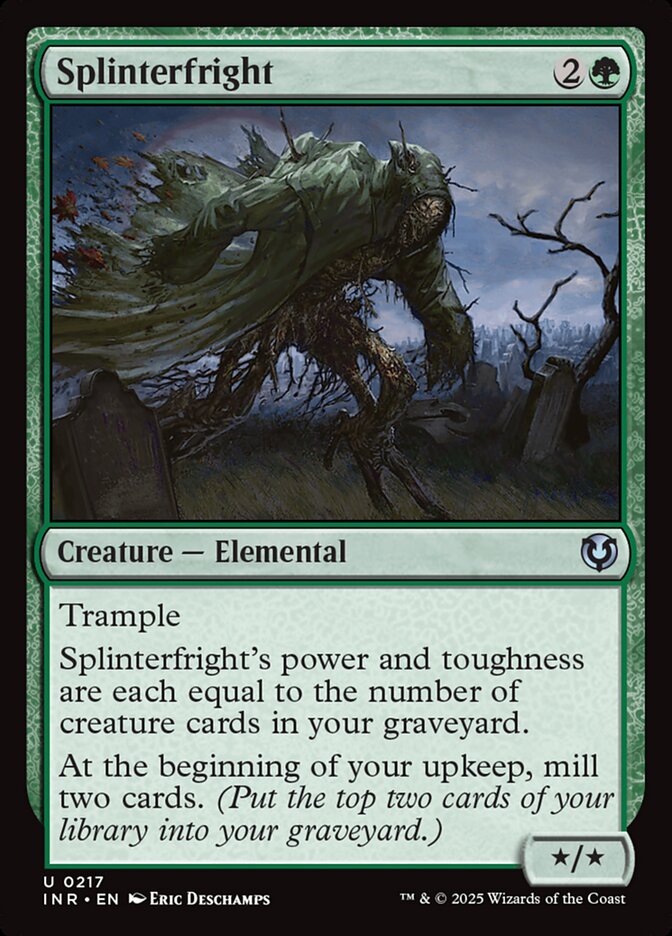
Trample Splinterfright's power and toughness are each equal to the number of creature cards in your graveyard. At the beginning of your upkeep, mill two cards. (Put the top two cards of your library into your graveyard.)
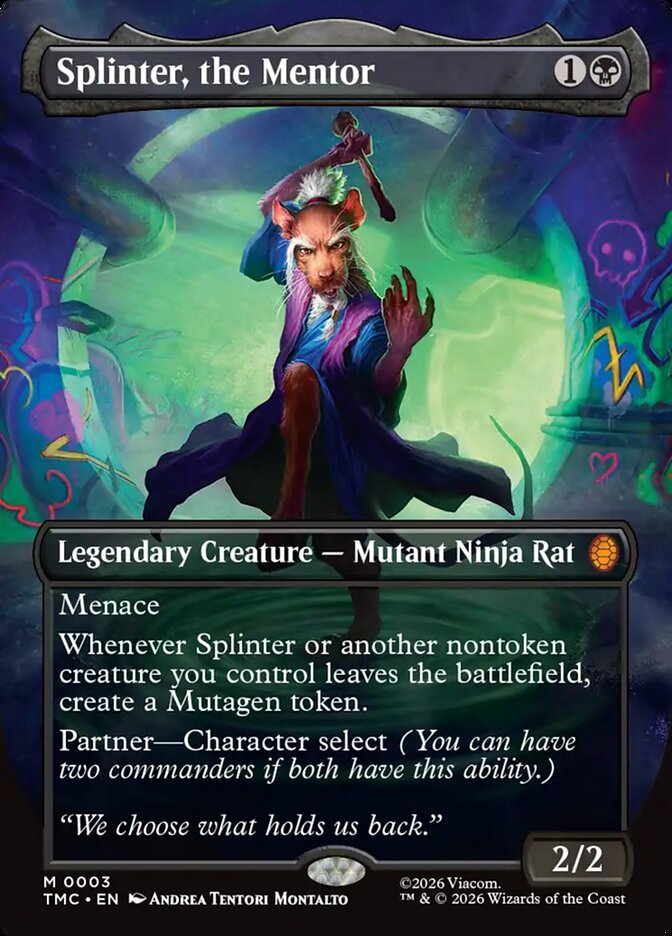
Menace Whenever Splinter or another nontoken creature you control leaves the battlefield, create a Mutagen token. Partner—Character select (You can have two commanders if both have this ability.)

When Splinter enters, destroy up to one target tapped creature. When Splinter leaves the battlefield, you and another target player each draw a card.

When Splinter & Leo enter, choose one or both. Each mode must target a different player. • Target player creates a 2/2 red Mutant creature token. • Put a +1/+1 counter on each other creature target player controls.
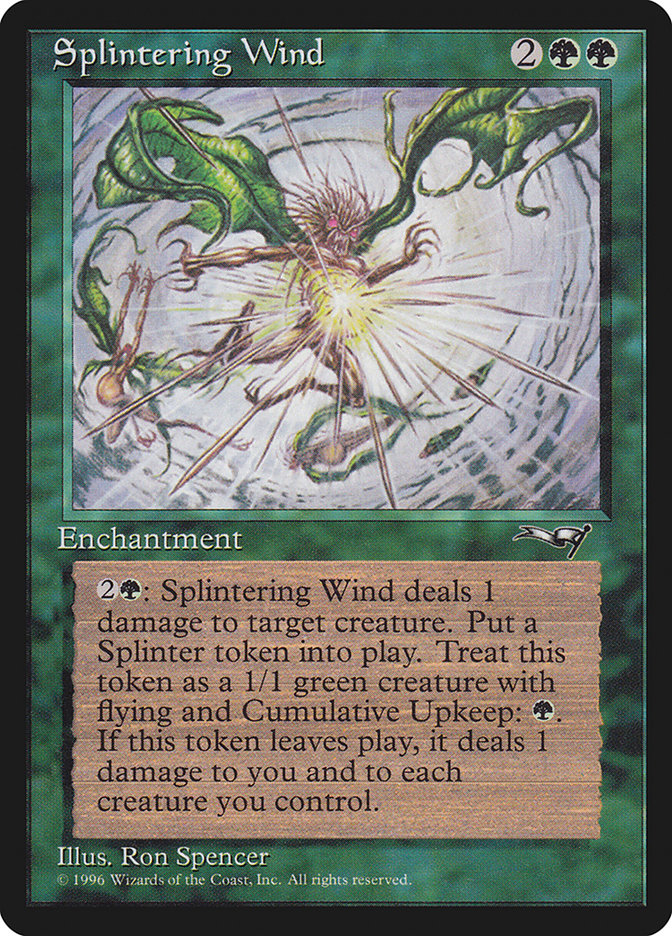
{2}{G}: This enchantment deals 1 damage to target creature. Create a 1/1 green Splinter creature token. It has flying and "Cumulative upkeep {G}." When it leaves the battlefield, it deals 1 damage to you and each creature you control. (At the beginning of its controller's upkeep, that player puts an age counter on it, then sacrifices it unless they pay its upkeep cost for each age counter on it.)
Legal formats
Commentaires
- Sois le premier à commenter cette carte.
Read next

Meta decks with Splinter
No archived Top 8 deck with this card yet.