

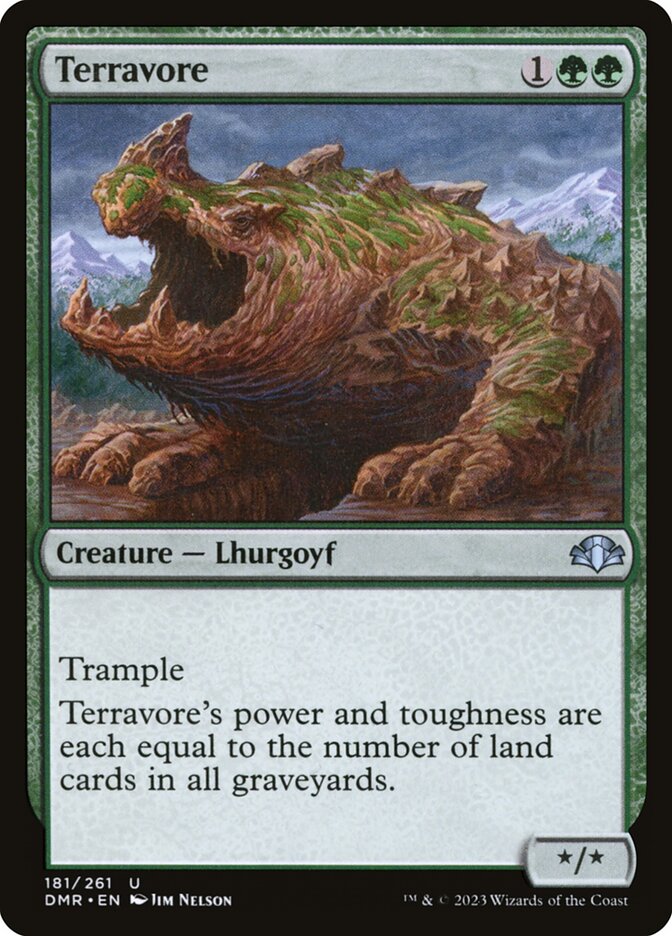
Terravore is one of those cards players keep asking about. Here is, in plain words, what its official text says, the rulings published by Wizards of the Coast, and the combos players actually run.
Official card text
Trample Terravore's power and toughness are each equal to the number of land cards in all graveyards.
Complete guide
Terravore is a classic Lhurgoyf that grows stronger as the landscape of the game shifts into the graveyard. With the ability to trample over blockers, it serves as a massive threat in any game where lands are frequently sacrificed or discarded.
Understanding the Lhurgoyf Ability
Terravore features a characteristic-defining ability that sets its power and toughness equal to the total number of land cards in all graveyards. Because this is a characteristic-defining ability, it functions in all zones, meaning Terravore's stats are updated constantly whether it is in your hand, library, or graveyard.
Step-by-Step Resolution
When Terravore is on the battlefield, its power and toughness are checked continuously as a continuous effect. First, the game identifies all players and their respective graveyards. Second, it counts every card that has the 'Land' type in those graveyards. Finally, Terravore's power and toughness are immediately updated to match that sum. This happens without using the stack, so the moment a land hits a graveyard, Terravore grows.
Common Mistakes to Avoid
A common misconception is that Terravore only counts lands in your own graveyard; however, it counts land cards in all graveyards. Additionally, players often forget that Terravore will survive a board wipe if a land is destroyed at the same time, provided the total number of lands in graveyards remains above zero. Remember that cards that are 'exiled' are not in the graveyard and do not contribute to its stats.
When to Play Terravore
Terravore is most effective in decks that utilize 'fetch lands' or effects that require sacrificing lands for value. Since it has Trample, it is a reliable finisher that can bypass small tokens or 'chump' blockers. It is best played after several lands have already entered the graveyard to ensure it survives any toughness-based removal.
Interaction examples
 Sakura-Tribe Elder
If you have Terravore on the battlefield and sacrifice Sakura-Tribe Elder, the Elder goes to the graveyard. While the search effect is on the stack, Terravore's stats remain the same. Once you find a basic land and put it onto the battlefield, nothing changes, but if a land card were to be discarded or destroyed later, Terravore would grow immediately.
 Solemn Simulacrum
When Solemn Simulacrum dies, it is put into the graveyard. Since Solemn Simulacrum is an artifact creature and not a land, its presence in the graveyard does not increase Terravore's power or toughness. Terravore only cares about the 'Land' card type.
If there are five land cards total in all graveyards, Terravore is a 5/5 creature with Trample. If your opponent blocks with a 1/1 creature, Terravore can deal 1 damage to the blocker and 'trample' for 4 damage to the opponent. If a land is put into a graveyard during the combat step before damage is dealt, Terravore will grow, potentially increasing the trample damage.
Guide written with AI from the official text and rulings. Official English text prevails.
How it works : Terravore
Original English text — Wizards of the Coast / Scryfall
- #1· Wizards of the Coast
The ability that defines Terravore’s power and toughness works in all zones, not only the battlefield.
No other card is named in this ruling.
Legal formats
Commentaires
- Sois le premier à commenter cette carte.
Read next
Meta decks with Terravore
No archived Top 8 deck with this card yet.