

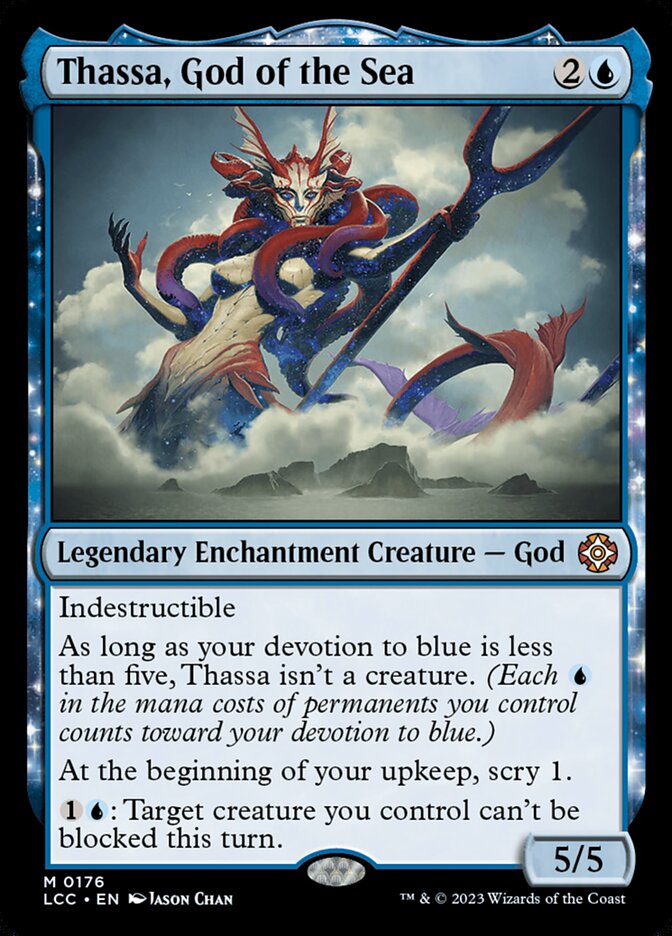
Thassa, God of the Sea is one of those cards players keep asking about. Here is, in plain words, what its official text says, the rulings published by Wizards of the Coast, and the combos players actually run.
Official card text
Indestructible As long as your devotion to blue is less than five, Thassa isn't a creature. (Eachin the mana costs of permanents you control counts toward your devotion to blue.) At the beginning of your upkeep, scry 1.
Complete guide
Thassa, God of the Sea is an iconic legendary enchantment creature from the Theros block, embodying the power and foresight of the deep. This indestructible God provides consistent card selection and tactical evasion, transitioning from a static enchantment to a powerful creature once your devotion to blue is high enough.
Divine Devotion and Form
Thassa's identity is tied to your devotion to blue, which is the total number of blue mana symbols ({U}) in the mana costs of permanents you control. While your devotion is less than five, Thassa is not a creature; she is a legendary enchantment. Importantly, Thassa's own {U} in her mana cost counts toward this total. If she is on the battlefield and your devotion drops below five, she immediately loses the creature and God types and is removed from combat if she was attacking or blocking.
Resolving the Tide
Step one: At the beginning of your upkeep, Thassa's triggered ability goes on the stack. Step two: As it resolves, you scry 1, looking at the top card of your library and deciding whether to keep it on top or put it on the bottom. Step three: During your main phase or combat, you can pay {1}{U} to target a creature. Step four: Upon resolution, that creature gains a continuous effect that prevents it from being blocked for the remainder of the turn.
Common Pitfalls
A common mistake involves timing the unblockable ability; activating it after a creature has already been blocked will not remove the blocker. Another confusion arises with card types: Thassa is always a creature card in your hand, library, or graveyard. However, if your devotion is low as she enters the battlefield, replacement effects that affect creatures (like entering with +1/+1 counters) will not apply to her because she isn't a creature yet.
When to Unleash the Sea
Thassa is best utilized in decks that can consistently maintain a board presence of blue permanents. Her upkeep scry is invaluable for smoothing out draws in the early game, while her activated ability serves as a finisher by allowing large threats to bypass your opponent's defenses entirely. Even if she isn't a creature, her indestructible nature makes her a resilient source of utility.
Interaction examples
 Solemn Simulacrum
If you control Thassa, God of the Sea and cast Solemn Simulacrum, your devotion to blue does not increase. The mana cost of Solemn Simulacrum contains only generic mana, which does not contribute to devotion. Thassa will only become a creature if you control other permanents with enough blue mana symbols in their costs to reach five.
 Roaming Throne
If you name 'God' as Roaming Throne enters the battlefield and your devotion to blue is five or greater, Thassa is a God creature. During your upkeep, Thassa's scry ability will trigger twice because of Roaming Throne. However, if your devotion is less than five, Thassa is not a creature, and Roaming Throne will not cause her abilities to trigger an additional time.
Guide written with AI from the official text and rulings. Official English text prevails.
How it works : Thassa, God of the Sea
Original English text — Wizards of the Coast / Scryfall
- #1· Wizards of the Coast
The type-changing ability that can make a God not be a creature functions only on the battlefield. It's always a creature card in other zones, regardless of your devotion to its color. It's always a creature spell while it's on the stack.
No other card is named in this ruling.
- #2· Wizards of the Coast
As a God enters the battlefield, your devotion to its color will determine whether any replacement effects that affect creatures entering the battlefield apply to that God. Because replacement effects are considered before the God is on the battlefield, the mana symbols in its mana cost won't be counted when determining this.
No other card is named in this ruling.
- #3· Wizards of the Coast
When a God enters the battlefield, your devotion to its color (including the mana symbols in the mana cost of the God itself) will determine if a creature entered the battlefield or not for abilities that trigger whenever a creature enters the battlefield.
No other card is named in this ruling.
- #4· Wizards of the Coast
If a God stops being a creature, it loses the type creature and the creature type God. It continues to be a legendary enchantment.
No other card is named in this ruling.
- #5· Wizards of the Coast
The abilities of Gods function as long as they're on the battlefield, regardless of whether they're creatures.
No other card is named in this ruling.
- #6· Wizards of the Coast
If a God is attacking or blocking and it stops being a creature, it will be removed from combat. It won't rejoin combat if it resumes being a creature later during that combat.
No other card is named in this ruling.
- #7· Wizards of the Coast
Counters put on a God remain on it while it's not a creature, even if they have no effect.
No other card is named in this ruling.
- #8· Wizards of the Coast
If an effect causes a God to lose all abilities, its ability that causes it to stop being a creature still applies if appropriate.
No other card is named in this ruling.
- #9· Wizards of the Coast
Activating Thassa's last ability after the target creature has been blocked won't change or undo the block.
No other card is named in this ruling.
- #10· Wizards of the Coast
Scry appears on some spells and abilities with one or more targets. If all of the spell or ability's targets are illegal when it tries to resolve, it won't resolve and none of its effects will happen. You won't scry.
No other card is named in this ruling.
- #11· Wizards of the Coast
Numeric mana symbols (
 ,
 , and so on) in mana costs of permanents you control don't count toward your devotion to any color.
No other card is named in this ruling.
- #12· Wizards of the Coast
Mana symbols in the text boxes of permanents you control don't count toward your devotion to any color.
No other card is named in this ruling.
- #13· Wizards of the Coast
Hybrid mana symbols, monocolored hybrid mana symbols, and Phyrexian mana symbols do count toward your devotion to their color(s).
No other card is named in this ruling.
- #14· Wizards of the Coast
If an activated ability or triggered ability has an effect that depends on your devotion to a color, you count the number of mana symbols of that color among the mana costs of permanents you control as the ability resolves. The permanent with that ability will be counted if it's still on the battlefield at that time.
No other card is named in this ruling.
- #15· Wizards of the Coast
When you scry, you may put all the cards you look at back on top of your library, you may put all of those cards on the bottom of your library, or you may put some of those cards on top and the rest of them on the bottom.
No other card is named in this ruling.
- #16· Wizards of the Coast
You choose how to order cards returned to your library after scrying no matter where you put them.
No other card is named in this ruling.
- #17· Wizards of the Coast
You perform the actions stated on a card in sequence. For some spells and abilities, that means you'll scry last. For others, that means you'll scry and then perform other actions.
No other card is named in this ruling.
Legal formats
Commentaires
- Sois le premier à commenter cette carte.