

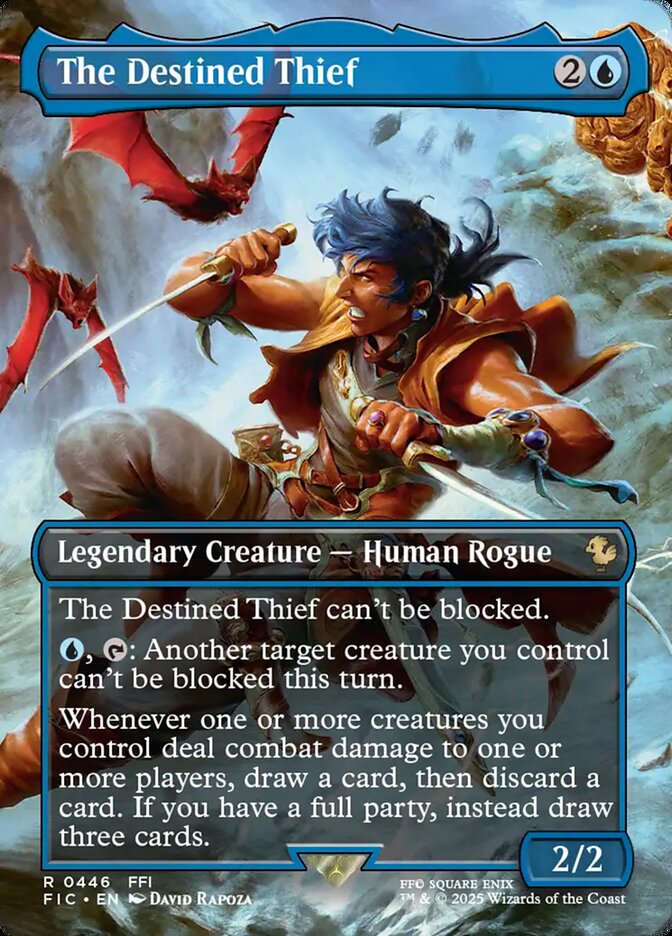
The Destined Thief is one of those cards players keep asking about. Here is, in plain words, what its official text says, the rulings published by Wizards of the Coast, and the combos players actually run.
Official card text
The Destined Thief can't be blocked.,
: Another target creature you control can't be blocked this turn. Whenever one or more creatures you control deal combat damage to one or more players, draw a card, then discard a card. If you have a full party, instead draw three cards.
Complete guide
The Destined Thief is a powerhouse for party-themed decks, offering both evasion and significant card advantage. As a Legendary Human Rogue, it fills a slot in your party while ensuring your creatures always find a way past the enemy's defenses. Whether you are looting or drawing three cards at once, this Rogue is a master of infiltration.
Unblockable Infiltration
The Destined Thief has two abilities focused on evasion. First, it is naturally unblockable, meaning opponents cannot declare blockers against it during the declare blockers step. Second, you can pay one blue mana and tap it to make another target creature you control unblockable for the rest of the turn. This is an activated ability that must be used before the declare blockers step to be effective.
Mastering the Party Mechanic
The final ability triggers whenever one or more creatures you control deal combat damage to one or more players. Normally, you draw a card and discard a card. however, if you have a full party—meaning you control a Cleric, a Rogue, a Warrior, and a Wizard—you instead draw three cards and do not discard anything. Each creature can only fill one role in the party, but the game will always calculate the highest possible number if a creature has multiple types.
Common Mistakes
A common error is waiting too long to activate the unblockable ability. If a creature has already been blocked, making it unblockable will not remove it from combat or negate the block. Additionally, remember that the draw ability triggers only once per combat event, regardless of how many creatures deal damage simultaneously. However, if creatures deal damage at different times (like via First Strike), it may trigger multiple times.
When to Play It
Deploy The Destined Thief when you have a board presence that needs help connecting with your opponent. It is most effective in decks that can quickly assemble the four party roles to maximize the draw-three effect. Since it can make itself and others unblockable, it is a reliable engine for consistent card selection and advantage.
Interaction examples
 Solemn Simulacrum
You control The Destined Thief and Solemn Simulacrum. During your pre-combat main phase, you pay one blue mana and tap The Destined Thief, targeting Solemn Simulacrum. Now, both creatures can attack, and your opponent cannot block either of them. When they deal combat damage, The Destined Thief's ability triggers, allowing you to draw and discard.
 Roaming Throne
You play Roaming Throne and choose 'Rogue' as the creature type. Because Roaming Throne is a Golem (not a Cleric, Warrior, or Wizard), your party count is only two (Thief and Throne). When The Destined Thief deals combat damage, its ability triggers. Roaming Throne causes it to trigger an additional time. You will draw a card and discard a card, then repeat that process for the second trigger.
If you attack with Solemn Simulacrum and your opponent declares a blocker, it is too late to use The Destined Thief's activated ability to make it unblockable. To ensure the Simulacrum gets through, you must activate the ability during the Declare Attackers step at the latest, before the Declare Blockers step begins.
Guide written with AI from the official text and rulings. Official English text prevails.
How it works : The Destined Thief
Original English text — Wizards of the Coast / Scryfall
- #1· Wizards of the Coast
If a creature has more than one party creature type, and there are multiple ways to count that creature that could result in a different number of creatures in your party, the highest such number is used. For example, if you control a Cleric and a Cleric Wizard, the number of creatures in your party is two. You can't choose to have it be just one by counting the Cleric Wizard first as a Cleric.
No other card is named in this ruling.
- #2· Wizards of the Coast
Once a creature you control has been blocked, activating The Destined Thief's second ability targeting that creature won't cause it to become unblocked.
No other card is named in this ruling.
- #3· Wizards of the Coast
Some cards refer to you having a "full party." This is true if the number of creatures in your party is four.
No other card is named in this ruling.
- #4· Wizards of the Coast
To determine "the number of creatures in your party," check whether you control a Cleric, whether you control a Rogue, whether you control a Warrior, and whether you control a Wizard. The number is the total number of those checks to which you answered yes. Each creature you control can be counted for only one of those checks.
No other card is named in this ruling.
- #5· Wizards of the Coast
If you have a full party, you won't discard at all when The Destined Thief's last ability resolves.
No other card is named in this ruling.
Legal formats
Commentaires
- Sois le premier à commenter cette carte.
Read next
Meta decks with The Destined Thief
No archived Top 8 deck with this card yet.