

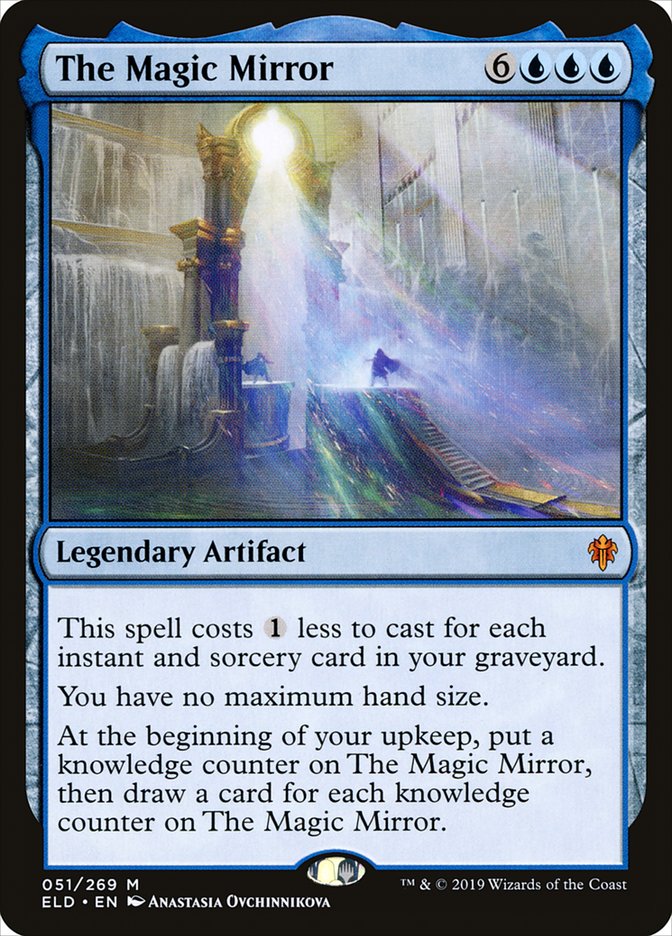
The Magic Mirror is one of those cards players keep asking about. Here is, in plain words, what its official text says, the rulings published by Wizards of the Coast, and the combos players actually run.
Official card text
This spell costsless to cast for each instant and sorcery card in your graveyard. You have no maximum hand size. At the beginning of your upkeep, put a knowledge counter on The Magic Mirror, then draw a card for each knowledge counter on The Magic Mirror.
Complete guide
The Magic Mirror is a legendary artifact that rewards you for filling your graveyard with spells. Once it hits the battlefield, it offers an infinite hand size and an ever-increasing flow of card advantage that can quickly overwhelm your opponents. Understanding how its cost reduction and upkeep triggers function is key to mastering this powerful engine.
Casting the Mirror
The Magic Mirror has a high mana value of nine, but its cost reduction ability significantly lowers this price. For every instant and sorcery card currently in your graveyard, the spell costs {1} less to cast. This reduction only applies to the generic mana portion of the cost; you must always pay the three blue mana. If you have six or more spells in your graveyard, you can cast it for its minimum cost of {U}{U}{U}.
Resolution and Upkeep
Once The Magic Mirror is on the battlefield, you no longer have a maximum hand size, meaning you do not have to discard down to seven cards during your cleanup step. The primary ability triggers at the beginning of your upkeep. First, you place a knowledge counter on the artifact. Then, you count the total number of knowledge counters on it and draw that many cards. This happens every turn, meaning you draw one card the first turn, two the next, and so on.
Common Pitfalls
A common mistake involves counting card types incorrectly. Split cards that are both an instant and a sorcery only count as one card for the cost reduction. Similarly, Adventurer cards are considered creature cards while in the graveyard, so they do not reduce the cost. Furthermore, once you announce you are casting The Magic Mirror, opponents cannot exile cards from your graveyard to increase the cost; the cost is locked in once the casting process begins.
Strategic Timing
Because The Magic Mirror draws cards during your upkeep, it is best played when you can protect it or when you already have a lead. Since it provides an exponential draw effect, it often becomes a priority target for removal. Note that if The Magic Mirror is destroyed in response to its upkeep trigger, you still draw cards based on the number of counters it had before it left the battlefield.
Interaction examples
If your graveyard contains three instants and two sorceries, the cost to cast The Magic Mirror is reduced by {5}. Instead of {6}{U}{U}{U}, you pay {1}{U}{U}{U}.
At the start of your upkeep, the trigger goes on the stack. You add a second knowledge counter to the Mirror. If an opponent casts a spell to destroy the Mirror while the trigger is still on the stack, the Mirror leaves the battlefield. When the trigger finally resolves, the game checks the last known information and sees it had two counters, so you still draw two cards.
With The Magic Mirror on the field, you draw three cards during your upkeep on the third turn. Even if you have 15 cards in hand at the end of your turn, the static ability ensures you do not discard any of them during the cleanup step.
Guide written with AI from the official text and rulings. Official English text prevails.
How it works : The Magic Mirror
Original English text — Wizards of the Coast / Scryfall
- #1· Wizards of the Coast
Adventurer cards aren't instant or sorcery cards while they're in your graveyard.
No other card is named in this ruling.
- #2· Wizards of the Coast
If a split card is both an instant card and a sorcery card, it's only counted once for The Magic Mirror's cost reduction ability.
No other card is named in this ruling.
- #3· Wizards of the Coast
If The Magic Mirror leaves the battlefield while its last ability is on the stack, the ability will use the number of knowledge counters The Magic Mirror had before leaving the battlefield to determine how many cards you'll draw.
No other card is named in this ruling.
- #4· Wizards of the Coast
To determine the total cost of a spell, start with the mana cost or alternative cost you're paying, add any cost increases, then apply any cost reductions. The mana value of the spell remains unchanged, no matter what the total cost to cast it was.
No other card is named in this ruling.
- #5· Wizards of the Coast
The cost reduction ability reduces only the generic mana in the relic's cost. The colored mana must still be paid.
No other card is named in this ruling.
- #6· Wizards of the Coast
Once you announce that you're casting a spell, no player may take actions until the spell has been paid for. Notably, opponents can't try to change by how much a relic's cost is reduced.
No other card is named in this ruling.
Legal formats
Commentaires
- Sois le premier à commenter cette carte.
Read next

Meta decks with The Magic Mirror
No archived Top 8 deck with this card yet.