

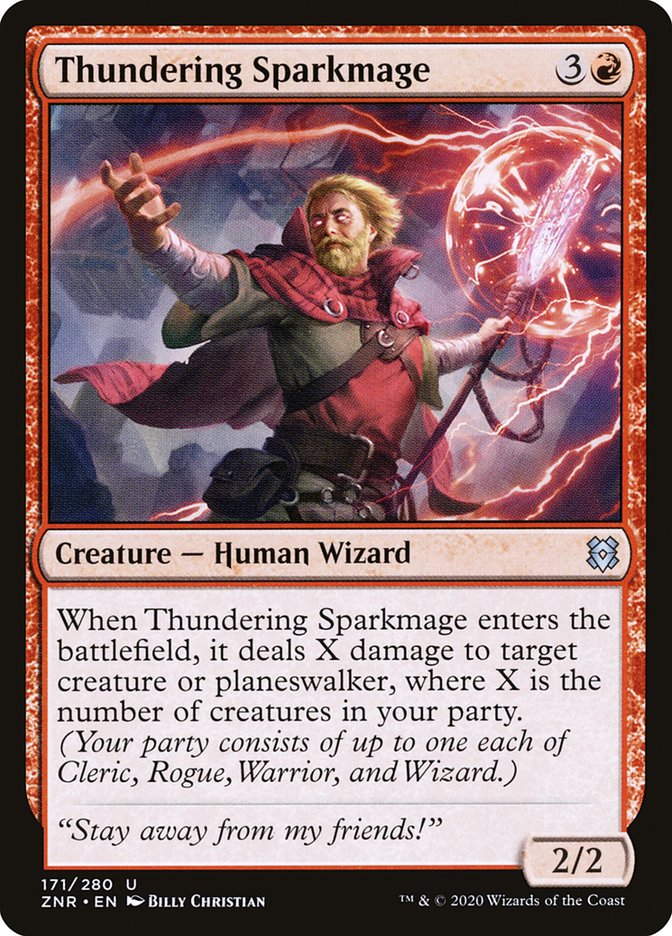
Thundering Sparkmage is one of those cards players keep asking about. Here is, in plain words, what its official text says, the rulings published by Wizards of the Coast, and the combos players actually run.
Official card text
When this creature enters, it deals X damage to target creature or planeswalker, where X is the number of creatures in your party. (Your party consists of up to one each of Cleric, Rogue, Warrior, and Wizard.)
Complete guide
Thundering Sparkmage is a versatile Wizard that harnesses the synergy of your adventuring party to strike down threats. By assembling a team of distinct professionals, you can maximize the impact of its entry ability to clear the battlefield. This guide explores how to calculate your party count and optimize the Sparkmage's damage potential.
How the Party Mechanic Works
Your party consists of up to one each of the following creature types: Cleric, Rogue, Warrior, and Wizard. Thundering Sparkmage checks how many of these specific roles you have filled. Each creature you control can count for only one role, but the game will automatically calculate the highest possible number for you, ranging from zero to four. For example, if you control a Cleric and a Cleric Wizard, you have a party of two because the second creature counts as your Wizard.
Resolving the Trigger
When Thundering Sparkmage enters the battlefield, its triggered ability is put on the stack and you must choose a target creature or planeswalker. The value of X is not determined until the ability actually resolves. If your party composition changes while the ability is on the stack—for instance, if another party member is destroyed—X will be based on the number of roles filled at the moment of resolution. Since Thundering Sparkmage is a Wizard, it will count itself if it is still on the battlefield when the ability resolves.
Common Mistakes
A common misconception is that you need four separate creatures to have a full party. While you do need different types, one creature can only occupy one 'slot' in the party calculation. Additionally, remember that you cannot choose to lower the damage by excluding creatures you control; the ability always uses the maximum possible party count. Finally, because the ability targets, you must have a legal target (a creature or planeswalker) to put the ability on the stack, even if your party count is zero.
Strategic Timing
To get the most out of Thundering Sparkmage, try to cast it when your board already has a Cleric, Rogue, or Warrior. Since the Sparkmage is a Wizard, playing it as your fourth distinct type allows it to deal a full 4 damage upon entry. It is also important to protect your other party members while the trigger is on the stack, as losing a creature will directly reduce the damage dealt.
Interaction examples
If you control no other creatures and play Thundering Sparkmage, its ability triggers. When the ability resolves, the game checks your party. You control a Wizard (the Sparkmage), so your party count is 1. The Sparkmage deals 1 damage to the target.
 Solemn Simulacrum
If you control Solemn Simulacrum and cast Thundering Sparkmage, the party count is still only 1. Even though Solemn Simulacrum is a creature, it is a Golem, which is not one of the four party types (Cleric, Rogue, Warrior, or Wizard). Only the Sparkmage counts toward the party.
 Roaming Throne
If you control Roaming Throne with 'Wizard' chosen as the creature type, it becomes a Wizard and a party member. When Thundering Sparkmage enters, its ability triggers twice because of Roaming Throne's effect. Each trigger will resolve separately. If these are your only two creatures, the first trigger checks the party (Wizard) and deals 2 damage. The second trigger also deals 2 damage, provided the party size hasn't changed.
Guide written with AI from the official text and rulings. Official English text prevails.
How it works : Thundering Sparkmage
Original English text — Wizards of the Coast / Scryfall
- #1· Wizards of the Coast
To determine “the number of creatures in your party,” check whether you control a Cleric, whether you control a Rogue, whether you control a Warrior, and whether you control a Wizard. The number is the total number of those checks to which you answered yes. Each creature you control can be counted for only one of those checks.
No other card is named in this ruling.
- #2· Wizards of the Coast
If a creature has more than one party creature type, and there are multiple ways to count that creature that could result in a different number of creatures in your party, the highest such number is used. For example, if you control a Cleric and a Cleric Wizard, the number of creatures in your party is two. You can’t choose to have it be just one by counting the Cleric Wizard first as a Cleric.
No other card is named in this ruling.
- #3· Wizards of the Coast
An ability referring to the number of creatures in your party gets a number from zero to four. Such abilities never ask which creatures are in your party, and you never have to designate specific creatures as being in your party. You can’t choose to exclude creatures from this count to lower the number.
No other card is named in this ruling.
- #4· Wizards of the Coast
If an ability of a creature counts the number of creatures in your party, that number is counted as the ability resolves. If that creature is still on the battlefield when the ability resolves, it’ll be counted if appropriate.
No other card is named in this ruling.
Legal formats
Commentaires
- Sois le premier à commenter cette carte.
Read next
Meta decks with Thundering Sparkmage
No archived Top 8 deck with this card yet.