

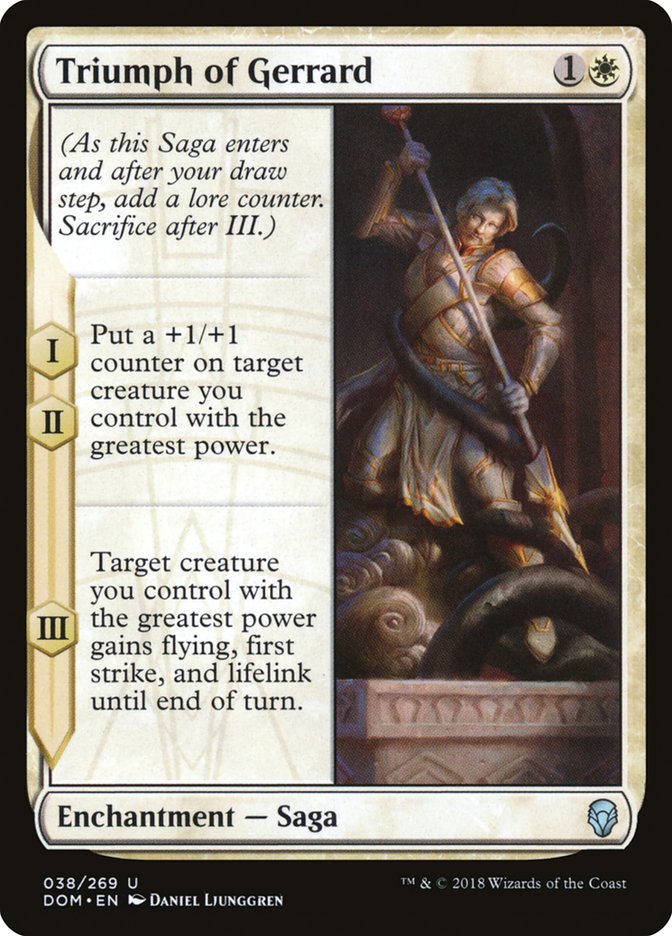
Triumph of Gerrard is one of those cards players keep asking about. Here is, in plain words, what its official text says, the rulings published by Wizards of the Coast, and the combos players actually run.
Official card text
(As this Saga enters and after your draw step, add a lore counter. Sacrifice after III.) I, II — Put a +1/+1 counter on target creature you control with the greatest power. III — Target creature you control with the greatest power gains flying, first strike, and lifelink until end of turn.
Complete guide
Triumph of Gerrard is a White Saga that tells the legendary tale of a hero's rise to power. By placing lore counters, you empower your strongest champion, eventually granting them a suite of keywords to end the game. This card is a powerhouse for aggressive decks looking to break through stalled board states.
What it Does
Triumph of Gerrard follows the standard Saga rules: it enters with a lore counter and gains one after each of your draw steps. The first two chapters place a +1/+1 counter on your creature with the greatest power, while the third chapter grants that creature flying, first strike, and lifelink. This ensures your biggest threat becomes even more difficult to block or out-race.
How it Resolves Step by Step
When a lore counter is added, the chapter ability triggers and goes on the stack. You must choose a target creature you control that currently has the highest power among creatures you control. As the ability resolves, the game checks again if that creature still has the greatest power; if a different creature now has higher power, the target becomes illegal and the ability fizzles. After the third chapter ability leaves the stack, you sacrifice the Saga.
Common Mistakes
A common mistake involves responding to the trigger by buffing a different, smaller creature. If you cast a spell to make a smaller creature bigger than the target, the ability will fail to resolve because the target is no longer 'a creature you control with the greatest power.' Also, remember that if you have two creatures tied for the highest power, you can choose either one as the target.
When to Play It
This Saga is best played when you already have a board presence. Since it requires a creature to target, you want to ensure you have a reliable attacker. It is particularly effective for bypassing defensive setups or recovering life in a close race.
Interaction examples
 Ghostly Prison
If your opponent has Ghostly Prison, your ground forces might be stalled due to mana costs. When Triumph of Gerrard reaches Chapter III, your strongest creature gains flying. This allows you to soar over ground blockers, though you must still pay the {2} tax to attack the player directly.
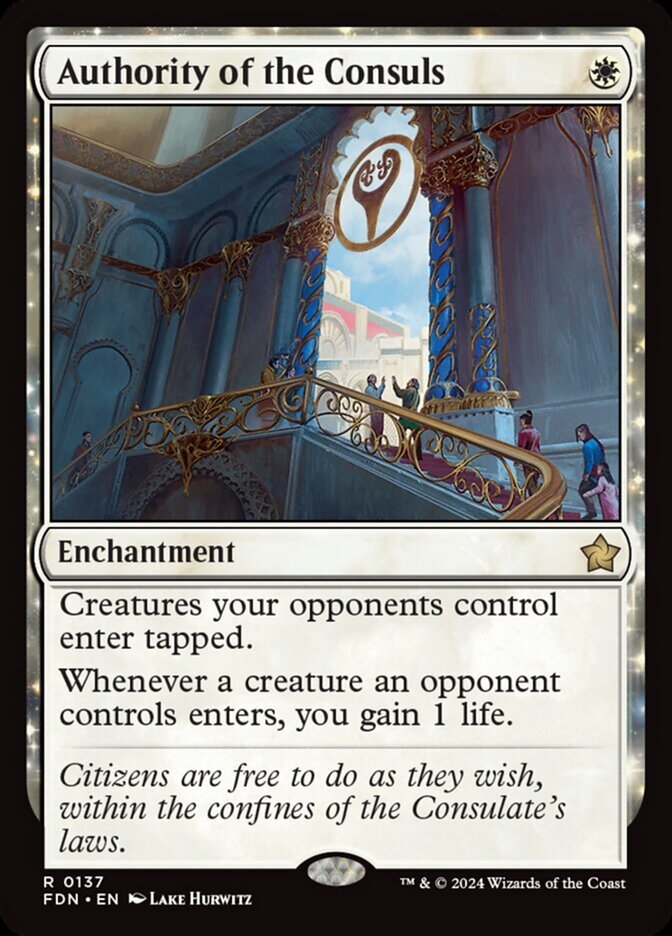 Authority of the Consuls
If an opponent has Authority of the Consuls, your new creatures enter tapped, making defense difficult. However, by placing Triumph of Gerrard, you can use Chapter III to give an existing creature lifelink and first strike. This allows you to attack, gain life to offset their aggression, and likely survive combat thanks to first strike.
Guide written with AI from the official text and rulings. Official English text prevails.
How it works : Triumph of Gerrard
Original English text — Wizards of the Coast / Scryfall
- #1· Wizards of the Coast
Triumph of Gerrard’s chapter abilities each target any creature you control with the greatest power among creatures you control. If the power of another creature you control becomes greater before that ability resolves, the target is illegal.
No other card is named in this ruling.
- #2· Wizards of the Coast
As a Saga enters the battlefield, its controller puts a lore counter on it. As your precombat main phase begins (immediately after your draw step), you put another lore counter on each Saga you control. Putting a lore counter on a Saga in either of these ways doesn’t use the stack.
No other card is named in this ruling.
- #3· Wizards of the Coast
Each symbol on the left of a Saga’s text box represents a chapter ability. A chapter ability is a triggered ability that triggers when a lore counter that is put on the Saga causes the number of lore counters on the Saga to become equal to or greater than the ability’s chapter number. Chapter abilities are put onto the stack and may be responded to.
No other card is named in this ruling.
- #4· Wizards of the Coast
A chapter ability doesn’t trigger if a lore counter is put on a Saga that already had a number of lore counters greater than or equal to that chapter’s number. For example, the third lore counter put on a Saga causes the III chapter ability to trigger, but I and II won’t trigger again.
No other card is named in this ruling.
- #5· Wizards of the Coast
Once a chapter ability has triggered, the ability on the stack won’t be affected if the Saga gains or loses counters, or if it leaves the battlefield.
No other card is named in this ruling.
- #6· Wizards of the Coast
If multiple chapter abilities trigger at the same time, their controller puts them on the stack in any order. If any of them require targets, those targets are chosen as you put the abilities on the stack, before any of those abilities resolve.
No other card is named in this ruling.
- #7· Wizards of the Coast
If counters are removed from a Saga, the appropriate chapter abilities will trigger again when the Saga receives lore counters. Removing lore counters won’t cause a previous chapter ability to trigger.
No other card is named in this ruling.
- #8· Wizards of the Coast
Once the number of lore counters on a Saga is greater than or equal to the greatest number among its chapter abilities—in the Dominaria set, this is always three—the Saga’s controller sacrifices it as soon as its chapter ability has left the stack, most likely by resolving or being countered. This state-based action doesn’t use the stack.
No other card is named in this ruling.
Legal formats
Commentaires
- Sois le premier à commenter cette carte.
Read next
Meta decks with Triumph of Gerrard
No archived Top 8 deck with this card yet.