
Trouble in Pairs is one of those cards players keep asking about. Here is, in plain words, what its official text says, the rulings published by Wizards of the Coast, and the combos players actually run.
Official card text
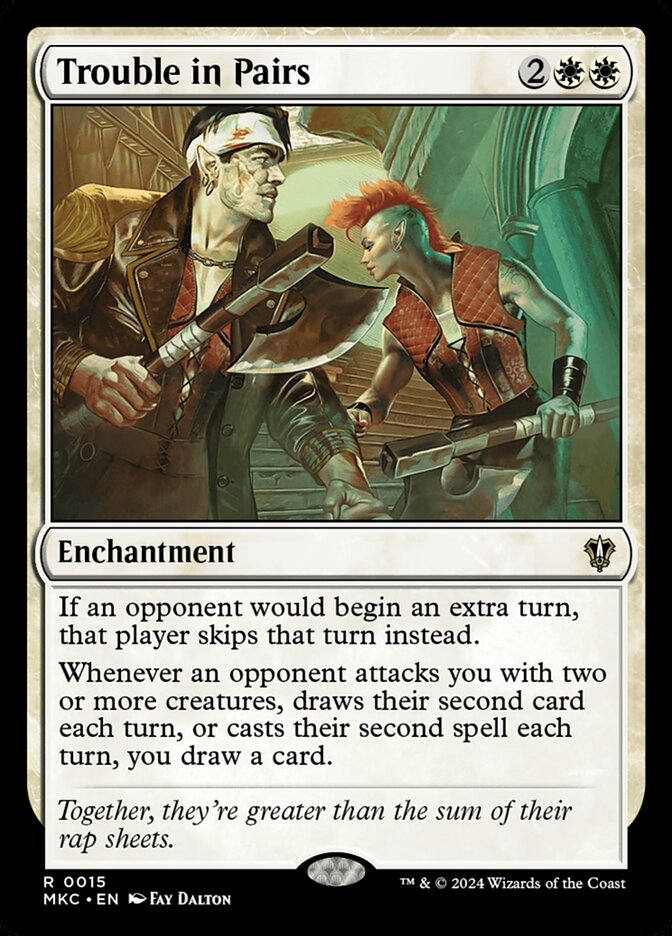
If an opponent would begin an extra turn, that player skips that turn instead. Whenever an opponent attacks you with two or more creatures, draws their second card each turn, or casts their second spell each turn, you draw a card.
Complete guide
Trouble in Pairs is a powerful white enchantment that punishes opponents for overextending and taking extra turns. By providing consistent card draw in response to common gameplay actions, it ensures you never fall behind in resources. Whether your opponents are drawing extra cards or mounting a large attack, you will be the one reaping the rewards.
What It Does
Trouble in Pairs serves two main functions: it acts as a preventative measure against extra turn spells and a repeatable source of card advantage. Its static ability completely shuts down extra turns, forcing players to skip them entirely if they would begin while this enchantment is on the battlefield. Its triggered ability watches for three specific actions from opponents: attacking you with at least two creatures, drawing their second card in a turn, or casting their second spell in a turn. Each of these events triggers a card draw for you.
How It Resolves Step by Step
First, the extra turn prevention is a replacement effect; if an opponent would start an extra turn, they simply skip it. For the draw triggers, the game checks if the conditions are met. If an opponent casts a spell, Trouble in Pairs checks if it is their second spell of the turn. If it is, the ability triggers and goes on the stack on top of that spell. The same logic applies to the second card drawn. For combat, the trigger occurs specifically when the 'Declare Attackers' step is completed, provided at least two creatures were declared as attackers against you.
Common Mistakes
A common misconception is that Trouble in Pairs must be on the battlefield for the entire turn to 'see' the first spell or card draw. This is incorrect; if an opponent has already cast one spell and then you flash in Trouble in Pairs, you will draw a card when they cast their second spell. Additionally, remember that it counts spells even if they are countered. Finally, keep in mind that if Trouble in Pairs is destroyed before an extra turn actually begins, that extra turn will not be skipped.
When to Play It
This card is best utilized in multiplayer formats where you have multiple opponents who can trigger it. It is particularly effective against 'Spellslinger' decks that cast many low-cost spells or 'Go-Wide' aggressive decks. Since it is an enchantment, it is relatively durable, making it a reliable engine for long-term games where incremental advantage leads to victory.
Interaction examples
 Smothering Tithe
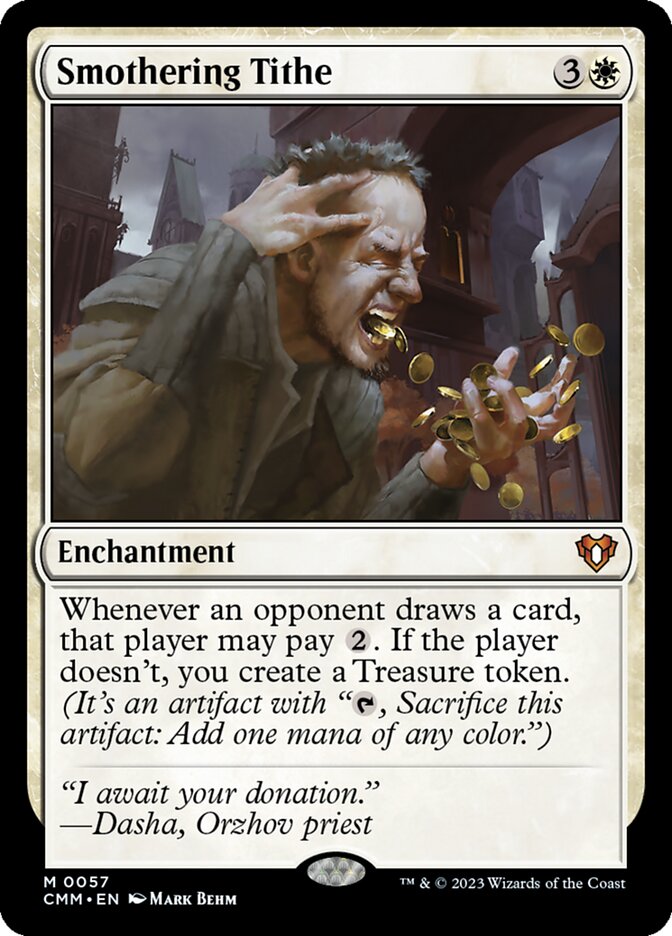
If an opponent draws their second card of the turn, both Smothering Tithe and Trouble in Pairs will trigger. You will draw a card from Trouble in Pairs, and the opponent must choose to pay {2} or give you a Treasure token from Smothering Tithe. These two enchantments together create a massive resource swing whenever an opponent tries to cycle through their deck.
 Ghostly Prison
When an opponent wants to attack you with two creatures, Ghostly Prison requires them to pay {4} total ({2} for each creature). If they pay and successfully declare both creatures as attackers against you, Trouble in Pairs triggers immediately. You draw a card as a reward for surviving the taxed assault, effectively replacing the resources you might lose in combat.
Guide written with AI from the official text and rulings. Official English text prevails.
How it works : Trouble in Pairs
Original English text — Wizards of the Coast / Scryfall
- #1· Wizards of the Coast
An "extra turn" is any turn created by a spell or ability. Notably, it doesn't include additional turns taken in tournaments after time expires for a round.
No other card is named in this ruling.
- #2· Wizards of the Coast
Trouble in Pairs counts spells that were cast even if they didn't resolve. This means it still counts spells that were countered.
No other card is named in this ruling.
- #3· Wizards of the Coast
Extra turns can still be created while Trouble in Pairs is on the battlefield. They're not skipped until they would begin, so if Trouble in Pairs leaves the battlefield before that happens, the extra turns will be unaffected.
No other card is named in this ruling.
- #4· Wizards of the Coast
Trouble in Pairs doesn't have to be on the battlefield to see the first card an opponent draws in a turn or the first spell they cast in a turn. As long as it's already on the battlefield when they draw their second card or cast their second spell in a turn, its last ability will trigger.
No other card is named in this ruling.
- #5· Wizards of the Coast
Trouble in Pairs's last ability can trigger multiple times per opponent per turn. For example, if an opponent draws a second card, casts a second spell, and attacks you with two or more creatures in a single turn, Trouble in Pairs's last ability will trigger once when each of those events occurs, for a total of three times.
No other card is named in this ruling.
- #6· Wizards of the Coast
If an opponent attacks you with two or more creatures more than once in a turn (probably because they've generated extra combat phases), Trouble in Pairs's last ability will trigger each time that happens.
No other card is named in this ruling.
Legal formats
Commentaires
- Sois le premier à commenter cette carte.
Read next
Meta decks with Trouble in Pairs
No archived Top 8 deck with this card yet.