

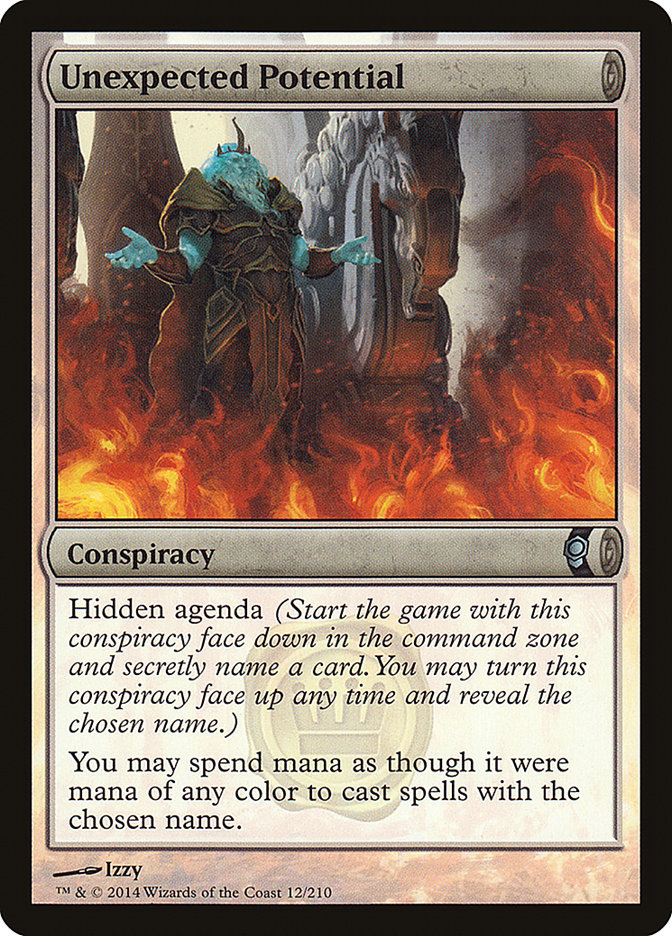
Unexpected Potential is one of those cards players keep asking about. Here is, in plain words, what its official text says, the rulings published by Wizards of the Coast, and the combos players actually run.
Official card text
Hidden agenda (Start the game with this conspiracy face down in the command zone and secretly choose a card name. You may turn this conspiracy face up any time and reveal that name.) You may spend mana as though it were mana of any color to cast spells with the chosen name.
Complete guide
Unexpected Potential is a powerful Conspiracy card that breaks the traditional limits of mana requirements in Magic: The Gathering. By utilizing the Hidden agenda mechanic, you can surprise your opponents by casting a specific spell regardless of which lands you have in play. This card ensures that your most powerful draft picks are never stuck in your hand due to color screw.
The Hidden Agenda Mechanic
Before the game begins, you place Unexpected Potential face down in the command zone and secretly record a card name. This is a special action that happens as the game starts, not during your turn. The conspiracy remains hidden until you choose to reveal it, which you can do at any time you have priority. Once revealed, its static ability becomes active, allowing you to spend mana as though it were mana of any color to cast spells with the chosen name.
Casting the Chosen Spell
When you are ready to cast the spell you named, you can turn Unexpected Potential face up as a special action that does not use the stack. From that moment on, your mana pool becomes flexible for that specific card. If the card costs three green mana and you only have three mountains, you can spend that red mana as if it were green. Note that this only applies to casting the spell itself, not to activated abilities of the card once it is on the battlefield.
Crucial Timing and Rulings
It is important to remember that you must name a specific Magic card name, not a token. Because Conspiracies exist in the command zone, they cannot be destroyed or countered like permanents on the battlefield. Furthermore, if you are playing a multi-game match, you are allowed to choose a different card name for Unexpected Potential at the start of each new game, allowing you to adapt your strategy to your opponent's deck.
Interaction examples
 Sol Ring
If you named a card like 'Counterspell' with Unexpected Potential, you can tap Sol Ring for two colorless mana and spend that mana as if it were two blue mana to cast the spell. Unexpected Potential allows colorless mana to satisfy specific color requirements for the named card.
 Command Tower
In a format where you use Command Tower, the land might only produce certain colors based on your commander. However, if you use Unexpected Potential to name a card outside those colors, you can use the mana produced by Command Tower (or any other source) to pay for the named spell's costs, as the conspiracy allows mana to be spent as though it were any color.
Guide written with AI from the official text and rulings. Official English text prevails.
How it works : Unexpected Potential
Original English text — Wizards of the Coast / Scryfall
- #1· Wizards of the Coast
Conspiracies are never put into your deck. Instead, you put any number of conspiracies from your card pool into the command zone as the game begins. These conspiracies are face up unless they have hidden agenda, in which case they begin the game face down.
No other card is named in this ruling.
- #2· Wizards of the Coast
A conspiracy doesn't count as a card in your deck for purposes of meeting minimum deck size requirements. (In most drafts, the minimum deck size is 40 cards.)
No other card is named in this ruling.
- #3· Wizards of the Coast
You don't have to play with any conspiracy you draft. However, you have only one opportunity to put conspiracies into the command zone, as the game begins. You can't put conspiracies into the command zone after this point.
No other card is named in this ruling.
- #4· Wizards of the Coast
You can look at any player's face-up conspiracies at any time. You'll also know how many face-down conspiracies a player has in the command zone, although you won't know what they are.
No other card is named in this ruling.
- #5· Wizards of the Coast
A conspiracy's static and triggered abilities function as long as that conspiracy is face-up in the command zone.
No other card is named in this ruling.
- #6· Wizards of the Coast
Conspiracies are colorless, have no mana cost, and can't be cast as spells.
No other card is named in this ruling.
- #7· Wizards of the Coast
Conspiracies aren't legal for any sanctioned Constructed format, but may be included in other Limited formats, such as Cube Draft.
No other card is named in this ruling.
- #8· Wizards of the Coast
You name the card as the game begins, as you put the conspiracy into the command zone, not as you turn the face-down conspiracy face up.
No other card is named in this ruling.
- #9· Wizards of the Coast
There are several ways to secretly name a card, including writing the name on a piece of paper that's kept with the face-down conspiracy. If you have multiple face-down conspiracies, you may name a different card for each one. It's important that each named card is clearly associated with only one of the conspiracies.
No other card is named in this ruling.
- #10· Wizards of the Coast
You must name a Magic card. Notably, you can't name a token.
No other card is named in this ruling.
- #11· Wizards of the Coast
If you play multiple games after the draft, you can name a different card in each new game.
No other card is named in this ruling.
- #12· Wizards of the Coast
As a special action, you may turn a face-down conspiracy face up. You may do so any time you have priority. This action doesn't use the stack and can't be responded to. Once face up, the named card is revealed and the conspiracy's abilities will affect the game.
No other card is named in this ruling.
- #13· Wizards of the Coast
At the end of the game, you must reveal any face-down conspiracies you own in the command zone to all players.
No other card is named in this ruling.
- #14· Wizards of the Coast
A conspiracy with hidden agenda that has a triggered ability must be face up before that ability's trigger condition is met in order for it to trigger. Turning it face up afterward won't have any effect.
No other card is named in this ruling.
- #15· Wizards of the Coast
At the end of the game, you must reveal any face-down conspiracies you own in the command zone to all players. Notably, you can't bluff conspiracies with hidden agenda by putting other cards into the command zone face down as the game starts.
No other card is named in this ruling.
Commentaires
- Sois le premier à commenter cette carte.
Read next
Meta decks with Unexpected Potential
No archived Top 8 deck with this card yet.