

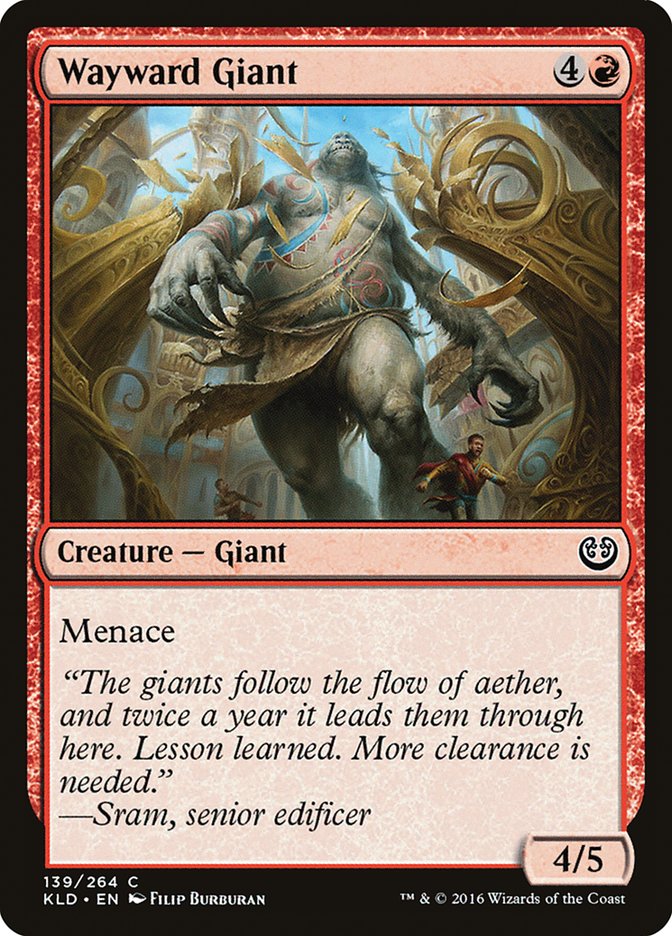
Wayward Giant is one of those cards players keep asking about. Here is, in plain words, what its official text says, the rulings published by Wizards of the Coast, and the combos players actually run.
Official card text
Menace
Complete guide
Wayward Giant is a straightforward red threat that brings significant pressure to the battlefield. Standing as a 4/5 creature with Menace, it forces your opponent to commit multiple resources just to keep it from dealing damage. Understanding how its keyword interacts with other board pieces is key to maintaining your board advantage.
What It Does
Wayward Giant is a Giant creature that possesses the Menace keyword. In Magic: The Gathering, Menace is an evasion ability that dictates blocking requirements. A creature with menace can't be blocked except by two or more creatures. If your opponent only has one creature available to block, Wayward Giant will simply walk past it to deal damage to the player or planeswalker it is attacking.
How Menace Resolves
The menace ability is checked during the Declare Blockers step. When you attack with Wayward Giant, your opponent must decide how to assign their untapped creatures. If they wish to block the Giant, they must select at least two creatures and assign them both to block it. If they only have one creature, or choose to block with only one, that block is illegal and the Giant remains unblocked.
Synergy and Strategy
While Wayward Giant is a simple creature, its Giant subtype allows it to benefit from tribal synergies. Because it requires two blockers, it is most effective when your opponent's board is thin or when you have other threats that also demand attention. Removing an opponent's single blocker often guarantees that Wayward Giant will connect for four damage.
Common Mistakes
A common mistake involves losing one of the two blockers before combat damage. If Wayward Giant is blocked by two creatures, and one of those blockers is removed from the battlefield (or removed from combat) before damage is dealt, the Giant remains blocked by the remaining creature. Menace only checks for the 'two or more' requirement at the moment blockers are declared.
Interaction examples
 Solemn Simulacrum
You cast Solemn Simulacrum to ramp into your fifth land, ensuring you can play Wayward Giant on curve. Once the Giant is on the battlefield, your opponent faces a dilemma: they need two creatures to stop the Giant, but if they use their small utility creatures to block, you are trading a common Giant for their valuable resources. If they kill your Solemn Simulacrum to try and find a second blocker, you draw a card, keeping your hand full while the Giant remains a threat.
 Roaming Throne
You play Roaming Throne and choose 'Giant' as the creature type. While Wayward Giant's Menace is a keyword ability and not a triggered ability, Roaming Throne still benefits the Giant by sharing the 'Giant' type itself. Now you have two large threats on the board. Because Wayward Giant has menace, your opponent needs at least two creatures to block it, plus another creature to block the Roaming Throne, making it nearly impossible for them to stop all incoming damage.
Guide written with AI from the official text and rulings. Official English text prevails.
How it works : Wayward Giant
Original English text — Wizards of the Coast / Scryfall
No additional ruling has been published for this card.
Legal formats
Commentaires
- Sois le premier à commenter cette carte.
Read next
Meta decks with Wayward Giant
No archived Top 8 deck with this card yet.