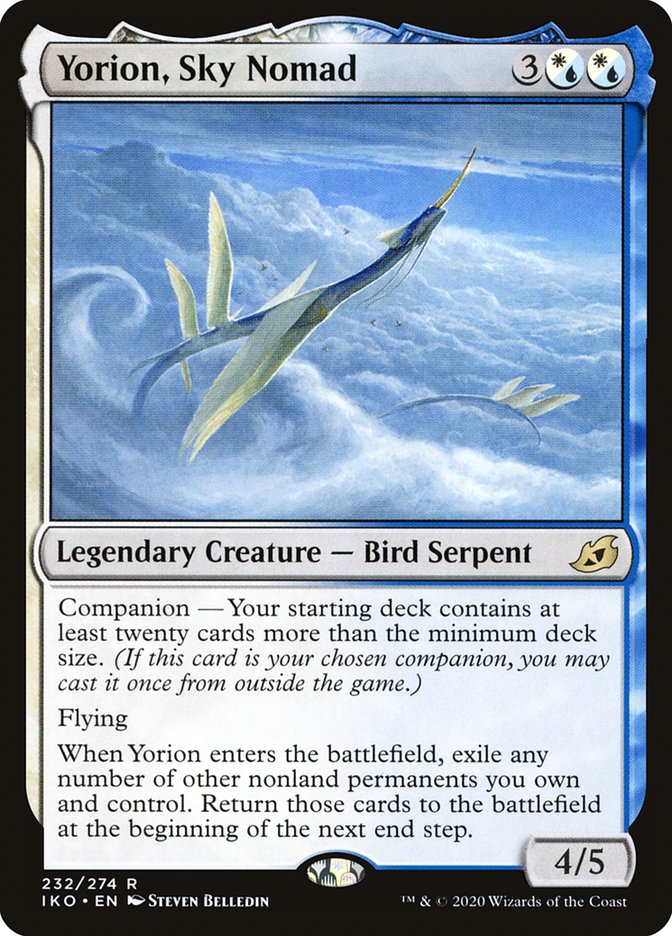
Yorion, Sky Nomad is one of those cards players keep asking about. Here is, in plain words, what its official text says, the rulings published by Wizards of the Coast, and the combos players actually run.
Official card text
Companion — Your starting deck contains at least twenty cards more than the minimum deck size. (If this card is your chosen companion, you may put it into your hand from outside the game foras a sorcery.) Flying When Yorion enters, exile any number of other nonland permanents you own and control. Return those cards to the battlefield at the beginning of the next end step.
Complete guide
Yorion, Sky Nomad is a powerful legendary Bird Serpent that rewards players for building exceptionally large decks. As a centerpiece of 'blink' strategies, it allows you to temporarily remove your own permanents to reuse their powerful entry effects. This guide covers how to manage your companion and maximize the value of your sky-high deck.
The Companion Rule
To use Yorion as your companion, your starting deck must be at least 20 cards larger than the minimum requirement (e.g., 80 cards for Standard). During the game, as long as the stack is empty during your main phase, you can pay {3} as a special action to put Yorion from your sideboard into your hand. This action does not use the stack and cannot be responded to or countered. Once in your hand, Yorion acts like any other card; it can be cast, discarded, or countered normally.
How the Blink Resolves
When Yorion enters the battlefield, its triggered ability goes on the stack. You do not choose which permanents to exile until the ability actually resolves. You can exile any number of nonland permanents you both own and control. These cards are moved to the exile zone immediately. Any Auras attached to them go to the graveyard, Equipment falls off and stays on the battlefield, and counters are removed. At the beginning of the next end step, all those cards return to the battlefield simultaneously as new objects.
Common Mistakes
A frequent error is trying to use Yorion as a companion in Commander; because Commander requires exactly 100 cards, you cannot meet the '20 cards more than minimum' requirement. Additionally, remember that tokens cease to exist if exiled by Yorion and will not return. Finally, note that you can only exile permanents you both own AND control. You cannot exile a creature you've stolen from an opponent, nor can you exile a card you own that an opponent currently controls.
When to Play Yorion
Yorion is best played when you have multiple permanents with 'Enters' abilities. Since the cards return at the beginning of the next end step, if you cast Yorion during your main phase, your permanents will return that same turn's end step. However, if you use a flash effect to bring Yorion in during an opponent's end step, the cards won't return until the following turn's end step, effectively hiding your permanents for a full turn cycle.
Interaction examples
 Solemn Simulacrum
If you have Solemn Simulacrum on the battlefield and Yorion enters, you can exile the Golem. At the beginning of the end step, Solemn Simulacrum returns to the battlefield. Its triggered ability triggers again, allowing you to search for another basic land and put it onto the battlefield tapped.
 Roaming Throne
With Roaming Throne on the battlefield naming 'Bird' or 'Serpent', Yorion's entry ability will trigger an additional time. Since you choose which permanents to exile only as each trigger resolves, you could use the first trigger to exile some permanents, and then the second trigger to exile others (including the Roaming Throne itself!). They will all return together at the next end step.
Guide written with AI from the official text and rulings. Official English text prevails.
How it works : Yorion, Sky Nomad
Original English text — Wizards of the Coast / Scryfall
- #1· Scryfall
Once you put your companion into your hand, it behaves like any other card you’ve brought into the game. For example, if it’s countered or destroyed, it’s put into your graveyard, remaining in the game.
No other card is named in this ruling.
- #2· Scryfall
Wizards of the Coast has issued functional errata for the Companion mechanic. Instead of casting companions from outside the game: Once per game, any time you could cast a sorcery (during your main phase when the stack is empty), you can pay
to put your companion from your sideboard into your hand. This is a special action, not an activated ability. It happens immediately and can’t be responded to. It can’t be countered or stopped by cards like Phyrexian Revoker. For more information please see https://magic.wizards.com/en/articles/archive/news/june-1-2020-banned-and-restricted-announcementNo other card is named in this ruling.
- #3· Wizards of the Coast
If you reveal a companion outside the game, for as long as it remains there, you may pay
any time you could cast a sorcery (that is, you have priority during your main phase and the stack is empty). Once you do, you put it into your hand and behaves like any other card you've brought into the game. For example, if it's discarded, countered, or destroyed, it's put into your graveyard, remaining in the game. This is a change from previous rules.No other card is named in this ruling.
- #4· Wizards of the Coast
Paying
to put your companion into your hand is a special action. It doesn't use the stack and players can't respond to it. Once you take this action, you may cast that card if it's legal to do so before any other player can take actions.No other card is named in this ruling.
- #5· Wizards of the Coast
Your minimum deck size is forty cards for Limited events (such as Booster Draft and Sealed Deck) and sixty cards for Constructed events (such as Standard or casual freeform play). Certain variants may have other minimums. The Commander variant requires exactly one hundred cards, so Yorion can never be your chosen companion in a Commander game.
No other card is named in this ruling.
- #6· Wizards of the Coast
You choose which permanents to exile as Yorion's triggered ability resolves. No player may take action between the time you choose the permanents and the time they're exiled.
No other card is named in this ruling.
- #7· Wizards of the Coast
You can't exile permanents you control but don't own, or permanents that you own but don't control.
No other card is named in this ruling.
- #8· Wizards of the Coast
Auras attached to the exiled permanents will be put into their owners' graveyards. Equipment attached to the exiled permanents will become unattached and remain on the battlefield. Any counters on the exiled permanents will cease to exist. Once the exiled permanents return, they're considered new objects with no relation to the objects that they were.
No other card is named in this ruling.
- #9· Wizards of the Coast
If a token is exiled this way, it will cease to exist and won't return to the battlefield.
No other card is named in this ruling.
- #10· Wizards of the Coast
Your companion begins the game outside the game. In tournament play, this means your sideboard. In casual play, it's simply a card you own that's not in your starting deck.
No other card is named in this ruling.
- #11· Wizards of the Coast
Before shuffling your deck to become your library, you may reveal one card from outside the game to be your companion if your starting deck meets the requirements of the companion ability. You can't reveal more than one. It remains revealed outside the game as the game begins.
No other card is named in this ruling.
- #12· Wizards of the Coast
The requirements of the companion ability apply only to your starting deck. They do not apply to your sideboard.
No other card is named in this ruling.
- #13· Wizards of the Coast
If more than one player wishes to reveal a companion, the starting player does so first, and players proceed in turn order. Once a player has chosen not to reveal a companion, that player can't change their mind.
No other card is named in this ruling.
- #14· Wizards of the Coast
If you reveal a companion outside the game, for as long as it remains there, you may pay
any time you could cast a sorcery (that is, you have priority during your main phase and the stack is empty). Once you do, you put it into your hand and behaves like any other card you've brought into the game. For example, if it's discard, countered, or destroyed, it's put into your graveyard, remaining in the game. This is a change from previous rules.No other card is named in this ruling.
- #15· Wizards of the Coast
Paying
to put your companion into your hand is a special action. It doesn't use the stack and players can't respond to it. Once you take this action, you may cast that card if it's legal to do so before any other player can take actions.No other card is named in this ruling.
- #16· Wizards of the Coast
The companion's other abilities apply only if the creature is on the battlefield. They have no effect while the companion is outside the game.
No other card is named in this ruling.
- #17· Wizards of the Coast
The companion ability has no effect if the card is in your starting deck and creates no restriction on putting a card with a companion ability into your starting deck. For example, Zirda may be in your starting deck even if your other permanent cards don't all have activated abilities.
No other card is named in this ruling.
- #18· Wizards of the Coast
You may have one companion in the Commander variant. Your deck, including your commander, must meet its companion requirement. Your companion is not one of your one hundred cards.
No other card is named in this ruling.
Legal formats
Commentaires
- Sois le premier à commenter cette carte.
Read next
Meta decks with Yorion, Sky Nomad