
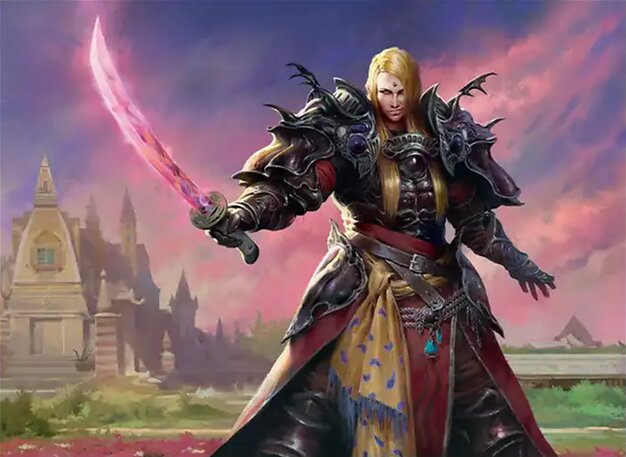

Zenos yae Galvus // Shinryu, Transcendent Rival is one of those cards players keep asking about. Here is, in plain words, what its official text says, the rulings published by Wizards of the Coast, and the combos players actually run.
Official card text
My First Friend — When Zenos yae Galvus enters, choose a creature an opponent controls. Until end of turn, creatures other than Zenos yae Galvus and the chosen creature get -2/-2. When the chosen creature leaves the battlefield, transform Zenos yae Galvus. Flying As this creature transforms into Shinryu, choose an opponent. Burning Chains — When the chosen player loses the game, you win the game.
Complete guide
Zenos yae Galvus // Shinryu, Transcendent Rival is a terrifying commander that thrives on the bond between rivals. By isolating a single enemy creature, Zenos reshapes the battlefield before ascending into a game-ending draconic threat.
My First Friend: The Debuff
When Zenos yae Galvus enters the battlefield, you choose one creature an opponent controls. This is not a targeted ability, so it can bypass Hexproof or Shroud. Once chosen, every other creature on the board—except for Zenos and that specific 'friend'—gets -2/-2 until the end of the turn. If your opponent controls no creatures, you simply don't choose one, and the -2/-2 effect applies to every creature except Zenos.
The Transformation Step-by-Step
Zenos waits for his chosen rival to leave the battlefield. This can happen through death, exile, or being returned to the hand. As soon as that creature is no longer on the battlefield, a triggered ability puts the transformation onto the stack. When it resolves, Zenos transforms into Shinryu, Transcendent Rival. At this exact moment, you choose an opponent to be linked to Shinryu's fate. This choice is vital because it sets the stage for your ultimate victory.
Burning Chains and Victory
Shinryu's 'Burning Chains' ability is a powerful win condition in multiplayer games. Once you have chosen a player during the transformation, you simply need that player to lose the game. The moment they are eliminated, Shinryu's ability triggers, and you immediately win the game regardless of the life totals or board states of any other remaining players.
Common Mistakes to Avoid
Remember that Zenos's mana value is always 5, based on the front face, even when he is transformed into Shinryu. Additionally, if Zenos is somehow put onto the battlefield back-face up without 'transforming' (such as through a specific effect that skips the transformation process), you will not get to choose an opponent for the Burning Chains ability, rendering his final win condition inactive.
Interaction examples
 Solemn Simulacrum
You play Zenos yae Galvus while your opponent controls a Solemn Simulacrum. You choose the Simulacrum as your 'friend'. All other creatures, including any small tokens your opponent has, get -2/-2. If you then destroy the Solemn Simulacrum, Zenos will transform into Shinryu.
 Roaming Throne
With Roaming Throne on the battlefield naming 'Human' or 'Noble', Zenos's entry ability triggers twice. You can choose two different 'friends'. Because the transformation ability is also a triggered ability of a Noble Warrior, if one of those creatures leaves, Roaming Throne will cause the transform ability to trigger twice; however, the second instance will do nothing as Zenos is already transformed.
Guide written with AI from the official text and rulings. Official English text prevails.
How it works : Zenos yae Galvus // Shinryu, Transcendent Rival
Original English text — Wizards of the Coast / Scryfall
- #1· Wizards of the Coast
In the case where you can't choose a creature an opponent controls for Zenos's first ability (probably because your opponents control no creatures), other creatures will still get -2/-2 until end of turn when Zenos's first ability resolves.
No other card is named in this ruling.
- #2· Wizards of the Coast
If this card somehow enters the battlefield with its back face up, it didn't transform, so you won't choose an opponent.
No other card is named in this ruling.
- #3· Wizards of the Coast
The mana value of a nonmodal double-faced card is the mana value of its front face, no matter which face is up.
No other card is named in this ruling.
- #4· Wizards of the Coast
Each nonmodal double-faced card in this release is cast face up. In every zone other than the battlefield, consider only the characteristics of its front face. If it is on the battlefield, consider only the characteristics of the face that's up; the other face's characteristics are ignored.
No other card is named in this ruling.
- #5· Wizards of the Coast
If you are instructed to put a card that isn't a double-faced card onto the battlefield transformed, it will not enter at all. In that case, it stays in the zone it was previously in. For example, if a single-faced card is a copy of Crystal Fragments, it will be exiled during the resolution of its second ability and remain in exile.
No other card is named in this ruling.
- #6· Wizards of the Coast
The back face of a nonmodal double-faced card usually has a color indicator that defines its color.
No other card is named in this ruling.
- #7· Wizards of the Coast
A nonmodal double-faced card enters with its front face up by default, unless a spell or ability instructs you to put it onto the battlefield transformed or allows you to cast it transformed, in which case it enters with its back face up.
No other card is named in this ruling.
- #8· Wizards of the Coast
Each face of a nonmodal double-faced card has its own set of characteristics: name, types, subtypes, abilities, and so on. While a nonmodal double-faced permanent is on the battlefield, consider only the characteristics of the face that's currently up. The other set of characteristics is ignored.
No other card is named in this ruling.
- #9· Wizards of the Coast
A token that is created as a copy of a double-faced permanent or a double-faced card in another zone is a double-faced token. It will have both the front face and back face of whatever object it's copying. If it's copying a double-faced permanent whose back face is up, the token will enter with its back face up. It can transform if instructed to do so.
No other card is named in this ruling.
- #10· Wizards of the Coast
In the Commander variant, a double-faced card's color identity is determined by the mana costs and mana symbols in the rules text of both faces combined. If either face has a color indicator or basic land type, those are also considered. For example, Cecil, Dark Knight's color identity is black and white, since its front face is black and its back face has a white color indicator.
No other card is named in this ruling.
Legal formats
Commentaires
- Sois le premier à commenter cette carte.
Read next
Meta decks with Zenos yae Galvus // Shinryu, Transcendent Rival
No archived Top 8 deck with this card yet.