

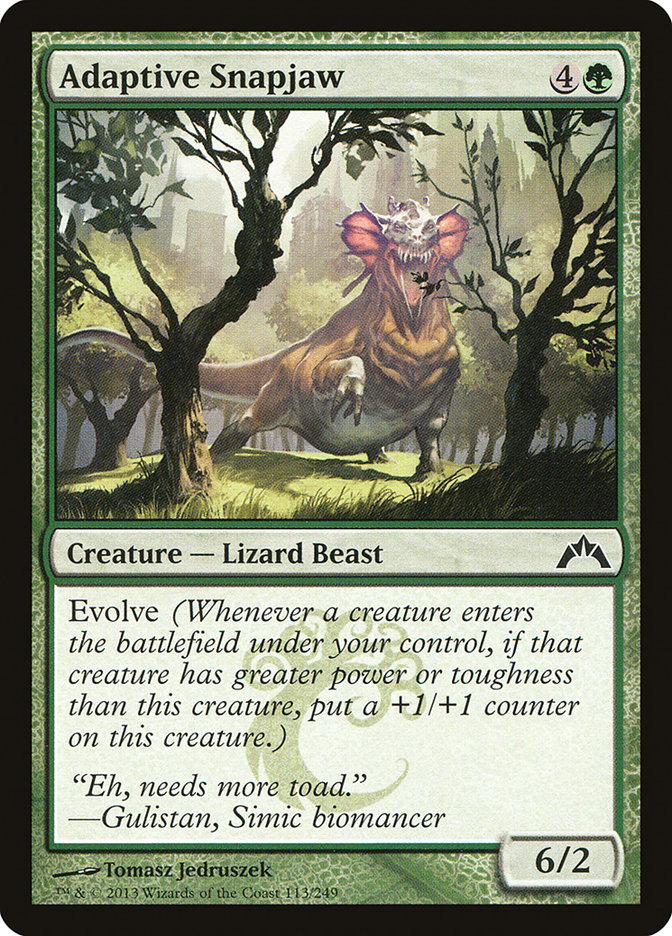
Adaptive Snapjaw is one of those cards players keep asking about. Here is, in plain words, what its official text says, the rulings published by Wizards of the Coast, and the combos players actually run.
Official card text
Evolve (Whenever a creature you control enters, if that creature has greater power or toughness than this creature, put a +1/+1 counter on this creature.)
Complete guide
Adaptive Snapjaw is a formidable Lizard Beast that showcases the Evolve mechanic, allowing it to grow larger as you summon more powerful allies. This Simic-themed keyword rewards you for playing creatures that exceed its current stats, turning a mid-range threat into a massive powerhouse. Understanding the timing of these triggers is key to maximizing your board presence.
How Evolve Functions
Evolve is a triggered ability that monitors whenever another creature enters the battlefield under your control. For the ability to even put a trigger on the stack, the entering creature must have a power or toughness strictly greater than Adaptive Snapjaw's current power or toughness. If both stats of the new arrival are equal to or less than the Snapjaw, nothing happens.
The Resolution Process
The ability uses an 'intervening if' clause, meaning the condition is checked twice: once when the creature enters, and again when the ability attempts to resolve. If Adaptive Snapjaw grows (perhaps from another Evolve trigger) before the first one resolves, and its stats are no longer smaller than the new creature, you won't get the counter. If the new creature leaves the battlefield before resolution, the game uses its last known information for the comparison.
Strategic Considerations
When playing with Evolve, the order of entry matters significantly. If multiple creatures enter at once, you stack the triggers, but each resolves one by one. A common mistake is assuming multiple triggers will all result in counters; however, if the first counter makes the Snapjaw larger than the subsequent creatures waiting to resolve, those later triggers will fail the second check and do nothing.
Interaction examples
 Solemn Simulacrum
You control a base 6/2 Adaptive Snapjaw. You cast Solemn Simulacrum, which is a 2/2. When it enters, its power (2) is not greater than the Snapjaw's power (6), and its toughness (2) is not greater than the Snapjaw's toughness (2). Because neither stat is strictly greater, Evolve does not trigger at all.
 Roaming Throne
You control Adaptive Snapjaw (6/2) and Roaming Throne, for which you chose 'Lizard'. If a 7/7 creature enters, the Snapjaw's Evolve triggers. Roaming Throne sees a Lizard's ability triggering and adds a second Evolve trigger to the stack. The first trigger resolves, checking if 7 is greater than 6 (it is), placing a +1/+1 counter on the Snapjaw (making it 7/3). The second trigger then resolves; it checks if 7 is greater than 7 (no) or if 7 is greater than 3 (yes). Since one stat is still greater, the Snapjaw gets a second counter, becoming 8/4.
Guide written with AI from the official text and rulings. Official English text prevails.
How it works : Adaptive Snapjaw
Original English text — Wizards of the Coast / Scryfall
- #1· Wizards of the Coast
When comparing the stats of the two creatures for evolve, you always compare power to power and toughness to toughness.
No other card is named in this ruling.
- #2· Wizards of the Coast
Whenever a creature enters the battlefield under your control, check its power and toughness against the power and toughness of the creature with evolve. If neither stat of the new creature is greater, evolve won't trigger at all.
No other card is named in this ruling.
- #3· Wizards of the Coast
If evolve triggers, the stat comparison will happen again when the ability tries to resolve. If neither stat of the new creature is greater, the ability will do nothing. If the creature that entered the battlefield leaves the battlefield before evolve tries to resolve, use its last known power and toughness to compare the stats.
No other card is named in this ruling.
- #4· Wizards of the Coast
If a creature enters the battlefield with +1/+1 counters on it, consider those counters when determining if evolve will trigger. For example, a 1/1 creature that enters the battlefield with two +1/+1 counters on it will cause the evolve ability of a 2/2 creature to trigger.
No other card is named in this ruling.
- #5· Wizards of the Coast
If multiple creatures enter the battlefield at the same time, evolve may trigger multiple times, although the stat comparison will take place each time one of those abilities tries to resolve. For example, if you control a 2/2 creature with evolve and two 3/3 creatures enter the battlefield, evolve will trigger twice. The first ability will resolve and put a +1/+1 counter on the creature with evolve. When the second ability tries to resolve, neither the power nor the toughness of the new creature is greater than that of the creature with evolve, so that ability does nothing.
No other card is named in this ruling.
- #6· Wizards of the Coast
When comparing the stats as the evolve ability resolves, it's possible that the stat that's greater changes from power to toughness or vice versa. If this happens, the ability will still resolve and you'll put a +1/+1 counter on the creature with evolve. For example, if you control a 2/2 creature with evolve and a 1/3 creature enters the battlefield under your control, it toughness is greater so evolve will trigger. In response, the 1/3 creature gets +2/-2. When the evolve trigger tries to resolve, its power is greater. You'll put a +1/+1 counter on the creature with evolve.
No other card is named in this ruling.
Legal formats
Commentaires
- Sois le premier à commenter cette carte.
Read next
Meta decks with Adaptive Snapjaw
No archived Top 8 deck with this card yet.