


Aether Spike is one of those cards players keep asking about. Here is, in plain words, what its official text says, the rulings published by Wizards of the Coast, and the combos players actually run.
Official card text
Choose target spell. You get(two energy counters), then you may pay any amount of
for each
Complete guide
Aether Spike is a versatile blue counterspell that introduces a unique tactical element through energy counters. Unlike traditional tax effects, it allows you to scale the cost based on your current resources and what you gain mid-resolution.
What it does
Aether Spike targets a spell on the stack. Upon resolution, it grants you two energy counters {E}{E}. You then have the option to spend any amount of your total energy counters to force the opponent to pay {1} for each energy spent this way. If they cannot or will not pay that mana, their spell is countered.
How it resolves step by step
First, you choose a target spell when casting Aether Spike. Once it begins to resolve, you immediately get {E}{E}. Then, you choose how much {E} to pay from your total energy pool. Crucially, no player can respond between you choosing the energy amount and the opponent choosing whether to pay the mana tax. If they don't pay, the spell is removed from the stack and put into its owner's graveyard.
Common Mistakes
A common error is thinking the opponent can react after you've spent the energy. Since the payment happens during resolution, the opponent must decide to pay the mana immediately after you commit your energy. Additionally, remember that if the target spell becomes illegal before Aether Spike resolves (for example, if it's exiled), Aether Spike fails to resolve and you gain no energy counters at all.
When to play it
This card is ideal for decks that utilize energy as a primary mechanic. Even if you don't need to counter a spell, you can cast it and pay zero energy just to bank the two energy counters for later use. It is also a powerful finisher against opponents who tap out, as you can dump your entire Energy Reserve into the spike to make the tax impossible to pay.
Interaction examples
 Aether Spike
 Energy Reserve
You target an opponent's minor spell. Upon resolution, you receive {E}{E} which you track in your Energy Reserve. You choose to pay 0 {E}. The opponent pays {0}, and their spell resolves, but you have successfully increased your energy total for future turns.
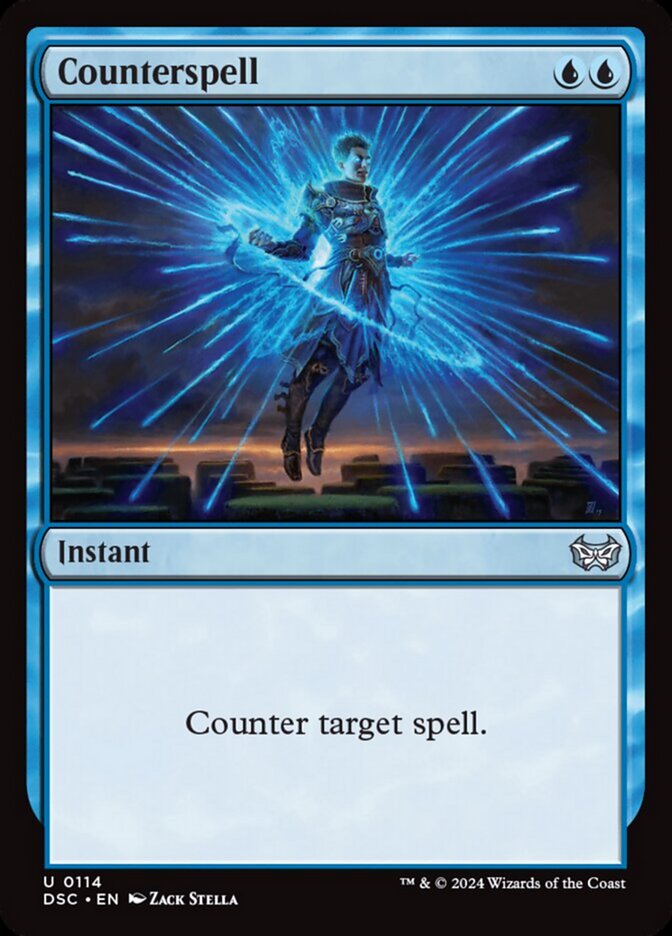 Counterspell
Your opponent casts a powerful creature. You cast Aether Spike targeting it. You already had {E}{E} from a previous turn. As Aether Spike resolves, you gain {E}{E}, totaling {E}{E}{E}{E}. You choose to pay all four. Your opponent must pay {4} mana. If they cannot, Aether Spike counters the spell just as effectively as a traditional Counterspell would.
 An Offer You Can't Refuse
An opponent casts a spell and you respond with An Offer You Can't Refuse. If they attempt to counter your counterspell with their own, you may cast Aether Spike targeting theirs. Because Aether Spike adds energy to your pool before you pay, you can use the newly gained energy to ensure their counterspell fails, allowing your initial disruption to resolve.
Guide written with AI from the official text and rulings. Official English text prevails.
How it works : Aether Spike
Original English text — Wizards of the Coast / Scryfall
- #1· Wizards of the Coast
You choose the target spell as you cast Aether Spike. You don't choose how much
to pay until Aether Spike is resolving. No player may take actions between the time you choose how much to pay and the time the target spell's controller chooses whether or not to pay for each paid this way.No other card is named in this ruling.
- #2· Wizards of the Coast
You may pay zero
. You will get , and the target spell will resolve as long as its controller chooses to pay  . In most cases, this won't be a difficult choice for them.
No other card is named in this ruling.
- #3· Wizards of the Coast is the energy symbol. It represents one energy counter.
No other card is named in this ruling.
- #4· Wizards of the Coast
Energy counters are a kind of counter that a player may have. They're not associated with any specific permanents.
No other card is named in this ruling.
- #5· Wizards of the Coast
Keep track of how many energy counters each player has. Potential ways to track this include writing theme down on paper or using dice, but any method that is clear and mutually agreeable is fine. (At higher levels of tournament play, dice may not be allowed for tracking counters that players have.)
No other card is named in this ruling.
- #6· Wizards of the Coast
If an effect says you get one or more
, you get that many energy counters. To pay one or more , you lose that many energy counters. You can't pay more energy counters than you have. Any effects that interact with counters a player gets, has, or loses can interact with energy counters.No other card is named in this ruling.
- #7· Wizards of the Coast
Energy counters aren't mana. They don't go away as steps, phases, and turns end, and effects that add mana "of any type" can't give you energy counters.
No other card is named in this ruling.
- #8· Wizards of the Coast
Some triggered abilities state that you "may pay" a certain amount of
. You can't pay that amount multiple times to multiply the effect. You simply choose whether or not to pay that amount of as the ability resolves.No other card is named in this ruling.
- #9· Wizards of the Coast
Some triggered abilities that state that you "may pay" a certain amount of
describe an effect that happens "If you do." In that case, no player may take actions to try to stop the ability's effect after you make your choice. If the payment is followed by the phrase "When you do," then you'll choose any targets for that reflexive triggered ability and put it on the stack before players can take actions.No other card is named in this ruling.
- #10· Wizards of the Coast
If a spell or ability with one or more targets states that you "may pay" some amount of
, and each permanent that it targets has become an illegal target, the spell or ability won't resolve. You can't pay any even if you want to.No other card is named in this ruling.
- #11· Wizards of the Coast
Some spells and abilities that give you
may require targets. If each target chosen is an illegal target as that spell or ability tries to resolve, it won't resolve. You won't get any .No other card is named in this ruling.
Related cards and tokens
Legal formats
Commentaires
- Sois le premier à commenter cette carte.
Read next
Meta decks with Aether Spike
No archived Top 8 deck with this card yet.