

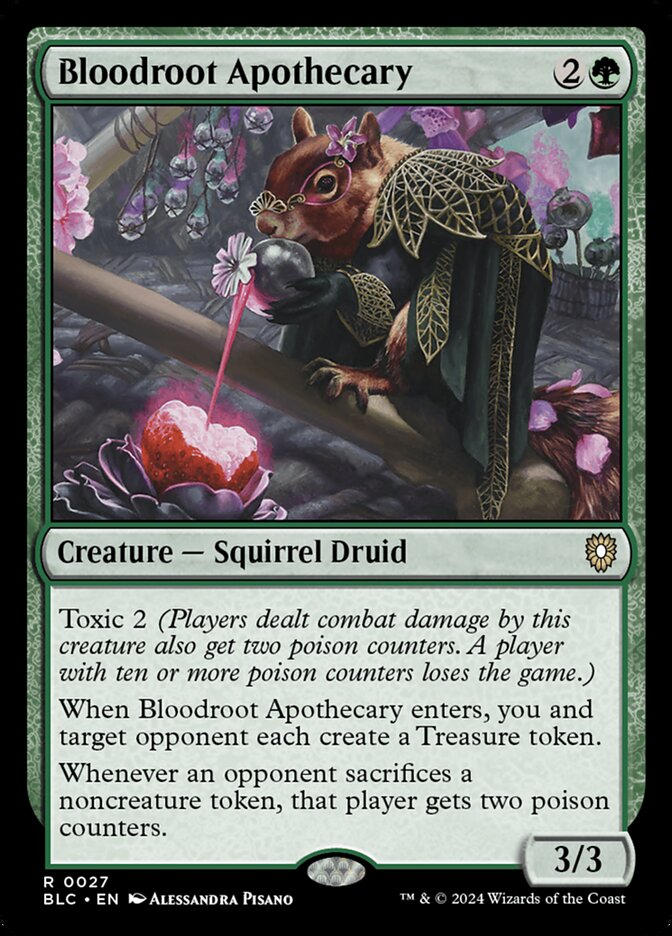
Bloodroot Apothecary is one of those cards players keep asking about. Here is, in plain words, what its official text says, the rulings published by Wizards of the Coast, and the combos players actually run.
Official card text
Toxic 2 (Players dealt combat damage by this creature also get two poison counters. A player with ten or more poison counters loses the game.) When this creature enters, you and target opponent each create a Treasure token. Whenever an opponent sacrifices a noncreature token, that player gets two poison counters.
Complete guide
Bloodroot Apothecary is a deceptive Squirrel Druid that blends the power of ramp with a lethal poisonous sting. By providing resources to your opponents, you set a trap that punishes them for using the very tokens you gave them.
Poisonous Gifts
Bloodroot Apothecary has a dual-purpose enter-the-battlefield ability. When it enters, you choose a target opponent, and both you and that opponent create a Treasure token. While this might seem like a friendly gesture, the Apothecary's triggered ability turns those Treasures into liabilities: whenever an opponent sacrifices a noncreature token, they receive two poison counters. This applies to any noncreature token they sacrifice, whether it is a Treasure, Clue, Food, or even a Map.
Toxic Combat and Resolution
In addition to its triggered ability, Bloodroot Apothecary features Toxic 2. When it deals combat damage to a player, that player loses life equal to the damage and gains two poison counters. If the Apothecary's enter-the-battlefield ability is countered because the target opponent is no longer legal, no one gets a Treasure. However, if it resolves, the opponent is immediately at risk; the moment they sacrifice that Treasure to add mana, the Apothecary triggers, and they get two poison counters.
Key Restrictions and Rulings
It is important to note that the Apothecary only punishes the sacrifice of noncreature tokens. Sacrificing a creature token or a non-token artifact will not trigger the poison ability. Furthermore, Toxic functions differently than Infect; the creature still deals normal damage to creatures and players, and the number of poison counters is a fixed value that does not change even if the damage is increased by power-buffing effects.
When to Play the Apothecary
This card shines in multiplayer formats where Treasure generation is common. It serves as a potent deterrent against 'Artifact Aristocrat' strategies and can unexpectedly end the game if an opponent is forced to use their tokens for mana or card draw. Use it early to build your own mana base while slowly ticking up the poison count on your most dangerous rivals.
Interaction examples
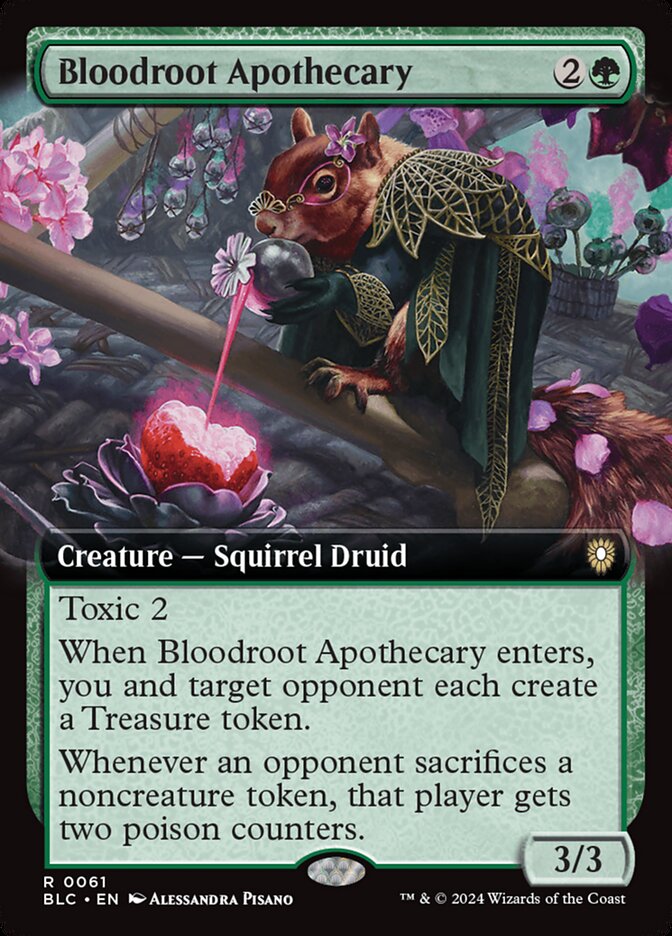 Bloodroot Apothecary
 Treasure
You cast Bloodroot Apothecary and target your opponent. Both you and the opponent create a Treasure token. Later, the opponent taps and sacrifices their Treasure to cast a spell. Because they sacrificed a noncreature token, Bloodroot Apothecary's ability triggers, giving that opponent two poison counters.
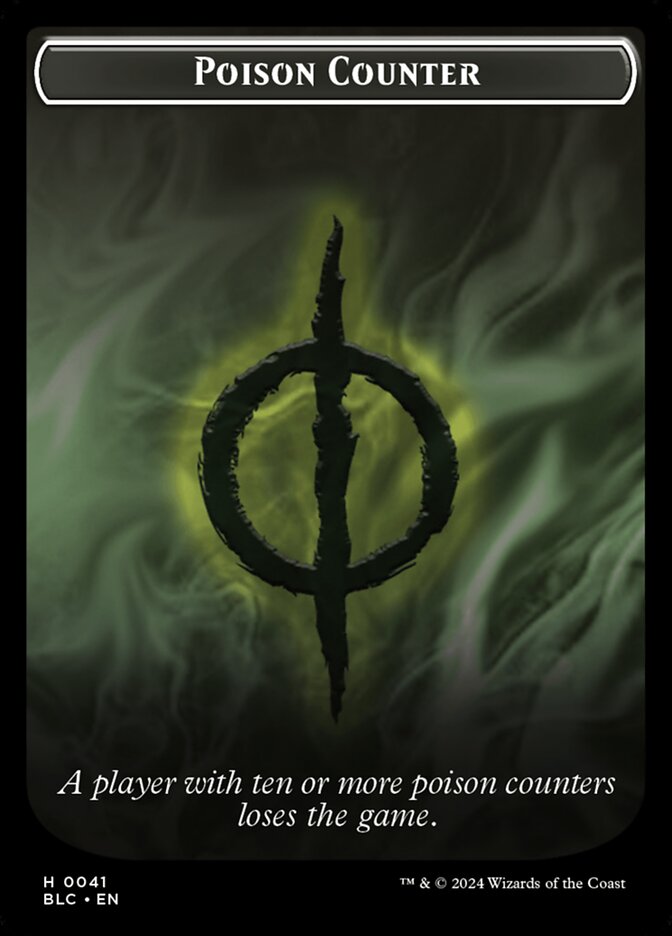 Poison Counter
Bloodroot Apothecary attacks and is not blocked, dealing 1 combat damage to the opponent. The opponent loses 1 life, and because of Toxic 2, they also receive two poison counters. This brings them closer to the ten-counter limit regardless of how much life they have.
 Sakura-Tribe Elder
 Solemn Simulacrum
If an opponent sacrifices Sakura-Tribe Elder or a Solemn Simulacrum that happens to be a token, Bloodroot Apothecary will not trigger because those are creature tokens. The ability strictly tracks noncreature tokens like Treasures, Foods, or Clues.
Guide written with AI from the official text and rulings. Official English text prevails.
How it works : Bloodroot Apothecary
Original English text — Wizards of the Coast / Scryfall
- #1· Wizards of the Coast
A player with ten or more poison counters loses the game. This is a state-based action and doesn't use the stack. In other words, it happens immediately and players can't respond to it, just like a player losing the game due to having 0 or less life.
Card named in this ruling
- #2· Wizards of the Coast
Toxic doesn't change the amount of combat damage a creature deals. For example, if a 2/2 creature with toxic 1 deals combat damage to a player, that creature will deal 2 damage. The results of that damage are the player loses 2 life and gets a poison counter.
Card named in this ruling
- #3· Wizards of the Coast
Any other effects of that damage, such as life gain from lifelink, still apply.
No other card is named in this ruling.
- #4· Wizards of the Coast
If a creature with toxic deals combat damage to a creature or planeswalker, or if it deals noncombat damage, toxic has no effect and no player gets poison counters.
Card named in this ruling
- #5· Wizards of the Coast
Damage dealt by a creature with toxic grants the same number of counters regardless of how much damage is dealt. Notably, if a replacement effect modifies the damage in some way (such as that of Gratuitous Violence), the number of counters given remains unchanged.
No other card is named in this ruling.
- #6· Wizards of the Coast
Conversely, replacement effects that apply to the number of counters put on a player can modify the counters placed this way. For example, Vorinclex, Monstrous Raider's last two abilities can apply to counters placed this way.
No other card is named in this ruling.
- #7· Wizards of the Coast
Multiple instances of toxic are cumulative. For example, if a creature has toxic 2 and gains toxic 1 due to another effect, combat damage that creature deals to a player will cause that player to get three poison counters.
Card named in this ruling
- #8· Wizards of the Coast
If the target player is an illegal target as Bloodroot Apothecary's second ability tries to resolve, it won't resolve and none of its effects will happen. No player will create a Treasure token.
Card named in this ruling
Related cards and tokens
Legal formats
Commentaires
- Sois le premier à commenter cette carte.
Read next
Meta decks with Bloodroot Apothecary
No archived Top 8 deck with this card yet.